Syrian salt and Sabkhat al-Jabbul
Most of the country’s salt comes off Sabkhat al-Jabbul, 30 km southeast of Aleppo. Every shelf of the winter pantry — olives, pickles, kishk, cheese — rests on it.
- Where to eat it
- On every shelf of the pantry: in brined olives, in mhallal pickles, in kishk, in white cheese, and in curing basterma and awarma.
- Price
- Variable — ask the price by the kilo in the souq
- When it is eaten
- The salt flats surface at the end of summer, once the water has withdrawn
One ingredient sits on every shelf of the pantry and most recipes never name it: salt. Brined olives, mhallal pickles, kishk, white cheese, basterma — all of them are built on it. And most of the country’s salt comes from one place: Sabkhat al-Jabbul, southeast of Aleppo.
Where the salt comes from
Sabkhat al-Jabbul is a saline lake with salt flats around it, 30 km southeast of Aleppo in the Bab district. It is the largest natural lake in Syria; the only larger body of water is the artificial reservoir on the Euphrates. It sits in a closed basin, so nothing drains to the sea and the water leaves by evaporation. That is why the salt collects.
Its traditional rhythm is seasonal: the basin fills in spring, shrinks through summer and autumn, and the lake bed comes up as a white crust. After 1988 irrigation schemes on the surrounding land began discharging partly saline drainage water into the basin; the water table steadied and the seasonal sabkha turned largely into a permanent lake. In 2009 it covered roughly 100 km2 and was relatively stable.
Al-Jabbul is the major source of salt in Syria. There are secondary sources too: Lake Jayrud in Rif Dimashq, northeast of Damascus, and Lake Khatuniyah in Hasakah, northeast of the city and near the Iraqi border.
The pantry is built on salt
Mune, the winter pantry, is a preserving system, and salt sits at its core. Olives wait in brine, the liquor of mhallal pickles is salt water, kishk is bulgur and yoghurt dried down with salt, white cheese keeps in brine, and basterma and awarma are meat cured with it. The half of the Syrian table that is laid down at the end of summer does not reach winter without it.
That is why salt earns its own entry on this shelf. It adds no flavour of its own the way a spice does; it makes the rest of the pantry possible.
The other side of the lake
The sabkha does more than yield salt. The steppe around it is grazing land, and the lake itself is a protected waterfowl site — the reason the Sabkhat al-Jabbul Nature Reserve exists. Waterfowl hunting is one of the older uses of the area, and those same birds are now the reason it is protected. The birds and wildlife guide in this section covers that side of it.
Can you see it
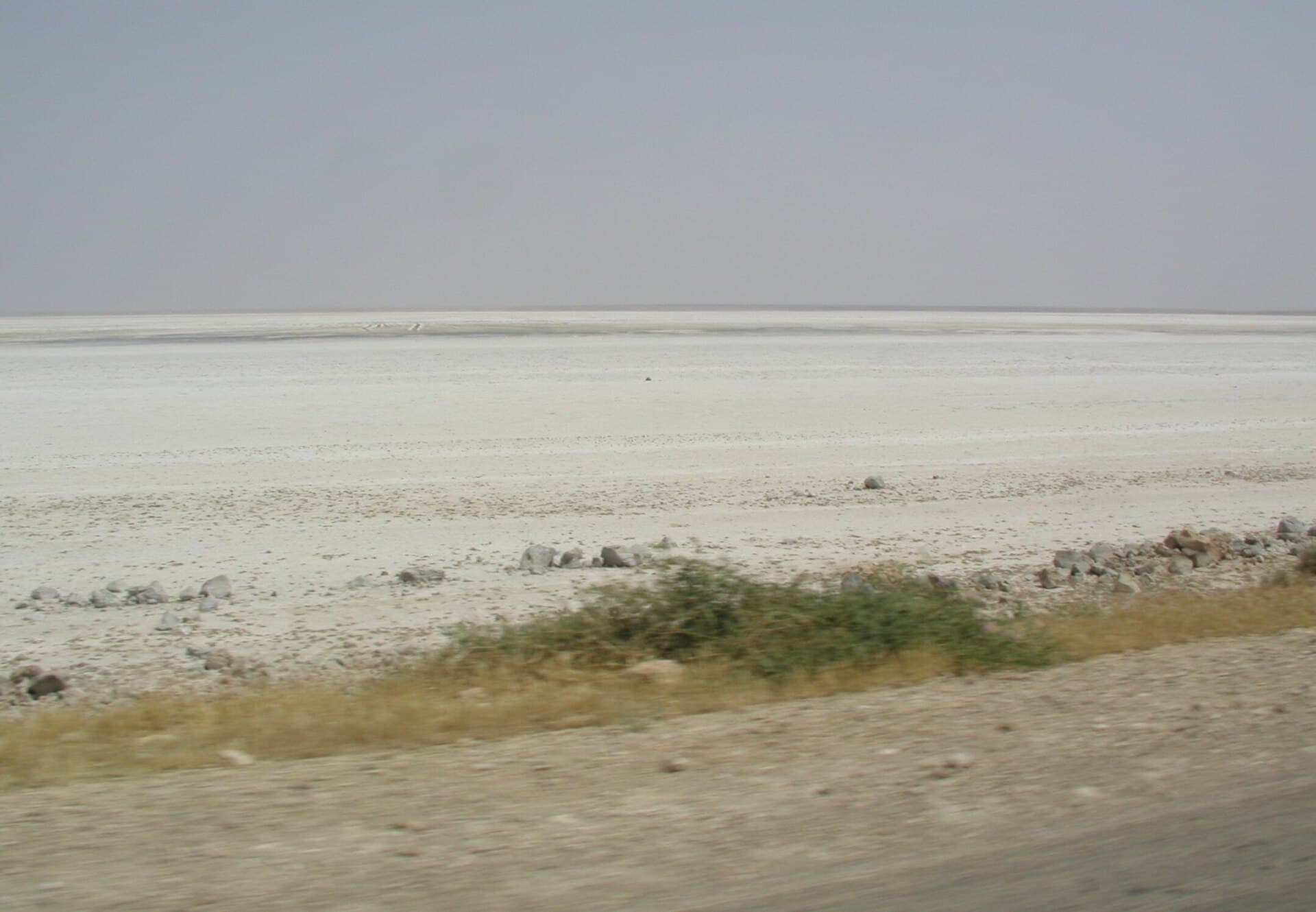
It is not laid out for visitors: there is no ticket office, no signboard and no marked path. What there is to see is the landscape itself. When the water withdraws at the end of summer the lake bed is left as a white salt crust running to the horizon, with a low stony shore and steppe behind it. The white reads from a distance. Come in spring and there is no white at all, only a pale green sheet of water.
Tips
- The white crust shows at the end of summer; in spring the basin is full of water
- The sabkha is not set up for visitors — no ticket office, signboard or path
- The area is also a protected waterfowl site
- Keep salt dry; damp salt cakes and throws your pantry measures off
Transparency
- How this was chosen
- Two kinds of record live here: the dish itself, and the place that serves it. Both are chosen and written by hand; ranking is not for sale and there are no sponsored entries. If a price range is not known for certain, it says so. Venues that serve alcohol are not listed on this site at all.
- Facts checked
- September 2026
- Last updated
- September 15, 2026