Food
What to eat, where to find it, what it costs.
99 Food
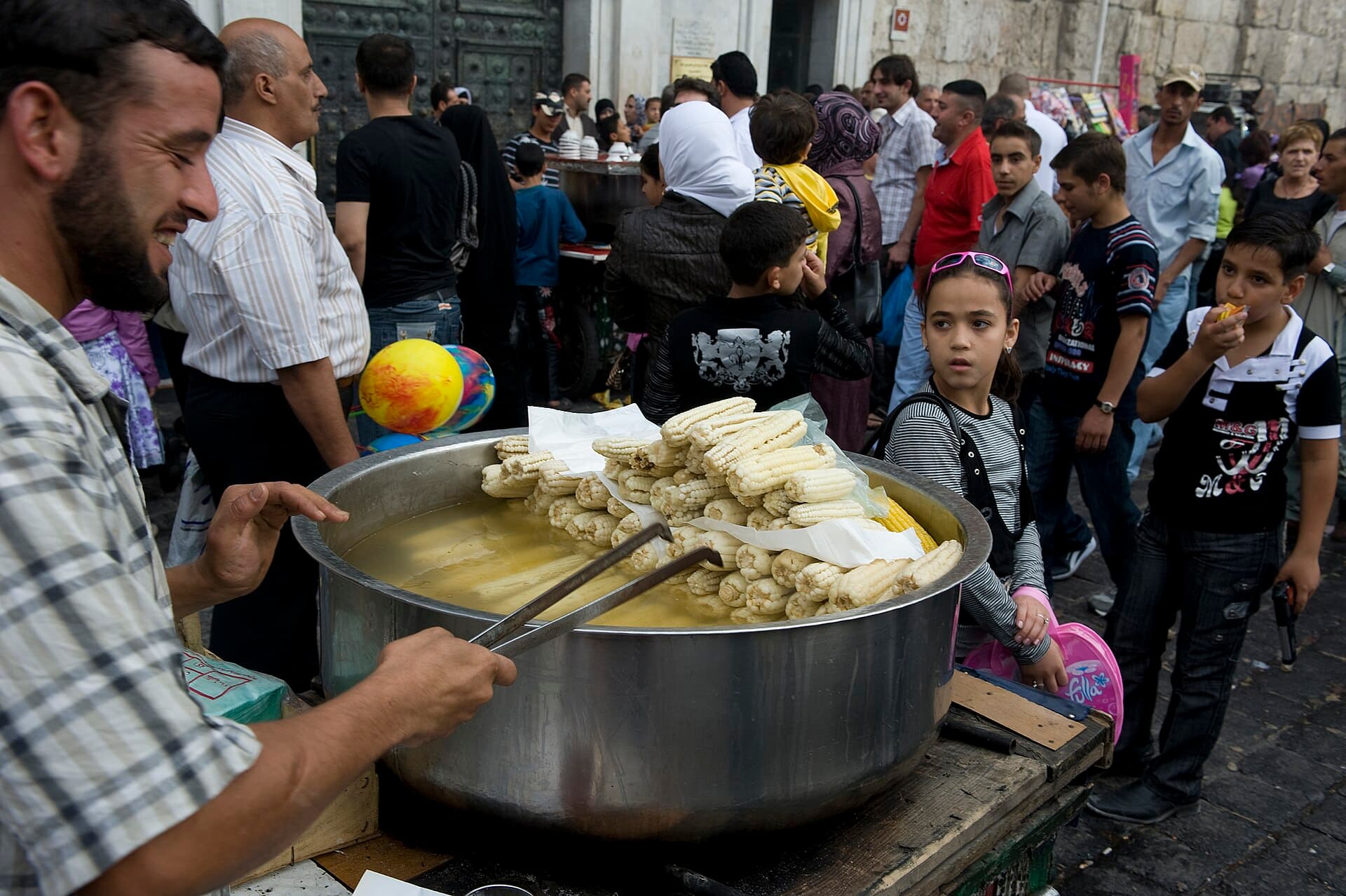
Syrian Street Corn (Boiled and Roasted Corn on the Cob)
On summer evenings in Damascus, corn comes boiled from a pot on a handcart; it was once roasted over charcoal. A trade on record for 120 years, sold in cups in Homs.
Variable — seasonal, with no official price; ask at the cart · Damascus
Sirik (Kocher garlic cheese)
Fresh spring cheese mixed with chopped green garlic, packed in a hide, buried underground and dug up as winter starts. The cheese of the Kocher villages near Derik.
Fresh cheese, chopped green garlic and salt, kept buried in the ground · Not something you buy — made in Kocher homes and given as gifts · Qamishli
Sharhat ‘ala ‘Ajin (lamb slices on dough)
Pounded lamb slices and tail fat baked on soft yeasted dough until the fat soaks in. Not minced sfiha: an old Damascus grill-house dish that got pricier with lamb.
Variable — it follows the price of lamb; ask before you order · Damascus
Salamiyah Eid Ka’ak (aqras al-eid)
Salamiyah’s Eid ka’ak: a disc scented with anise, fennel, mahlab and nigella, patterned by hand, baked in the last week of Ramadan at the neighbourhood oven.
Variable — ask the bakery for its order price before Eid · Hama
Rozune (Syriac mid-Lent coin bread)
A sweet tahini and cinnamon bread shaped as rounds or stars, a coin hidden in one piece. Syriac families in the Jazira bake it on 9 March, halfway through Lent.
Sweet tahini and cinnamon bread with a coin hidden in one piece · Not something you buy — it is baked at home · Qamishli
Prickly Pear (Sabbara) in Damascus
From June to November, Damascus sells prickly pears at stalls lit at night: the vendor peels the spiny skin and hands you the fruit, a summer habit tied to Mezzeh.
Variable — ask the price per fruit or per tray at the stall · Damascus
Mutabbaleh (coastal wheat and yoghurt)
Boiled wheat stirred into homemade yoghurt and eaten cold: the summer field food of villages around Tartus and Baniyas, and how it differs from Kurdish mehîr.
Boiled wheat in cold homemade yoghurt; in some homes with chickpeas, crushed garlic and tomato · Not a plate you buy — it belongs to the home and the field · Tartus
Mi’laq (Eid offal breakfast)
Lungs, liver, heart and spleen of the sacrificed sheep, grilled or pan-fried on the first morning of Eid al-Adha. In Deir ez-Zor the same offal is grilled all year.
Lungs, liver, spleen and heart, grilled on skewers or pan-fried · Not sold on the feast morning — it comes from the animal itself; at stalls it varies, ask · Deir ez-Zor
Moghrabieh (Syrian maftoul)
Bulgur grains rolled in flour by hand and steamed over the chicken pot. In Suwayda it is the fixed Eid al-Adha dish, with chickpeas, village chicken and ghee.
Variable — a home dish; ask sellers of ready-rolled grains for their price · As-Suwayda
Muhammara Flatbread (red pepper manakish)
Small rounds of dough spread with red pepper, onion and tomato paste, baked in oven or tannour. On Damascus bakery shelves with zaatar; not Aleppo’s walnut dip.
Variable — ask the price per piece at the bakery · Damascus
Malqasa (bulgur dumpling soup)
Small balls of fine bulgur and flour turn into a winter soup with garlic, lemon or pomegranate molasses. Malqasa in Masyaf and Salamiyah, laqqasat on the coast.
Balls of fine bulgur and flour with garlic, parsley, lemon or pomegranate molasses · Not a plate you buy — it belongs to the home table · Hama
Masyaf Ma’jouka (lamb pie)
Minced lamb and tail fat braided into the dough, with another layer on top: a double-thick pie about 30 cm wide. Breakfast in Masyaf, a student staple in Salamiyah.
Minced lamb, tail fat, green and red peppers; double-thick, about 30 cm · Varies — ask · Hama