Al-Andarin (Androna): A Byzantine Town on the Steppe
Ancient Androna, a Byzantine frontier town northeast of Hama: at least ten churches, a fortified barracks and two rings of walls, 25 km beyond Qasr Ibn Wardan.
- Opening hours
- Open site; visit in daylight
- Entry
- Variable — confirm on site
- Duration
- 90 minutes
- Best time
- Spring and autumn; there is no shade on the steppe in summer
- Period
- Late Roman — Byzantine
- Address
- 25 km beyond Qasr Ibn Wardan, steppe east of Hama
Al-Andarin is a Byzantine town spread across a wide area on the edge of the steppe, northeast of Hama. Its ancient name was Androna, and it was part of a defensive line against the desert nomads. The ruins include at least ten churches, a large military building (a kastron, or fortified barracks), public baths and two rings of walls around the town.
Getting there
About 25 kilometres beyond Qasr Ibn Wardan, so the two fit into one day. The site lies just inside the Aleppo governorate, but the road runs from Hama by way of Qasr Ibn Wardan. There is no public transport; you need a car with a driver. Road and security conditions change, so ask about the current situation before you set out.
How long it takes
An hour and a half. The site is large, and walking between the Large Church and the remains of the kastron takes most of that time.
What is there
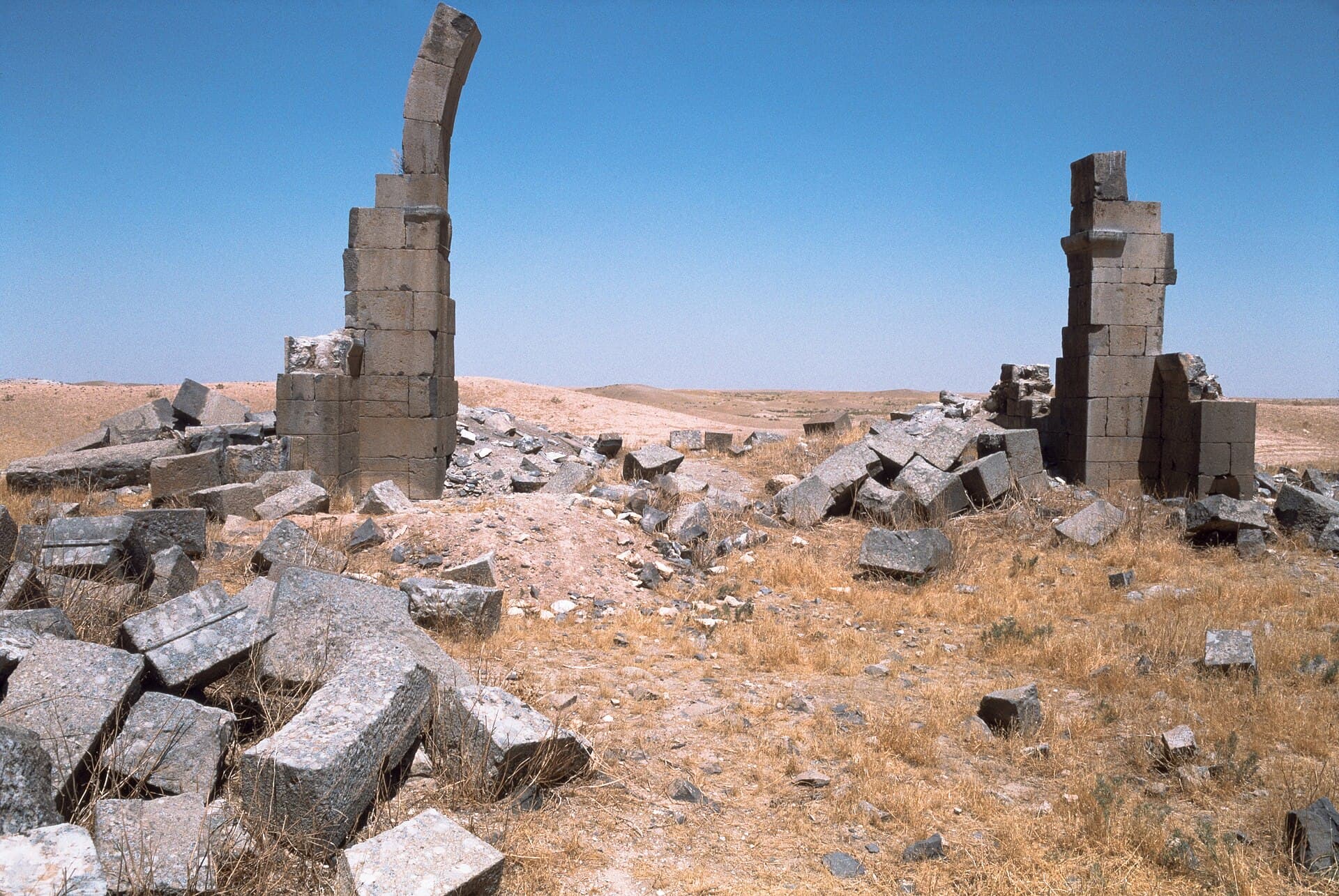
In the photographs of the Dumbarton Oaks archive, the apse arch of the Large Church stands on two cut-stone piers when seen from the west. On the south side of the apse there is a niche, and the lintels of the south doorway and of the side room (the prothesis) survive. Stones carved with a wheeled cross and reused lintels lie in different parts of the site. Sections of the kastron’s walls and arched openings still stand. Mudbrick domes were added later on top of some of the old buildings.
Al-Andarin in the sources
The town is named in the first line of the Muallaqa of Amr ibn Kulthum, a poet of pre-Islamic Arabia. The excavation results are in Christine Strube’s monograph, published in 2015 by the Römisch-Germanisches Zentralmuseum in Mainz, which covers the two walls and the kastron in detail.
What most people miss
The stone with the wheeled cross. On this block among the ruins, the cross is set inside a circle like the spokes of a wheel. It is the clearest sign of the town’s Christian Byzantine past.
Tips
- Combine it with Qasr Ibn Wardan; the road passes there
- There is no shade or water; bring both
- The stones are scattered and toppled; walk around the blocks, not over them
- Road and security conditions change; ask before you go
Transparency
- How this was chosen
- Written by hand; opening hours, entry fee and coordinates are kept as data. A field that is not known for certain is marked as variable rather than guessed.
- Facts checked
- September 2026
- Last updated
- September 15, 2026