Al-Aqaba Quarter, Aleppo
The highest ridge inside Aleppo’s walls and likely its first settlement: the lane north of Bab Antakya, a Hittite stele in a mosque wall and a minaret above a door.
- Opening hours
- Lanes at any hour; mosque and lodge doors depend on the time of day
- Entry
- Lanes free; ask at the door about entering buildings
- Duration
- 60 minutes
- Best time
- Morning, when the climb is cooler
- Period
- Hittite traces — Ottoman buildings
- Address
- The ridge inside the walls between Bab Antakya and Bab al-Jinan, Old City, Aleppo
Al-Aqaba is a quarter at the western end of Aleppo’s Old City, on the ridge that runs along the inside of the walls between Bab Antakya and Bab al-Jinan. Aqaba means slope in Arabic, and the quarter does stand higher than the rest of the city. Researchers consider it Aleppo’s first settlement. The evidence is in the walls: a Hittite stele built into the al-Qaiqan Mosque, and ancient column capitals scattered through the lanes. The al-Qaiqan and al-Shuaybiyya mosques each have their own page on this site; this one describes the quarter around them.
A name and a water problem
Its full name is Aqabat Bani al-Mundhir. The first part refers to the height. Nobody knows who the Bani al-Mundhir were; they are thought to have been the first to settle here after the Arab conquest. Height gave the quarter good air but no water. There was no running water, and the wells were deep and salty. The Hilan canal, which brought drinking water into the city, did not reach this ridge, so houses collected rainwater in cisterns. Old sources add that mosquitoes multiplied in summer and autumn, and that this was the quarter of Aleppo quickest to shake in an earthquake.
The city’s first hill
The height, and the nearness of the Queiq river when it still ran full, explain why settlement began here. The basalt Hittite stele re-set into the south wall of the al-Qaiqan Mosque dates from the 14th century BC. The straight street laid out by Seleucus Nicator passes the southern end of the quarter, and the main souq still follows its line. When the Arabs took Aleppo in 637, they entered through Bab Antakya and laid down their shields here. The mosque known as al-Atras, al-Shuaybiyya or al-Tuta was built on that spot and is counted as the first mosque Muslims founded in al-Aqaba.
Who lived here first
In the early Islamic period, Aleppo’s rulers lived in this quarter. Al-Fadl ibn Salih of the Abbasid family is named as the first to settle, moving here between 769 and 771. He was followed by Sabiq ibn Mahmud, the Mirdasid emir who ruled Aleppo in 1076. Al-Safi ibn al-Mundhir, overseer of the city under al-Zahir Ghazi of the Ayyubids (the dynasty of Saladin), also lived here and built the Hammam al-Bazdar. The Arabic source says the bathhouse still stands; we found no second record to confirm it.
Where it begins and ends
In the old description, the southern edge is Suq al-Hawa, which runs from Bab Antakya to the level of the al-Bahramiyya Mosque. The northern edge is the Qays gate and al-Hawa lane near Bab al-Jinan. To the west, the boundary is the khans road behind the wall between the two gates. The official district is drawn much wider and takes in Bahsita, Khan al-Harir, al-Masabin and Jubb Asad Allah, which is why the Bahsita Mosque carries an al-Aqaba address.
The sources also disagree. Archnet treats al-Aqaba as a neighbourhood inside the al-Jalloum district, while other lists count it as a district of its own. That is why buildings such as the al-Qaiqan Mosque sometimes appear, on this site and elsewhere, with a Jalloum address.
Getting there
Enter the walls at Bab Antakya. The al-Shuaybiyya Mosque is just inside the gate on the right. Instead of turning into the souq, take the lane that climbs north to the left; the al-Qaiqan Mosque is about 100 metres north of the gate, on a corner. The slope carries you into the quarter.
What to see
- The al-Qaiqan Mosque. A small mosque with ancient columns laid crosswise in its walls and a Hittite stele in its south wall.
- The al-Shuaybiyya Mosque. Just inside Bab Antakya, known for the classical cornice across its facade.
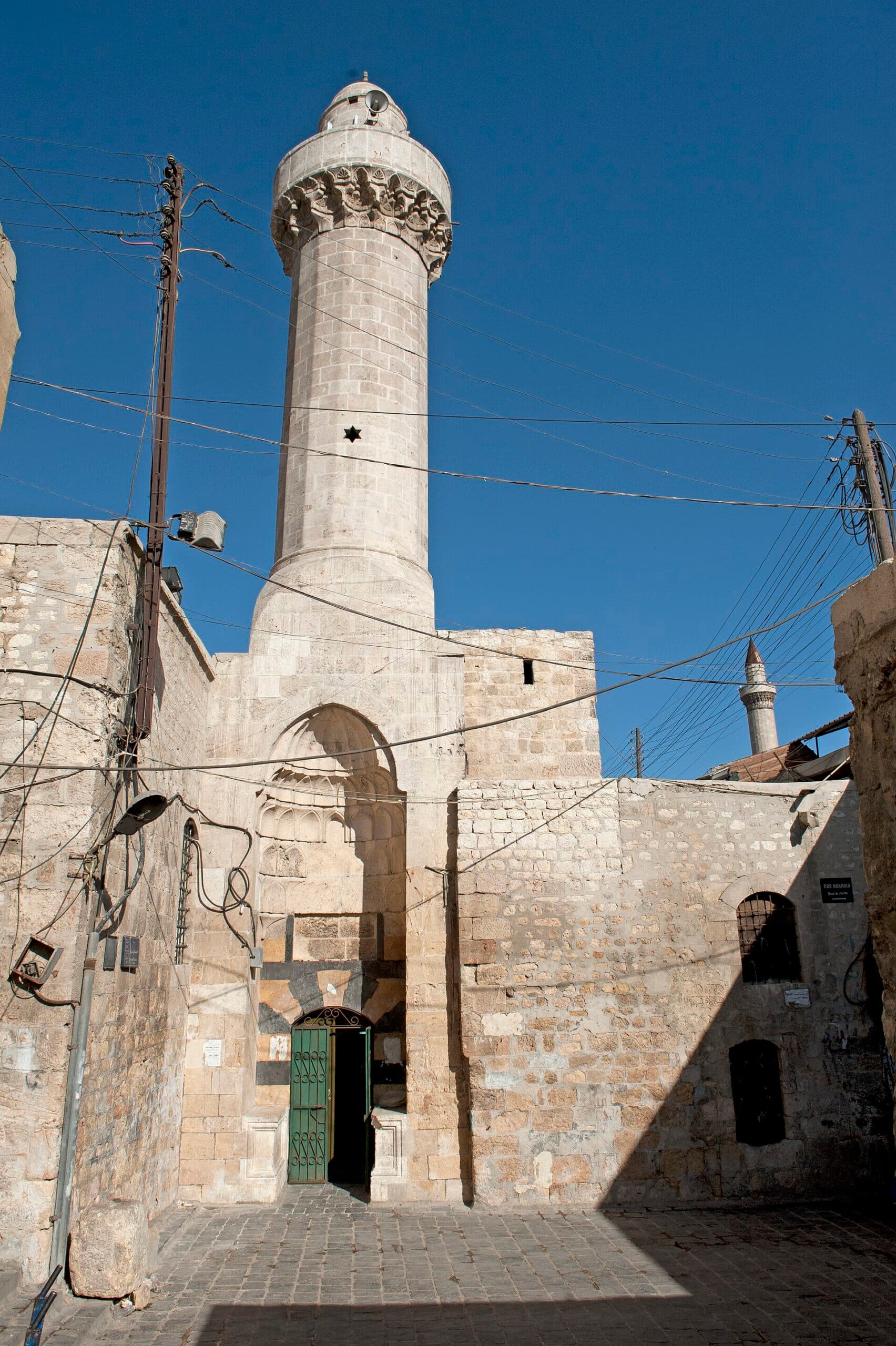
- The al-Kamaliyya zawiya. A small Sufi lodge and mosque on the square of the Hammam al-Bazdar. Sources mention an endowment dated 1773, and most of the building is Ottoman. The minaret rises straight from the top of its muqarnas portal, the doorway hood carved in tiers of small niches.
- Other buildings. The al-Kizwani and al-Khawaja mosques, Khan Kamil, and the al-Bazdar and al-Khawaja bathhouses.
How long it takes
An hour. Distances are short, but the slope and the dead-end lanes slow you down. Starting at Bab Antakya and finishing by walking down into the souq is the natural order.
Do not miss
The al-Kamaliyya doorway. The minaret does not stand at a corner of the courtyard; it sits directly on top of the portal, so the carved niche and the shaft form a single vertical line. You see it best from the opposite corner.
The quarter today
We found no dated damage or restoration report specific to the quarter. Our photographs of al-Kamaliyya date from 2009 and 2010, and map edits from 2023 show the quarter’s lanes and its bakery in place. Whether individual doors are open has to be asked on the spot.
Tips
- Enter at Bab Antakya and turn north before the souq; the lane climbs into the quarter
- Look for the basalt Hittite stele in the south wall of the al-Qaiqan Mosque; it is set into the masonry
- View the al-Kamaliyya doorway from the opposite corner; only from there do minaret and door fit one frame
- When asking the way, try both al-Aqaba and al-Jalloum; sources draw the boundary differently
Transparency
- How this was chosen
- Written by hand; opening hours, entry fee and coordinates are kept as data. A field that is not known for certain is marked as variable rather than guessed.
- Facts checked
- September 2026
- Last updated
- September 15, 2026