Al-Bayyada Quarter, Aleppo
The old quarter between the Aleppo Citadel and Bab al-Hadid: a mosque dated 1378, a bathhouse from 1450, an Ottoman endowment and a fountain down twenty steps.
- Opening hours
- Lanes at any hour; mosque and bathhouse doors depend on the time and the caretaker
- Entry
- Lanes free; ask at the bathhouse door about service and price
- Duration
- 60 minutes
- Best time
- Morning, starting at Citadel Square and ending at Bab al-Hadid
- Period
- Mamluk — Ottoman
- Address
- North-east of the citadel, between Citadel Square and Bab al-Hadid, Old City, Aleppo
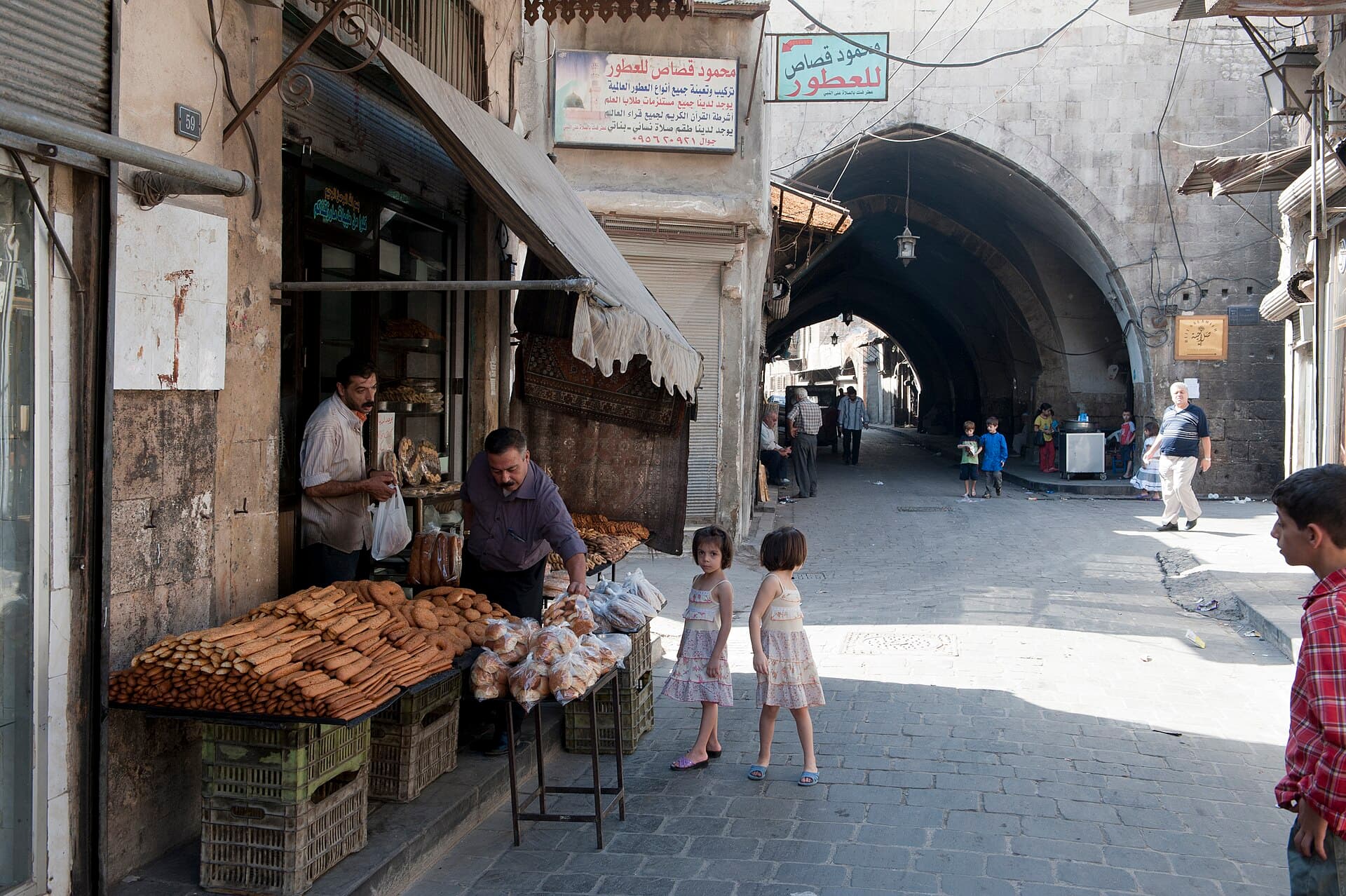
Al-Bayyada is an Old City quarter north-east of the Aleppo Citadel, between the citadel moat and Bab al-Hadid, the city’s north-eastern gate. The road linking the two runs through the middle of it, so anyone walking from Citadel Square to Bab al-Hadid crosses the whole quarter. Within a few hundred metres there is a Mamluk mosque, a bathhouse built in 1450, an Ottoman endowment complex and a fountain reached by more than twenty steps. The al-Sarawi Mosque, the Hammam al-Bayada and the al-Hamawi Mosque each have their own page on this site; this one describes the neighbourhood they stand in.
Where the name comes from
There are three explanations. Old Aleppo sources describe a khan in the quarter’s market where eggs were sold, and say its remains still stood in the market. The second points to the ground: the soil here was a white, chalky earth. The third is a trade. According to the researcher Nour al-Din al-Tinbi, the craftsmen who re-tinned copper pots were known collectively in the Aleppo dialect as bayyada. Many of them worked in this quarter, and some were still working here in 2011.
Where it begins and ends
The old description puts Oghulbek and Altunbugha to the south, the Rum moat to the east, Jubayla to the north, and the citadel moat and Mustadam Bey to the west. In practice that means the axis from the north-east corner of Citadel Square to Bab al-Hadid, with the lanes on either side. The official district today is drawn wider and also includes Jubayla, the Kiltawiyya hill and Mustadamiyya.
According to local accounts, Sultan Selim I entered Aleppo by Bab al-Hadid in 1516, when the Ottomans took the city, and passed through this quarter.
Getting there
From Citadel Square, take the road that circles the citadel and head north-east. After about 350 metres the al-Sarawi Mosque, the Hammam al-Bayada and the al-Hamawi Mosque appear within a few steps of each other. Carry on along the same road for another 250 metres and you reach Bab al-Hadid. The quarter is the two sides of the road between those points.
What to see
- The al-Sarawi Mosque. The inscription over the door dates it to 1378 and names its founder, Nasir al-Din ibn Muhammad al-Sarawi. At first it was only a prayer hall and a narrow courtyard; early in the 16th century Ali ibn Said al-Malati added a madrasa wing and prepared his own tomb there.
- The Hammam al-Bayada. Older sources call it the Hammam Nafis. It was built in 1450 by Jamal al-Din Nafis ibn Abd al-Samad, one of Aleppo’s leading merchants, and stands opposite the al-Sarawi Mosque, slightly to the south.
- The al-Hamawi Mosque and its endowment. The mosque was founded in 1560. In 1769 Hasan ibn Abd al-Rahman al-Hamawi enlarged it and added the minaret, which was struck by lightning in 1875. Opposite stands the endowment’s school; to the south, a public fountain with the Hamawi tomb west of it; and nearby, a soap works whose income went to the endowment.
- Qastal al-Tawil. A fountain reached by more than twenty steps. Saadallah al-Malati built it in the first half of the 16th century and put a children’s school on top of it; his mosque stands across the main road.
- The Ikhlasiyya Takiyya. A Sufi lodge opposite the al-Sarawi Mosque, slightly to the north, founded in the 17th century for the Khalwati sheikh Ikhlas. Older sources record that a Rifai spiritual retreat was held here every spring.
Who lived here
The 1922 count found 1289 people in the quarter: 390 men and 999 women. Its established families included the Rifais, who passed the leadership of the Ikhlasiyya lodge down the generations; the Ghuris, who traced their line to the Mamluk sultan Qansuh al-Ghuri; the Hamawis, who founded the mosque endowment; and the Kuranis. The large houses of the quarter were known by these families’ names.
How long it takes
An hour. The straight walk from Citadel Square to Bab al-Hadid takes less than ten minutes; the rest of the time goes on facades, door inscriptions and any courtyard you find open.
Do not miss
Qastal al-Tawil. From the street you see only the head of a stairway going down. There are more than twenty steps, and old sources say the residents drew their water here. We do not know whether water still runs there today. It lies directly opposite the mosque of Saadallah al-Malati; anyone in the lane can point you to it.
The quarter today
The al-Hamawi Mosque is standing in photographs dated 2019 and 2020, and map edits from 2022 and 2023 show a lived-in quarter with its mosque and lanes. We found no dated damage or restoration report for the quarter as a whole. Whether a particular door is open has to be asked on the spot.
Tips
- Route your walk from the citadel to Bab al-Hadid through here; the road already runs this way
- The al-Sarawi Mosque, the hammam and the al-Hamawi Mosque are a few steps apart; treat them as one stop
- Service days at the hammam change; ask at the door before planning a bath
- Jubayla and the Kiltawiyya hill are in the same district; you can extend the walk north from Bab al-Hadid
Transparency
- How this was chosen
- Written by hand; opening hours, entry fee and coordinates are kept as data. A field that is not known for certain is marked as variable rather than guessed.
- Facts checked
- September 2026
- Last updated
- September 15, 2026