Al-Fawwar Spring, Valley of the Christians
An intermittent spring in Zweitina, facing Saint George’s Monastery: some days it gushes three times, some months not at all. Winter brings the strongest surges.
- Opening hours
- Open site, all day
- Entry
- Varies — check on site
- Duration
- 45 minutes
- Best time
- Winter and early spring, when the flow and surges are strongest
- Period
- A spring known since Roman times
- Address
- Zweitina village, Wadi al-Nasara, western Homs governorate
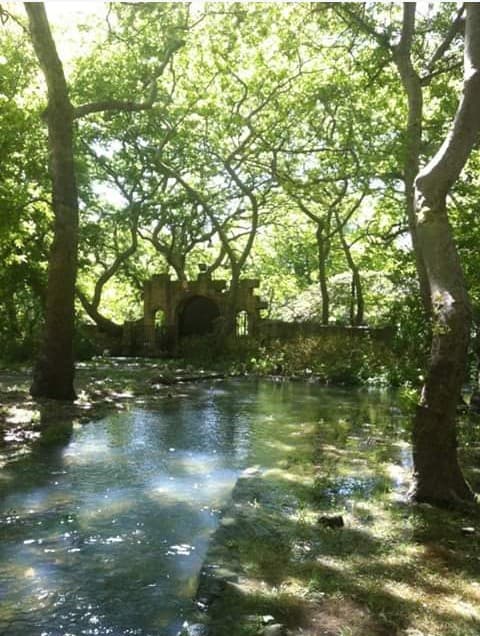
Al-Fawwar is a karst spring in the village of Zweitina, in Wadi al-Nasara, the Valley of the Christians, on the slope that looks across to Saint George’s Monastery. It takes its name from the way it gushes: at irregular intervals the water surges out of the ground, then draws back. Sometimes this happens three times in a day, sometimes not for months. The spring has been described since Roman times and is identified with the Sabbatikon river that the historian Josephus wrote about.
How the spring works
The spring is an underground hollow in limestone. Water comes out on the north side of the hollow and sinks back into the ground on the south side. After a while it bursts out again, in large volume, from the point where it went in; in Arabic this surge is called fawran, which gives the spring its name. Nobody can predict when it will happen. People in the area say they know it is coming by a tremor underfoot. The overflow runs into the valley of Nahr al-Atshan, the ‘thirsty river’.
The Sabbatic name and Josephus
The spring’s old name is al-Sabti. It is linked to the time of the Roman emperor Titus and comes from a local belief that the spring flowed only once every seven days. Josephus, in The Jewish War, describes the Sabbatikon river that Titus saw between Arqa and Raphanea, and that river is believed to be today’s al-Fawwar. The spring lay on the trade road linking Tripoli with Orthosia and Arqa.
The healing story
An old local story says the spring used to gush for three days and then stop, and the oddity drew travellers. A shrine was built nearby where people prayed for healing, and those with skin and digestive complaints came for its water. People in the area still fill containers here with drinking water.
When to go
Winter and early spring. The flow is strongest then, and so are the surges. In summer the spring can go months without overflowing, and all you see is the setting.
Do not miss
The two mouths of the hollow. The north mouth, where the water comes out, and the south mouth, where it sinks back in, are close together; when the spring surges, the water comes back through the south mouth.
Tips
- The surge keeps no timetable; missing it on a short visit is normal
- Saint George's Monastery is on the same slope; combine the two in one visit
- In winter the ground is wet and slippery; shoes with grip help
- Plan it as a short stop on a day in the Valley of the Christians
Transparency
- How this was chosen
- Written by hand; opening hours, entry fee and coordinates are kept as data. A field that is not known for certain is marked as variable rather than guessed.
- Facts checked
- September 2026
- Last updated
- September 15, 2026