The Mosque of Omar in Daraa
The oldest building still standing in Daraa, in the middle of the old town. How to reach it, what carries its roof, and what happened to its minaret in 2013.
- Opening hours
- Prayer times; visit between them
- Entry
- Free
- Duration
- 30 minutes
- Best time
- Before midday prayer, when the courtyard is empty
- Period
- Early Islamic, with Ottoman and later repairs
- Address
- Daraa al-Balad, the old town, Daraa
This mosque in the middle of Daraa al-Balad, the old town, is the oldest building still standing in the place. It carries the name of the caliph Umar: by tradition he ordered it built when he came to the Hauran, and the companions Abu Ubayda ibn al-Jarrah and Mu’adh ibn Jabal are named as overseeing the start of the work. It has been repaired many times since, and recent restorations changed some of the older detail — but the minaret and the qibla façade were left as they were.
Getting there
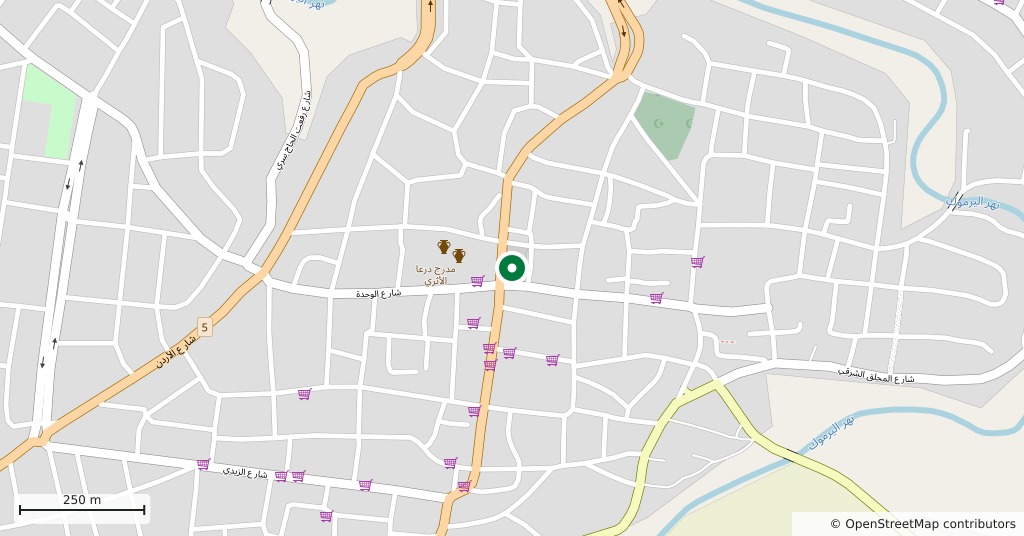
Inside the old town, south of the modern centre. Driving into the quarter is awkward and the last stretch is easier on foot; the minaret shows above the streets and gives you your bearing.
How long it takes
Half an hour. The courtyard, the arcades and the prayer hall take that long between them; add waiting time if you arrive at prayer.
What to see
The plan is a small echo of the Umayyad Mosque in Damascus: arcades on four sides of an open courtyard. The southern arcade is the prayer hall itself, with the mihrab in it and the space running east and west. The roof is the Hauran’s own technique. Stone arches carry corbels set across them the other way, stone beams close the gaps, and on top go small stones mixed with lime and then a thick layer of earth. The mosque has three main doors, the largest of them on the north, opening straight into the arcades.
What not to miss
Look at what carries the roof. There is no timber in the Hauran, so roofs across the whole region are built from stone arches and stone beams, and this one belongs to the ordinary house of the region before it belongs to a mosque. You will see the same system in the old houses of the town.
Where it stands now
The mosque was one of the gathering points of the protests that began in the town in 2011. Its minaret was brought down on 13 April 2013, in an attack that opposition sources attributed to the army. The mosque was repaired afterwards and is in use today. The quarter around it took heavy damage in the war, and there is still a risk of unexploded ordnance in ruined buildings — stay on the street and out of the rubble.
Tips
- Don't walk in at prayer time; wait for the gap — the courtyard is visible from outside anyway
- Women need a headscarf; knees and shoulders covered for everyone
- Ask before photographing, and keep people at prayer out of the frame
- Do not enter the ruined buildings nearby; unexploded ordnance is a real risk in rubble
Transparency
- How this was chosen
- Written by hand; opening hours, entry fee and coordinates are kept as data. A field that is not known for certain is marked as variable rather than guessed.
- Facts checked
- September 2026
- Last updated
- September 15, 2026