The Armenian Genocide Memorial Church in Deir ez-Zor
A church, museum and archive built where the 1915 deportation convoys ended, consecrated in 1991 and blown up in 2014. What it held and what is known of it today.
- Opening hours
- Variable — confirm before you go whether the site is open to visitors
- Entry
- Variable — confirm on site
- Duration
- 45 minutes
- Best time
- Daytime, with notice given in advance
- Period
- 1989-1990 · destroyed in 2014
- Address
- Deir ez-Zor
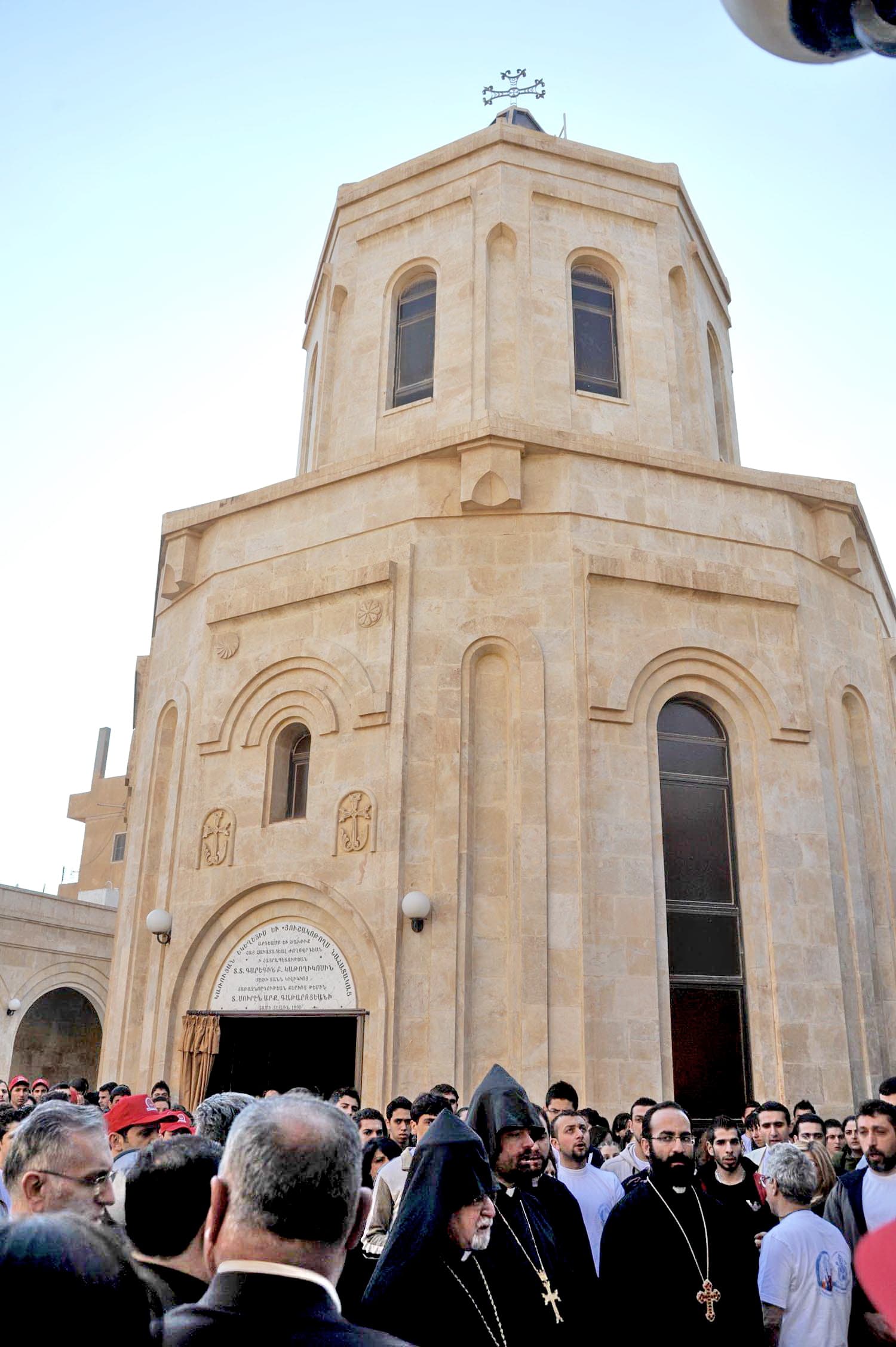
The Armenian Genocide Memorial Church in Deir ez-Zor — Der Zor to Armenians — was a church, museum and archive built where the Armenian deportation convoys of 1915-1916 came to an end. It was consecrated on 4 May 1991. On 21 September 2014 it was blown up. This page sets out what the building held, and what is and is not known about it today.
Why Deir ez-Zor
In 1915-1916, Armenians deported from Anatolia were marched to Deir ez-Zor, and the camps around the town became places of mass death and execution. The church stood on ground that had been used for burials, replacing a small earlier chapel, Surp Hripsime. The town tells one more part of the story: people in Deir ez-Zor gave the convoys food and shelter.
How it was built
The foundation stone was laid on 12 May 1985. Building began in December 1989. It was finished in November 1990. Catholicos Karekin II of Cilicia consecrated the church on 4 May 1991. It belonged to the Armenian Archdiocese of Aleppo and brought a museum, a memorial, an archive and an exhibition space together under one roof.
What was inside
- A stepped entrance rising to the square.
- The Friendship Wall, carved with Arab and Armenian ornament and fitted with two fountains.
- A khachkar — a carved Armenian cross-stone — brought from Armenia, with an eternal flame in front of it.
- In the lower hall, a white marble column rising through the centre of the church from a circular glass case that displayed the remains of victims.
Every 24 April, the day the Armenian Genocide is commemorated, tens of thousands of pilgrims came here from around the world.
The site today
The church was blown up on 21 September 2014; the English Wikipedia attributes this to members of ISIL. The area was retaken in 2017, and in 2019 the state promised to rebuild the church. Some things this page cannot confirm: whether rebuilding has started, who manages the site now and whether visitors can go in. If you plan to go, ask the Armenian archdiocese in Aleppo or someone local in Deir ez-Zor beforehand.
Before you visit
This is a burial ground as much as a memorial. Ask before taking photographs, and treat the site as a place of remembrance rather than a sight.
Tips
- Ask before you go whether the site is open; the state of the rebuilding is not confirmed
- This is a burial ground; ask before taking photographs
Transparency
- How this was chosen
- Written by hand; opening hours, entry fee and coordinates are kept as data. A field that is not known for certain is marked as variable rather than guessed.
- Facts checked
- September 2026
- Last updated
- September 15, 2026