Arslan Tash (Ancient Hadatu)
Arslan Tash near Kobani was the Assyrian city of Hadatu. Its stone gate lions gave it its name; its ivories are in Aleppo and the Louvre, its reliefs in Istanbul.
- Opening hours
- Open archaeological site; guard and access situation unclear — confirm on site
- Entry
- Variable — confirm on site
- Duration
- 60 minutes
- Best time
- Spring or autumn; there is no shade on open ground
- Period
- Aramaean — Neo-Assyrian — Hellenistic
- Address
- Near Ayn al-Arab (Kobani), Aleppo governorate
Arslan Tash is an archaeological site in the northeast of Aleppo governorate, near Ayn al-Arab (Kobani). Its ancient name was Hadatu. In the Iron Age it was the centre of an Aramaean kingdom, and Assyria took it in the 9th century BC. The city gates were decorated with lions carved from stone, and the Turkish name, meaning “lion stone”, comes from them. The most valuable finds from the site are not here but in museums.
Where it is
The site lies about 30 km east of Carchemish and the Euphrates. The nearest town is Ayn al-Arab. Ask there about the exact location and access before you go.
What stood in the city
Inside the walled city three main buildings were found: a Late Assyrian palace, an early temple to Ishtar and a Hellenistic temple. The excavators also named one building the “Bâtiment aux ivoires”, the ivory building, after the carved ivories found there.
Who excavated it
An expedition led by Francis Rawdon Chesney first examined the site in 1836. The real excavations came in 1928, when the French archaeologist François Thureau-Dangin dug two short seasons for the Louvre. The team worked on the fortifications, the two temples, the ivory building and the Late Assyrian remains.
In 2007 and 2008 the University of Bologna and Syria’s Directorate-General of Antiquities and Museums returned with a joint survey. Anas al-Khabour and Serena Maria Cecchini led the team. Each season lasted about a week. The second included geophysical work.
Where the finds are
The most important finds are ivories of high craftsmanship. They are now in the National Museum of Aleppo and the Louvre. One carries the name Hazael, and it is thought to come from a bed that may have belonged to Hazael, king of the Aramaean kingdom centred on Damascus.
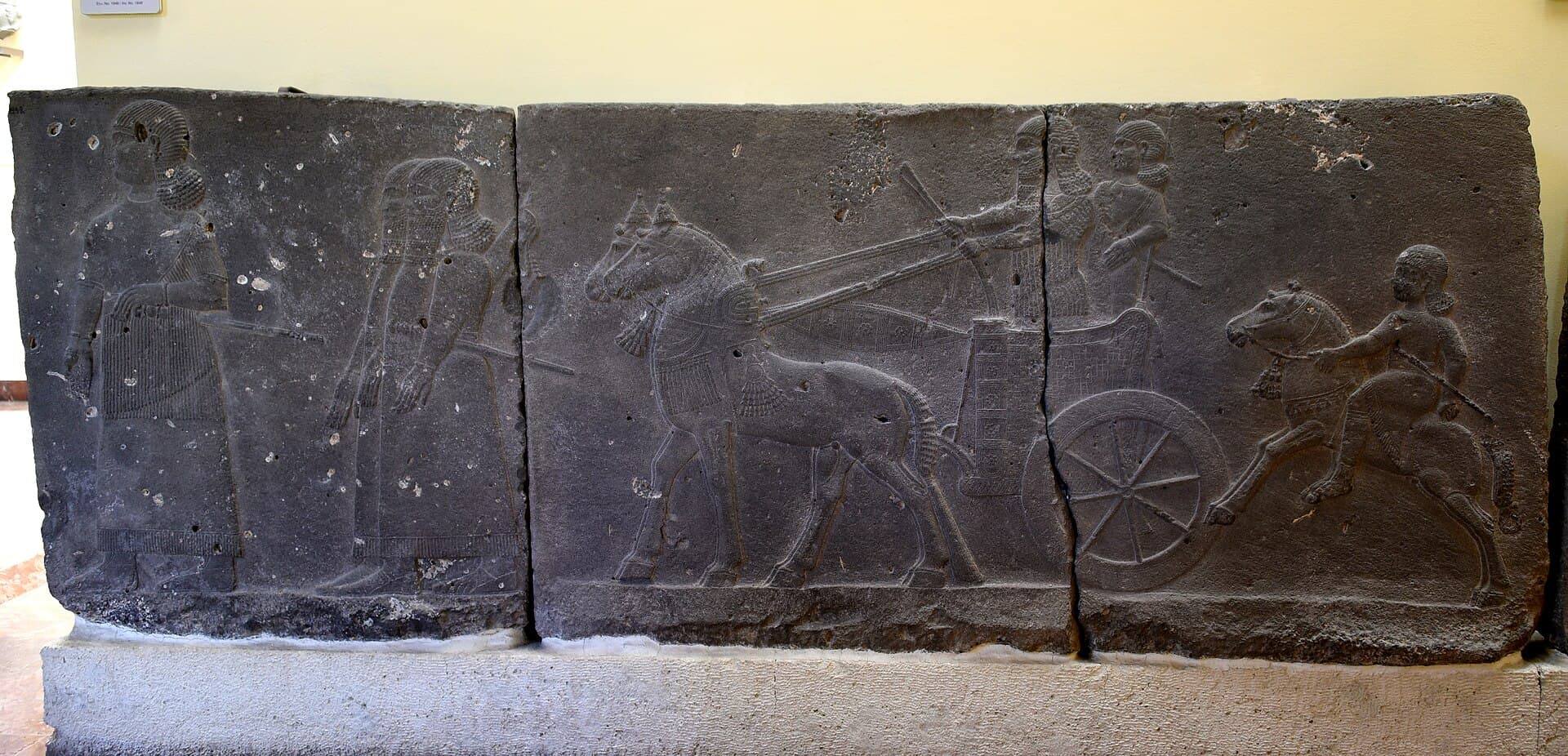
The gate reliefs show people and animals. Their dates are uncertain, but one bears an inscription of the Assyrian king Tiglath-Pileser III. A group of these reliefs is in the Ancient Orient Museum in Istanbul: basalt panels with two guards, a horse-drawn chariot and a rider.
The two limestone plaques known as the “Arslan Tash amulets” were not excavated but bought from an antiquities dealer. Where they really came from is therefore unclear, and some scholars doubt they are genuine.
What happened to the lions
In February 2015, in Raqqa, ISIS publicly had a huge Assyrian gateway lion from the 8th century BC broken up with a bulldozer. A second lion statue was also destroyed. Both came from Arslan Tash. No published assessment of the site’s current condition exists.
What most people miss
The relief in Istanbul. The piece that says most about the palace at Arslan Tash today is this set of basalt panels in the Ancient Orient Museum. The spokes of the chariot wheel and the horses’ harness can be picked out one by one in the stone.
Tips
- Do not look for the gate reliefs on site; a group of them is in the Ancient Orient Museum in Istanbul
- For the ivories, go to the National Museum of Aleppo or the Louvre
- Ask in Ayn al-Arab about the exact location and the road before you go
Transparency
- How this was chosen
- Written by hand; opening hours, entry fee and coordinates are kept as data. A field that is not known for certain is marked as variable rather than guessed.
- Facts checked
- September 2026
- Last updated
- September 15, 2026