Balis (Barbalissos) and its Ayyubid Minaret
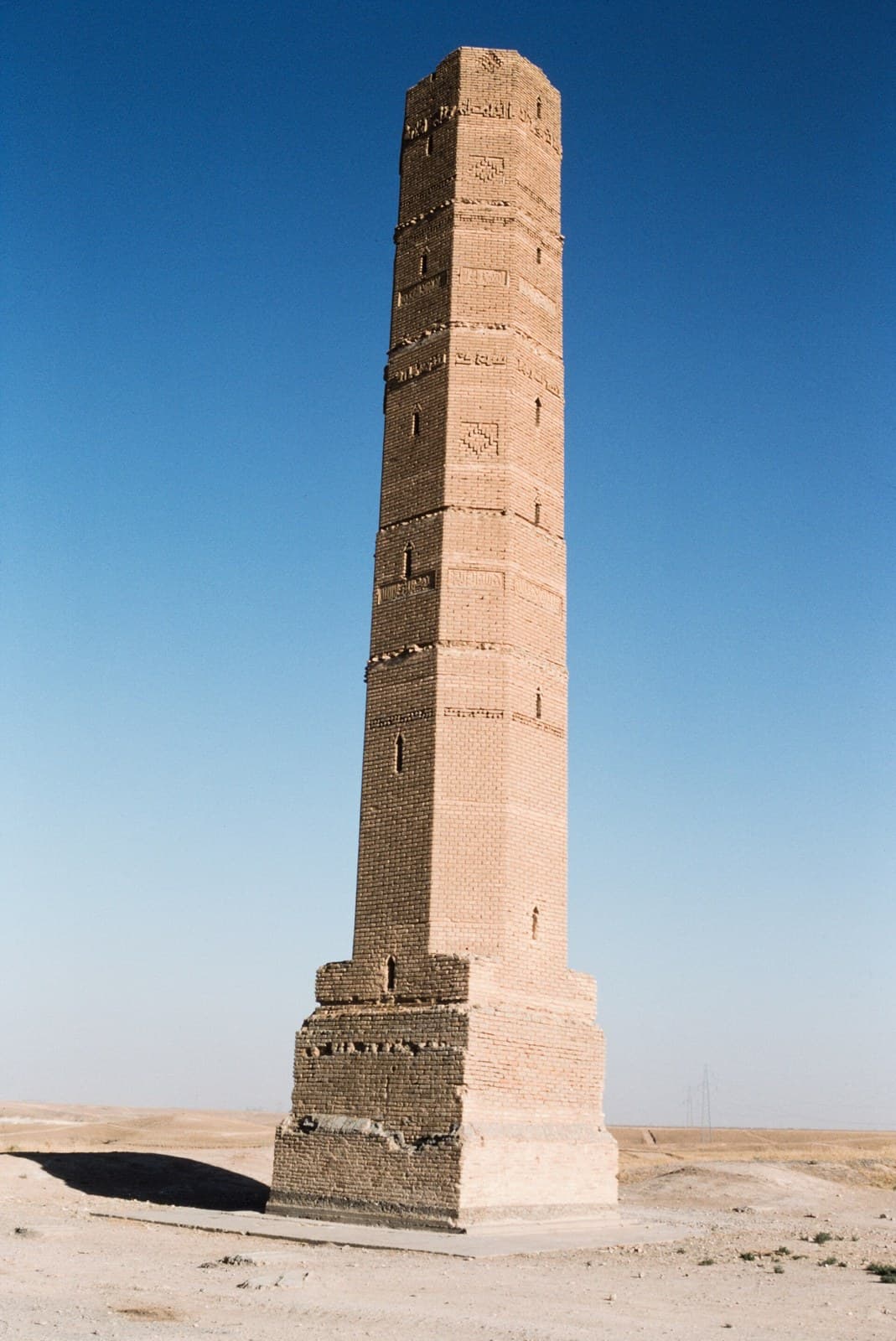
At Balis on the Euphrates, a Byzantine tower from the Roman frontier town and a brick Ayyubid minaret of 1210 still stand. Near the Emar mound, but a separate site.
- Opening hours
- Open site; guard arrangements vary — confirm on site
- Entry
- Variable — confirm on site
- Duration
- 60 minutes
- Best time
- A spring or autumn morning; there is no shade on the plain
- Period
- Roman — Byzantine — Umayyad — Ayyubid — Mamluk
- Address
- Near Maskanah, shore of Lake Assad, Aleppo Governorate
Balis is a town on the great bend of the Euphrates, near present-day Maskanah, that was lived in from Roman times to the Mamluks. Its ancient name was Barbalissos. Two structures are still visible: a brick minaret built in 1210 under the Ayyubids, the dynasty founded by Saladin’s family, and a Byzantine tower that remains standing. It is a separate place from Emar (Tell Meskene), the Bronze Age city in the same area, and it tells a much later story.
Where it is and getting there
The remains lie east of Aleppo, in the Maskanah area near the shore of Lake Assad. Published coordinates for the site differ by kilometres, and one of them actually marks the neighbouring Emar mound. For that reason we give no map pin. The minaret rises alone on flat ground, and the safest approach is to ask the way in Maskanah. How much of the old town Lake Assad now covers needs to be checked on site.
What you see
The minaret is a brick tower with a many-sided shaft on a square base, pierced by narrow windows and ringed with decorative brick bands. It was built in 1210, in the reign of the Ayyubid sultan al-Adil. The Mamluks added to it, and it was repaired in the 20th century. A Byzantine tower also still stands on the site.
The battle of 253
Under the Persians the place had the Aramaic name Bayt Bala. In Roman times Barbalissos was a frontier fort in the province of Euphratensis and home to a garrison of Dalmatian cavalry, the Equites Dalmatae Illyriciani. In 253 the Persian king Shapur I routed a Roman army here. He then went on to burn Antioch, Zeugma and Samosata.
Bishops, conquest and canals
The town was a bishopric in the early Christian period. Antonius, bishop of Barbalissos, appears on the list of the Council of Nicaea in 325. In 431 bishop Aquilinus was exiled for his Nestorian views. In the 6th century Justinian rebuilt the town walls.
In 637 the town surrendered by treaty to Habib ibn Maslama. Most of its people left, and tribes of Qays settled in their place. The Umayyad prince Maslama ibn Abd al-Malik took over the district, and the Nahr Maslama and Nahr Said canals were dug. The Abbasid caliph Harun al-Rashid gave the town to his son al-Ma’mun.
1916: Maskanah
In 1916 Maskanah was one of the stations of the Armenian deportations, and about 80 thousand people are recorded as having died there. The history of the plain around the minaret is not only medieval.
Don’t miss
The brick bands on the minaret’s shaft. From a distance it looks like a plain tower; up close you can make out patterns and strips formed by bricks laid in different directions.
Tips
- The nearby Emar mound is Bronze Age and a separate site; put both in the same day
- The minaret stands on a bare plain; bring water and a hat
- Ask on site how much of the old town Lake Assad now covers
- Ask the way in Maskanah; published coordinates do not agree
Transparency
- How this was chosen
- Written by hand; opening hours, entry fee and coordinates are kept as data. A field that is not known for certain is marked as variable rather than guessed.
- Facts checked
- September 2026
- Last updated
- September 15, 2026