Basufan and the Church of Saint Phocas
A three-aisled Byzantine church standing in the middle of a living village east of Jebel Sem’an. An inscription on its south wall dates it to 491-492.
- Opening hours
- Open site, daylight hours
- Entry
- Variable — confirm on arrival
- Duration
- 45 minutes
- Best time
- Spring and autumn; there is no shade in summer
- Period
- Byzantine
- Address
- Basufan village, east of Jebel Sem'an, Afrin district, Aleppo
A village 30 kilometres north-west of Aleppo, east of Jebel Sem’an, at 632 metres. Basufan is not an emptied ruin field: it is an inhabited settlement, and the Byzantine church stands in the middle of it. The church was dedicated to Saint Phocas, and an inscription on its south wall dates the building to 491-492.
Getting there
You take the Aleppo road towards Afrin as far as Deir Sem’an, and from there a side road runs east into the hills to Basufan. The monastery of Saint Simeon is on the same road, a few kilometres back. Public transport is thin; in practice you hire a car and driver in Aleppo.
How long it takes
Forty-five minutes. The church is a single building and it stands inside the village. Allow an hour if you also want to walk the older stonework and the burial ground around it.
What you see
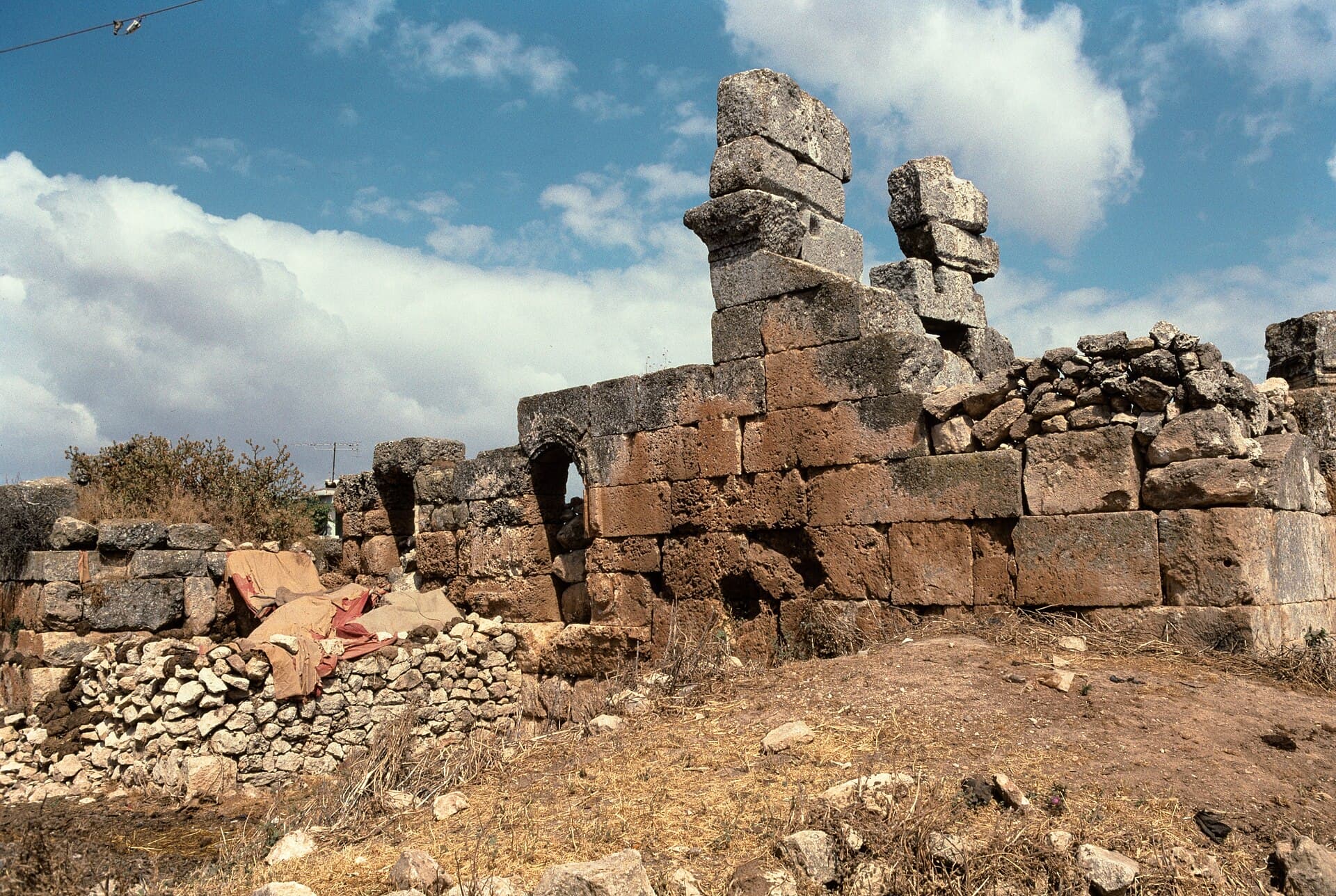
The church was a basilica of three aisles divided by columns. The nave is 24 metres long; the arches rested on the columns and the outer walls were strengthened by pilasters. At the east end there is a semicircular main apse framed by two rectangular chambers. The north chamber opens onto the aisle; the south one opens onto both the aisle and the main apse and served as a relic chamber. The arrangement echoes the church at Qal’at Sem’an, and the resemblance is very likely deliberate. One entrance is in the middle of the south façade, the other in the west gable.
Who passed through
Howard Crosby Butler, leading the Princeton expedition, came here in 1905. He recorded a large Muslim cemetery surrounding the church and traces of an older church that had been destroyed completely, and he took the building to be part of a monastic complex. Gertrude Bell passed through the village the same year and noted that it was inhabited mainly by Kurds, who let their houses through the hot months to Christian and Jewish families from Aleppo.
How it stands today
Basufan entered the UNESCO list in 2011 as part of the Ancient Villages of Northern Syria. The ruin sits inside a working village: there are animal pens against the walls, stretched tarpaulins, house gardens. This is not scenery, it is people’s daily life. Do not walk into a yard, do not photograph anyone without asking, and keep out of any part given over to shelter. Unexploded ordnance is a reported hazard in the countryside; stay on the path and do not touch metal lying on the ground.
Don’t miss
The dedicatory inscription on the south wall. Few buildings in the Dead Cities carry an inscription that fixes the year outright; Basufan’s reads 491-492, and the whole dating of the church rests on that one line.
Tips
- The monastery of Saint Simeon is on the same road; plan the two together
- The church stands in a living village; do not enter yards or photograph people without asking
- The dedicatory inscription is on the south wall, a little above eye level
- Nothing is signposted; your driver needs to know the village
Transparency
- How this was chosen
- Written by hand; opening hours, entry fee and coordinates are kept as data. A field that is not known for certain is marked as variable rather than guessed.
- Facts checked
- September 2026
- Last updated
- September 15, 2026