Barad (Brad): Dead City and the Church of Julianos
The largest ancient town of Jebel Sem’an: the Church of Julianos finished in 402, the oldest Roman bath in the area, and a tomb the Maronite Church links to Maron.
- Opening hours
- Open site, daylight hours
- Entry
- Variable — confirm on arrival
- Duration
- 120 minutes
- Best time
- Spring and autumn; there is no shade on the plateau
- Period
- Roman — Byzantine
- Address
- Barad village, Jebel Sem'an, Afrin district, Aleppo
A village at 586 metres in the middle of the Jebel Sem’an plateau, 40 kilometres north-west of Aleppo. Its ancient name was Kaprobarada. In the 6th century it was the administrative centre of the northern district under Antioch, and one of only three places in the limestone massif that counted as towns; the other two were al-Bara and Deir Semaan. The ruins spread over 2 square kilometres: four churches, a monastery, a Roman bath, a tomb with a pyramid roof and large houses. The modern village lives on the same ground.
Getting there
The Aleppo–Afrin road skirts the massif on its west side. At Basuta, 14 kilometres north of Deir Semaan, a narrow road turns east and reaches Barad after 10 kilometres. There is no public transport; you need a driver who knows the way. Kafr Nabo is 3 kilometres south, with a limestone ridge in between.
How long it takes
Two hours. The Church of Julianos is inside the village; the bath and the tomb are to the north, and the monastery lies 1200 metres south-west, a separate walk.
What you see
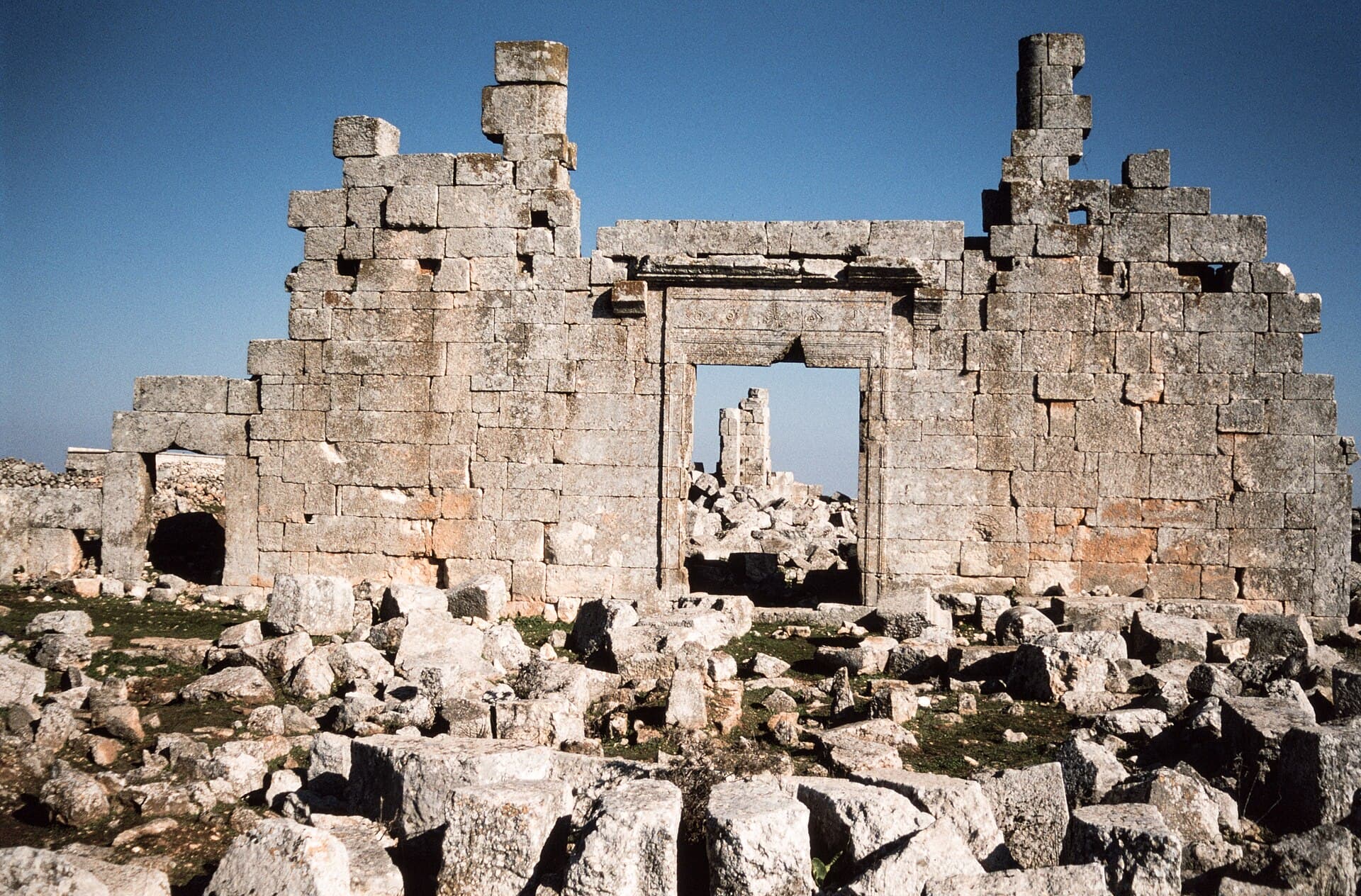
The Church of Julianos is the main building. The architect Julianos, working with Marinos, built it between 399 and 402 on the site of a Roman temple. The temple’s west doorway and some half-columns were reused in the new church. It is a three-aisled columned basilica, 42 by 22 metres. In the middle of the nave is a bema, the raised platform where the clergy sat — the earliest known in the region. Of the seven churches built in northern Syria before 400, only two had three aisles, and this is one of them.
The North Church is dated 561 and follows the same plan as the basilica at Qalb Lozeh. The Roman bath north of the village belongs to the 2nd or 3rd century and is considered the oldest in the area. 100 metres east of it stands a tomb monument: four piers carrying a pyramid roof, with busts looking down from the keystones of the arches. Furthest north is the Byzantine governor’s building, with a Greek inscription dated 496.
Locals call the monastery ruins to the south-west Qasr al-Barad. A single-nave 6th century church, a two-storey house and a tower standing to its roof cornice are there.
The Saint Maron connection
On 30 June 2004 the Maronite diocese of Aleppo declared a tomb in the small building north of the Church of Julianos to be the shrine of Saint Maron and made Barad a place of pilgrimage. In February 2010 a visit was held here for the 1600th anniversary of his death. This is a church decision rather than a settled archaeological finding: another view places Maron’s grave elsewhere.
How it stands today
Gertrude Bell described Barad in 1905 as the largest village in Jebel Sem’an and photographed it. The 2004 census counted 1229 people. On 22 March 2018, during the Afrin offensive, the village was bombed; the shrine of Maron and the Church of Julianos were damaged. No detailed survey of the damage has been published, so which walls still stand cannot be known without going. Part of the ruins are mixed in with houses people live in.
Don’t miss
The west doorway of the Church of Julianos. Built of long limestone blocks under a relieving arch, it is older than the church: it was taken from the Roman temple that stood on the spot and set into the new façade. In one doorway you see both buildings.
Tips
- Look closely at the west doorway; its stones come from a temple older than the church
- The monastery is 1200 metres south-west of the village; plan it as a separate walk
- Because of the 2018 damage, ask locally about the state of the buildings before you set out
- The ruins sit inside a living village; do not walk into courtyards uninvited
Transparency
- How this was chosen
- Written by hand; opening hours, entry fee and coordinates are kept as data. A field that is not known for certain is marked as variable rather than guessed.
- Facts checked
- September 2026
- Last updated
- September 15, 2026