Carchemish Outer Town, Syrian Side
35 of Carchemish’s 90 hectares lie in Syria: the Outer Town north of Jarabulus, the railway border that splits the site, the Woolley and Lawrence digs, access today.
- Opening hours
- Border zone; visitor access on the Syrian side could not be confirmed
- Entry
- Variable — confirm on site
- Duration
- 45 minutes
- Best time
- If access is open, spring or autumn; summer middays on the Euphrates are very hot
- Period
- Bronze Age – Iron Age (Neo-Hittite, Neo-Assyrian); Europus in the Roman period
- Address
- Just north of Jarabulus, along the Turkish border
Carchemish is a Bronze and Iron Age city on the west bank of the Euphrates, about 100 kilometres north-east of Aleppo. In the Neo-Hittite period it was the seat of a kingdom, and under Rome it was called Europus. The site covers about 90 hectares and is now split by a border: 55 hectares lie in Turkey and 35 in Syria. The part in Syria is most of the Outer Town, the city’s outermost ring. This page is about that part; the acropolis and the Turkish archaeological park are on the other side of the border.
How the city is laid out
Carchemish has three parts: the acropolis on the riverbank, the Inner Town ringed by earth ramparts, and the Outer Town beyond it. The Berlin–Baghdad railway cuts through the site, and today that railway forms the border. The acropolis lies north of the line, in Turkey. Most of the Outer Town lies south of it, in Syria, just north of Jarabulus.
Can you visit from the Syrian side?
This could not be confirmed. The site sits on the border, and no source from the last 12 months was found on visitor access to the Outer Town on the Syrian side. In February 2016 the Turkish army put up a prefabricated security wall without foundations south of the railway. The archaeological park in Turkey cannot be visited from Syria; getting there means crossing a border. If you go to Jarabulus, ask in town about the current situation and keep away from the border line.
How the city was identified
In 1874 J. H. Skene, the British consul in Aleppo, suggested that the ruins were Carchemish; in 1876 George Smith confirmed it. The city also appears in the Bible: the Battle of Carchemish in 605 BC is mentioned in the Book of Jeremiah (46:2). In that battle the Babylonian army defeated the Egyptian army.
Who excavated it
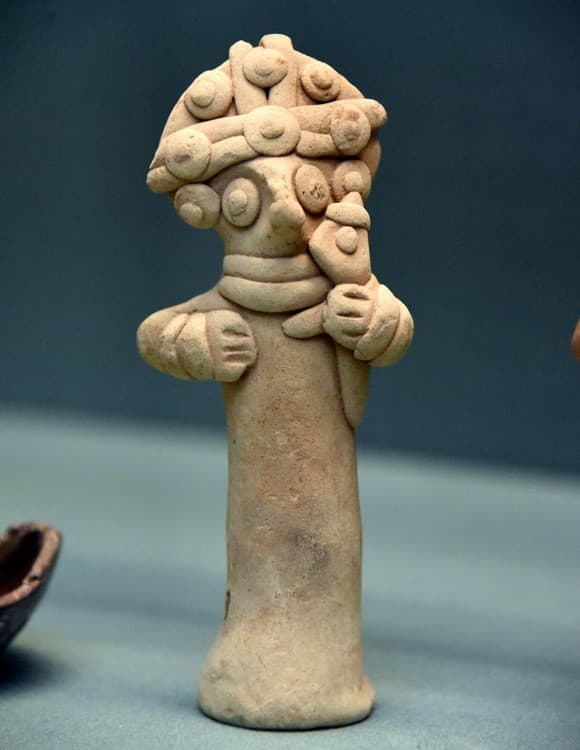
Henderson dug first, in 1878-1881. From 1911 to 1914 Hogarth, R. C. Thompson, Leonard Woolley and T. E. Lawrence worked here for the British Museum; Woolley led the last season in 1920. The figurine of a woman holding a child on the cover came from House B in the Outer Town during these digs and is now in the British Museum. The Turkish side was mined from 1956 to 1998. The mines were cleared in February 2011, and that year a Turkish-Italian team led by Marchetti began excavating. The archaeological park in Turkey opened on 13 July 2019.
What has been studied in the Outer Town
On the Syrian side, the Land of Carchemish project, led by Wilkinson and Peltenburg, carried out the research from 2006 to 2010; Durham University worked with Syria’s Directorate-General of Antiquities and Museums. Before the civil war the Global Heritage Fund listed the Outer Town among sites at risk: the spread of Jarabulus and field clearance were cutting into it. In July 2019 the Turkish-Italian team paid a scientific visit to the Outer Town. In 2015 six fragments of King Kamani’s Kubaba stele, dated to around 790 BC and scattered across three museums, were brought back together.
Do not miss
The railway. The track north of Jarabulus is more than a border: it is the line that splits the ancient city in two. The acropolis and most of the excavated buildings are on the far side; the Outer Town, still under the soil on the Syrian side, was the city’s widest ring.
Tips
- Do not plan to see the Turkish archaeological park from Syria; getting there means crossing a border
- Once in Jarabulus, ask in town whether the Outer Town can be approached
- Keep away from the border wall and the railway line
- The figurine of a woman with a child from House B in the Outer Town is in the British Museum, inventory number 108757
Transparency
- How this was chosen
- Written by hand; opening hours, entry fee and coordinates are kept as data. A field that is not known for certain is marked as variable rather than guessed.
- Facts checked
- September 2026
- Last updated
- September 15, 2026