Dederiyeh Cave, Where a Neanderthal Child Was Buried
In 1993 a cave near Afrin gave up the deliberately buried skeleton of a two-year-old Neanderthal child. The chamber runs 60 metres deep; the dig was wrecked in 2012.
- Opening hours
- Unguarded open site; no keeper or visiting hours
- Entry
- Variable — confirm on site
- Duration
- 60 minutes
- Best time
- Daytime, while light comes through the chimney at the back
- Period
- Middle Palaeolithic; Yabrudian, Mousterian and Natufian layers
- Address
- Dederiyeh valley, Afrin District, 60 km north-west of Aleppo
Dederiyeh Cave lies in Afrin District, 60 km north-west of Aleppo. In 1993 excavators found the almost complete skeleton of a Neanderthal child aged about two, laid out in a way that showed the child had been buried on purpose. What you can see on site today is the cave and its valley: the finds are in museums, and the excavation itself was wrecked in 2012.
Where the cave is and what it looks like
It sits on the left bank of the Dederiyeh valley, 450 metres above sea level and 60 metres above the valley floor. The name is Kurdish for ‘two doors’. The northern mouth, facing the valley, is the main entrance; a chimney at the back of the chamber is the second opening, and daylight comes in through it too. The main entrance is 15 metres wide and 8 metres high. Inside is a single chamber about 50-60 metres deep, 10-20 metres wide and 10 metres high.
Why the cave matters
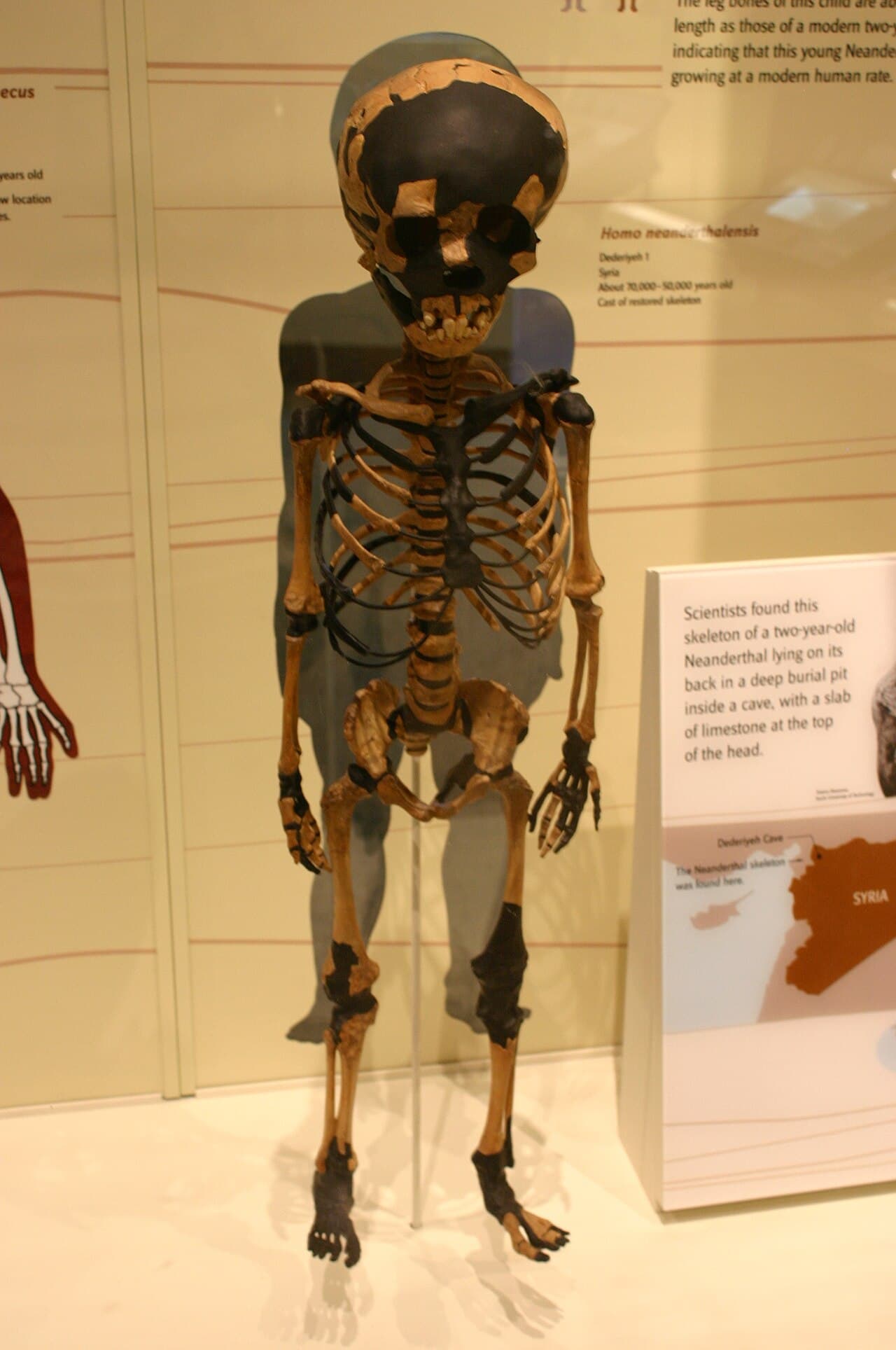
The cave was found in 1987. After trial digs in 1989-1990, a joint Syrian-Japanese team led by Sultan Muhesen and Akazawa worked here from 1993. That same year the skeleton known as ‘Dederiyeh 1’ came to light. The child lay on its back, arms stretched out and legs bent. A stone slab sat under the head and a flint tool on the chest. That arrangement does not happen by chance.
In the 1997-1998 seasons a deeper layer produced the partial skeleton of a second child, in a pit 70 by 50 centimetres. Remains of a third child, around fifty thousand years old, were also found. The human remains from the Middle Palaeolithic layers belong to 15-17 individuals, more than half of them children.
What the layers tell
The cave floor holds 15 layers, 3-5 metres thick in all, from the Yabrudian, Mousterian and Natufian cultures. Animal bones record a change of climate. Wild sheep and goat come from the lower layers; deer, wild boar and wild cattle from the upper ones, which points to a shift towards a warmer, wetter climate. Measurements of the child’s skeleton also led researchers to conclude that Neanderthal childhood lasted about as long as a modern human’s.
Where the finds are now
The National Museum of Damascus displays a skeleton from Dederiyeh. A cast of the restored skeleton of the first child stands in the human origins hall of the Smithsonian’s National Museum of Natural History in Washington.
What is left on site
According to a report by Syria’s Directorate-General of Antiquities and Museums, the excavation squares and sections were destroyed in 2012, and the digging equipment and wooden scaffolding kept in the store were stolen. The site is unguarded and the trenches are open. Whether there is unexploded ordnance in the area is not known. No source from the past year covers the road to the cave or its current state; ask in Afrin before setting out.
What most people miss
The second door. The chimney that gives the cave its name is at the back of the chamber, and from the main entrance the light falling through it shows you where it is.
Tips
- The trenches are open and unfenced; watch the floor inside the cave
- Bring a torch; the chamber runs 50-60 metres deep
- Ask in Afrin about unexploded ordnance before leaving the track
- Add the National Museum of Damascus to see the finds themselves
Transparency
- How this was chosen
- Written by hand; opening hours, entry fee and coordinates are kept as data. A field that is not known for certain is marked as variable rather than guessed.
- Facts checked
- September 2026
- Last updated
- September 15, 2026