Hama National Museum
Hama’s archaeology collection has been in this building since 1999. Five halls hold a Latamne hand axe, an Aramaean lion, a musicians mosaic and a Nuri minbar.
- Opening hours
- Varies — check at the entrance
- Entry
- Varies — check at the entrance
- Duration
- 90 minutes
- Best time
- Before noon; closing time is not certain, so start the day here
- Period
- Palaeolithic — Islamic period
- Address
- North of the city, east of the Orontes, near Said ibn al-As Street, Hama
Hama’s museum sets out seven hundred thousand years of human presence in the Orontes valley, in chronological order across five halls. It was founded in 1956 inside the Azm Palace. Work on a new building began in 1983, and when it opened in 1999 the archaeology collection moved here; the Azm Palace became a museum of popular traditions. For the archaeology of Hama, this building is now the place to go.
Where it is
The museum is in the north of the city, about 200 metres east of the Orontes. It lies north-east of the Azm Palace, with Said ibn al-As Street running along its east side.
What each hall covers
- First hall, Stone and Bronze Ages. Palaeolithic stone tools from the Orontes terraces at Latamne, including an Acheulean hand axe. A limestone bust from the Hama mound, dated to around 2800 BC; traces of red paint still show on the lips. A model of a Bronze Age tomb from Salamiyah.
- Second hall, Iron Age. Pottery and grave goods from Hama’s cremation cemetery, dated 1200-720 BC. The largest piece is a basalt lion that stood before the gate of the Aramaean palace. The Assyrians destroyed it in 720 BC, and a Danish excavation team found it in 1930.
- Third hall, burials. Gold jewellery of the 2nd and 3rd centuries from a woman’s tomb at Kazo, a wooden sarcophagus from the 1st century BC, and glass and lamps from a Byzantine chamber tomb at Mhardeh.
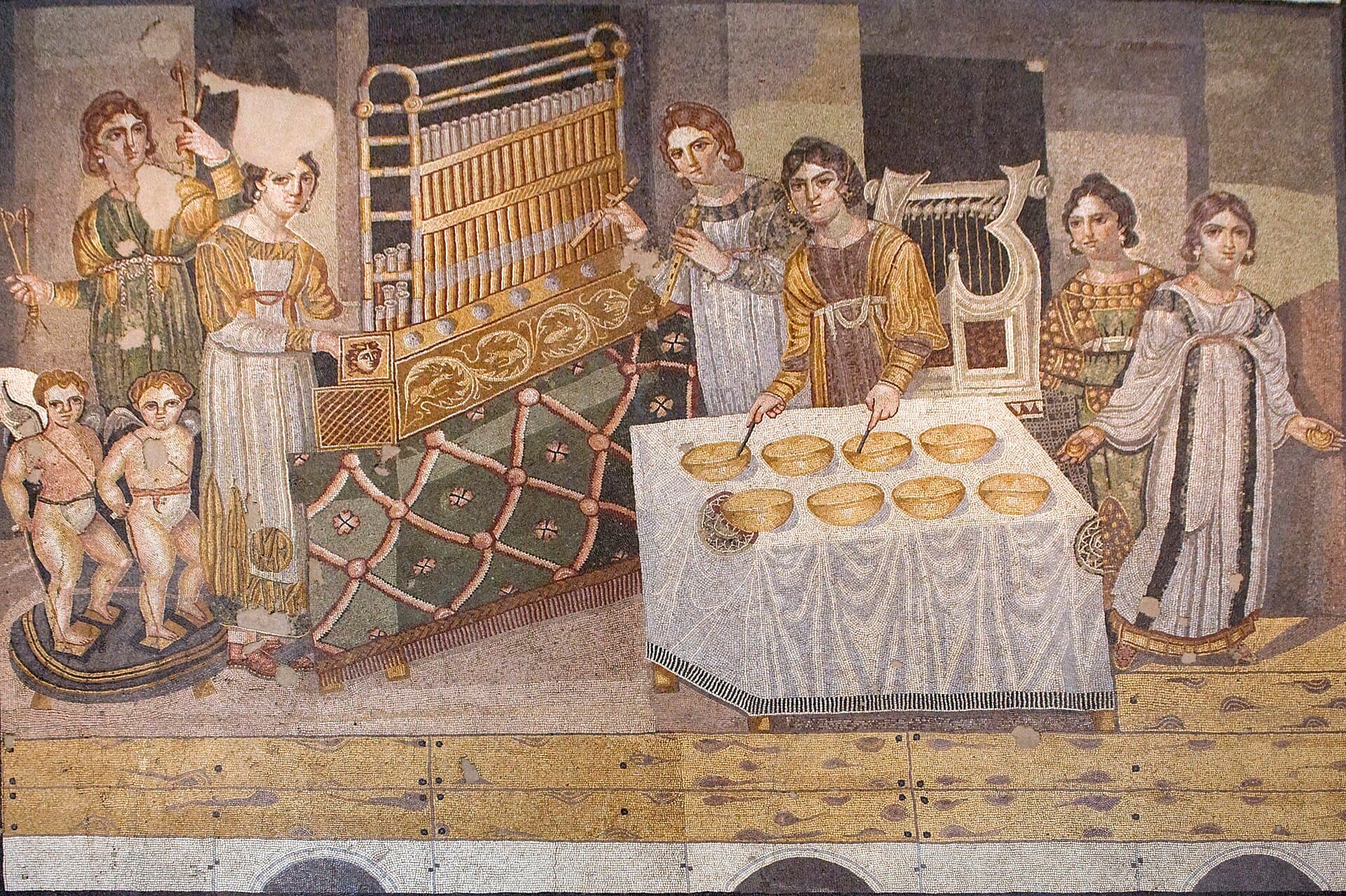
- Fourth hall, Hellenistic, Roman and Byzantine. Statues, capitals, helmets, coins, a basalt slab from Qasr Abu Samra carved with Saint Simeon Stylites, and the museum’s best-known piece: a floor mosaic from the reception hall of a villa excavated at Mariamin, dated to the late 3rd century.
- Fifth hall, Islamic period. The minbar given to the al-Nuri Mosque in the Hijri year 559, or 1163, a display on how the norias along the Orontes work, and glass, glazed ceramics and bronzes.
Is it open, and how long does it take
Reading your way through all five halls takes about an hour and a half; in the 2009 layout the labels were in Arabic and English. Some important pieces are reported to have gone missing during the war years. The hall layout above is based on pre-war descriptions, and it has not been confirmed that every piece is still in place. Ask about opening hours and the entry fee before you go.
Do not miss
Look closely at the Mariamin mosaic. Women musicians play an organ, cymbals and a double pipe; on the table in the middle a row of bowls is struck with small sticks, and two figures of Eros stand in the left corner.
Tips
- The Azm Palace is now a museum of popular traditions; the archaeology collection is in this building
- In the Mariamin mosaic in the fourth hall, look for the women playing the organ and cymbals
- Some pieces went missing during the war years; if you want to see a particular object, ask at the entrance
- If you have visited the al-Nuri Mosque, see its minbar dated 1163 in the fifth hall
Transparency
- How this was chosen
- Written by hand; opening hours, entry fee and coordinates are kept as data. A field that is not known for certain is marked as variable rather than guessed.
- Facts checked
- September 2026
- Last updated
- September 15, 2026