Kafr Nabo, a Village Named for the God Nabu
A Jebel Sem’an village where a press inscribed in 224 honours three local gods and the temple became a church in 398. Door frames and an inn still stand on the hill.
- Opening hours
- Open site, daylight hours
- Entry
- Variable — confirm on arrival
- Duration
- 60 minutes
- Best time
- Spring, while the grass is green; there is no shade on the hill
- Period
- Roman — Byzantine
- Address
- Kafr Nabo, north of Burj Haidar, Jebel Sem'an, Afrin district, Aleppo
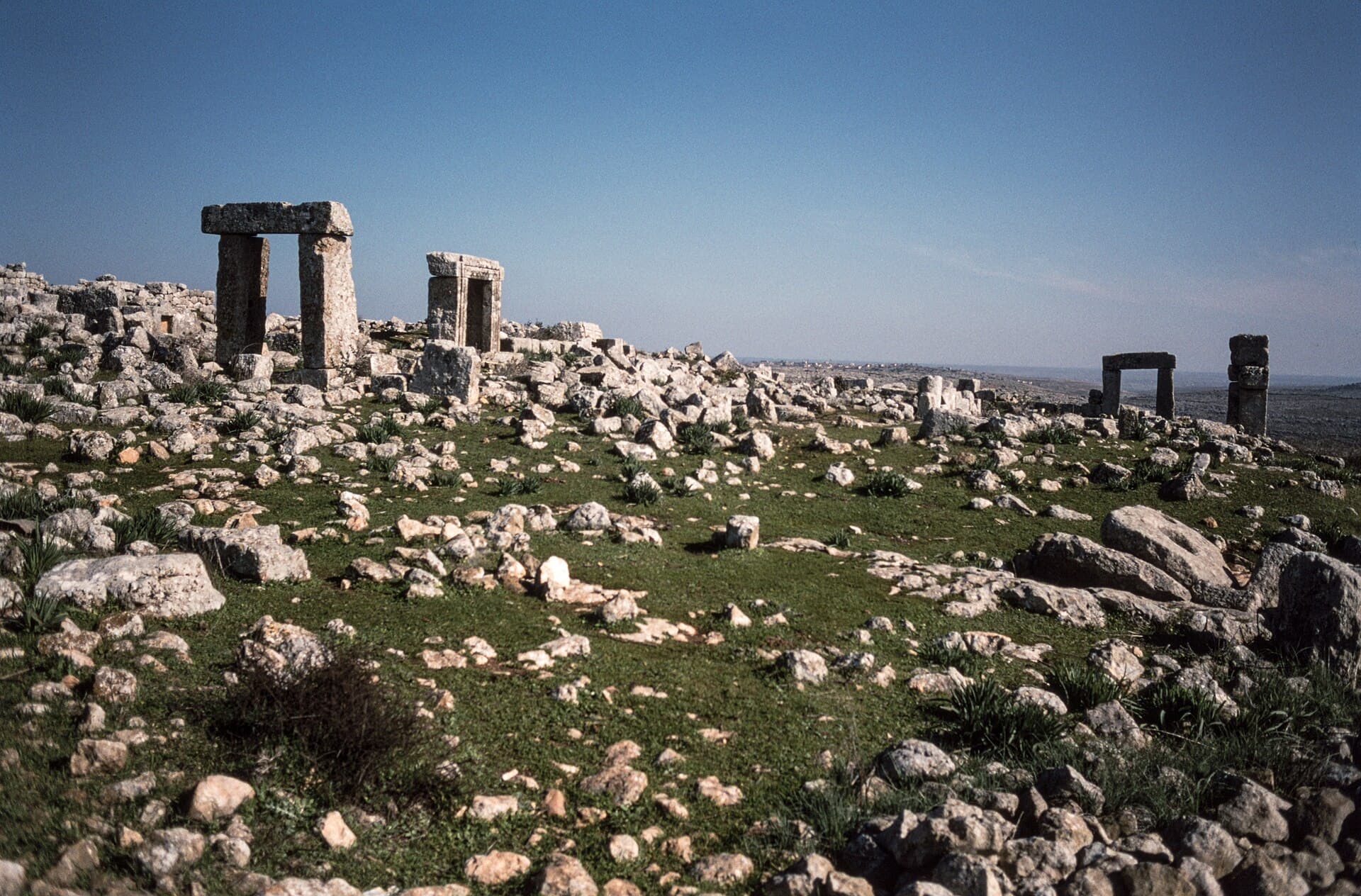
A scattered field of ruins on a flat ridge of Jebel Sem’an at 537 metres, 28 kilometres north-west of Aleppo. The name means “village of Nabu”, the Mesopotamian god of writing and wisdom. What sets Kafr Nabo apart is its dated inscriptions: here you can follow a village moving from pagan gods to Christianity year by year. Door frames, house walls and the façades of an inn still stand on the hilltop.
Getting there
From Deir Semaan on the Aleppo–Afrin road, a paved road runs east for 5 kilometres to Basufan and 3 kilometres more to Burj Haidar. From Burj Haidar a dirt track heads north and reaches Kafr Nabo after 2500 metres. Kalota lies 3500 metres to the east at the same height; Brad is 3 kilometres north, but a limestone ridge separates them. There is no public transport.
How long it takes
An hour. The ground is level but stony; the ruins are spread over the highest point of the hill, with no paths between them.
What you see
The village began to grow in the 2nd century, a century earlier than its neighbours on Jebel Sem’an. It lived on olive oil, and that shaped its religion: an inscription dated 224 on an olive press dedicates the press to three local ancestral gods — Seimios, Symbetylos and Leon. It shows that the region was getting rich before Christianity arrived. Very little is left of the temple to Nabu.
The village had 75 houses and 600 hectares of fields marked out with boundary stones. The early houses had two small rooms side by side, one storey and a flat roof. Between the 4th and 6th centuries they gave way to two-storey residences with pier porticoes along their long sides. Feeding troughs turned up in most houses, so livestock was part of every household’s living.
The temple was turned into a church in 398, and Maronite tradition credits Saint Maron with the conversion. A large inn — a lodging house for travellers — stands next to the church with its façades intact. German sources describe it as a stop for pilgrims on their way to Saint Simeon and date it by an inscription of 504-505; Arabic sources give the same date to a small church. A Syriac inscription over a south doorway dates a chapel to 525.
From pagan village to Christian village
The last door inscription without a cross is dated 455/456. So more than half a century after the temple became a church, families loyal to the old gods were still living here. In the 13th century the geographer Yaqut described a ruined temple here and called the whole mountain by its old name, Jebel Nabu.
How it stands today
Kafr Nabo entered the UNESCO list in 2011 as part of the Ancient Villages of Northern Syria. A small settlement sits next to the ruins; records from 2005 give 140 residents. No recent damage report is known. Unexploded ordnance is a reported hazard in the countryside: stay on the path and do not touch metal lying on the ground.
Don’t miss
The south façade of the inn. Its upper-floor doorways are still in place, and it is the clearest sign of how the building took in pilgrims.
Tips
- The last 2500 metres after Burj Haidar are dirt track; a high vehicle helps
- Kalota is 3500 metres east; pair the two in half a day
- Look for the upper-floor doorways in the south façade of the inn
- The ground is rock and rubble; wear shoes with firm soles
Transparency
- How this was chosen
- Written by hand; opening hours, entry fee and coordinates are kept as data. A field that is not known for certain is marked as variable rather than guessed.
- Facts checked
- September 2026
- Last updated
- September 15, 2026