The New Clock Tower of Homs
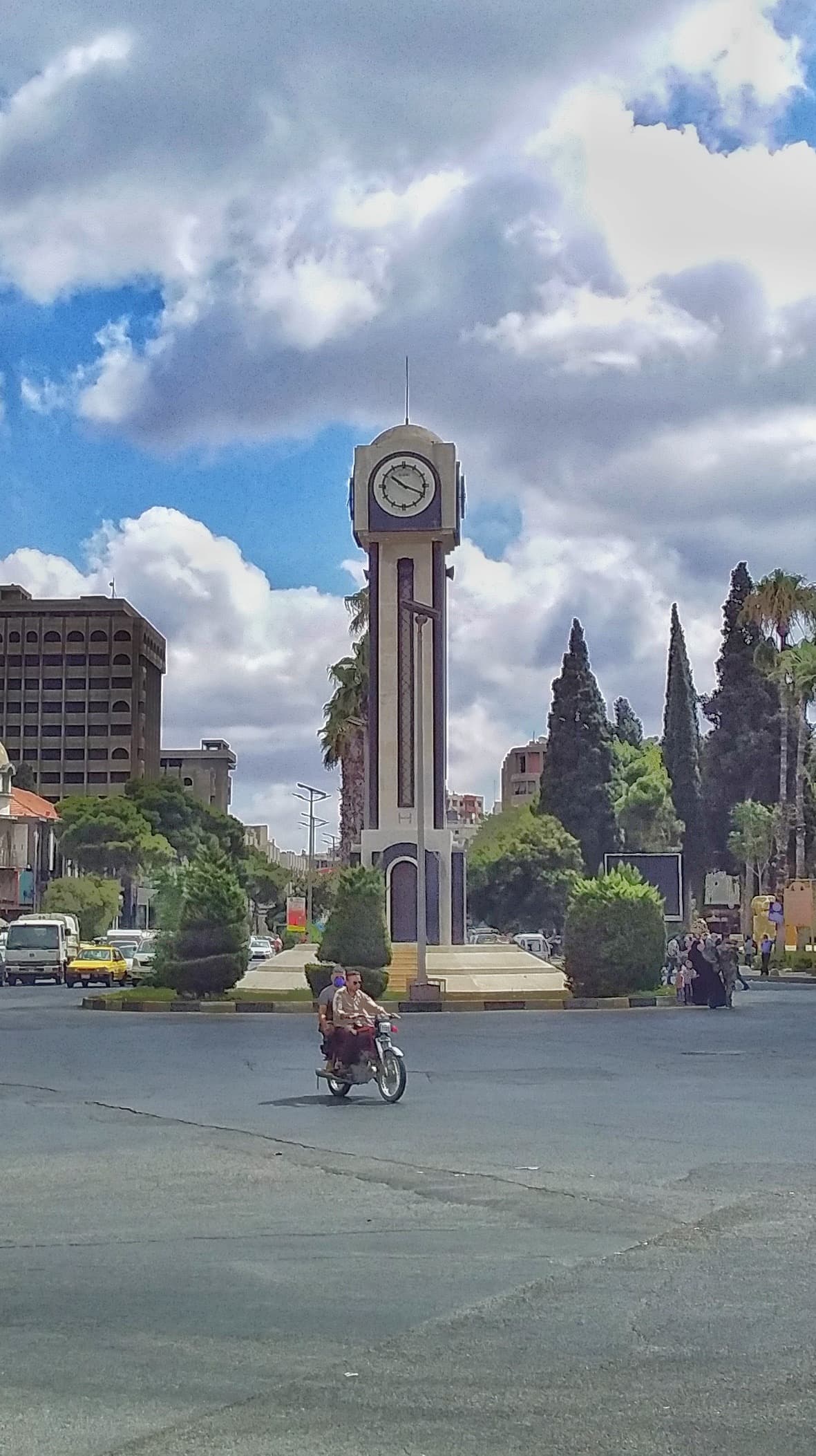
The clock tower seen as the symbol of Homs, funded in 1951 by the emigrant Karjieh Haddad: a black-and-white stone shaft with four clock faces over Clock Square.
- Opening hours
- Open square, any time
- Entry
- Free
- Duration
- 15 minutes
- Best time
- Evening, when the clock faces are lit from inside
- Period
- Mid-20th century
- Address
- Clock Square (Gamal Abdel Nasser Square), Homs
The New Clock Tower stands in the modern centre of Homs, in the middle of Gamal Abdel Nasser Square, which everyone calls Clock Square, and it is widely seen as the symbol of the city. It was funded in 1951 by Karjieh Haddad, an emigrant from Homs, and people still call it “Karjieh’s clock”. Its square shaft of black and white stone looks like a minaret. At the top is a clock room with four faces.
Who paid for it
Karjieh Haddad visited her home city in July 1951, donating 30000 Syrian pounds for the tower and, on the same visit, giving money to the Orthodox orphanage, to schools and to several associations. Sources give different years, between 1957 and 1961, for when construction started and finished. One account says the tower’s structure was ready in 1959, but the funds set aside for the clock mechanism itself fell short, so Karjieh sent a second donation to complete it. The tower was formally opened on 14 August 1964, in a ceremony attended by the mayor and the governor of Homs.
The square’s past
Under the French Mandate the site held a barracks and cavalry stables; later it became the traffic police square. Its official name is Gamal Abdel Nasser Square. In the city it is simply Clock Square. Al-Dablan, Abdul Moneim Riad, Abdul Hamid Drubi and Shukri al-Quwatli streets all meet here. In 2011 the square was the scene of large demonstrations.
What to see
The tower is about 11 metres tall. The shaft is ablaq work — courses of black and white stone laid in turn. At the top is a square clock room with four arches, and a clock face sits in the middle of each arch, so the time can be read from every side of the square. The faces are lit from inside at night.
What is around it
The Homs Museum is about 150 metres away, on Shukri al-Quwatli Street. Quwatli Street runs about 400 metres east to the Old Clock; the city’s two public clocks stand at either end of this short street.
Tips
- All four faces show the same time; from any corner of the square one of them faces you
- The Homs Museum is 150 metres away, so the two fit into one visit
- The Old Clock is about 400 metres east along Quwatli Street, an easy walk
Transparency
- How this was chosen
- Written by hand; opening hours, entry fee and coordinates are kept as data. A field that is not known for certain is marked as variable rather than guessed.
- Facts checked
- September 2026
- Last updated
- September 15, 2026