The Nymphaeum and the Four-Column Exedra of Bosra
Two Roman monuments face each other on Bosra’s main street: a fountain with a façade of nearly 24 metres, and the four-column exedra often mistaken for it.
- Opening hours
- Open-air site; no fixed timetable could be confirmed
- Entry
- Variable — confirm on the spot
- Duration
- 25 minutes
- Best time
- Morning or late afternoon, when side light brings out the carving on the capitals
- Period
- Roman — Severan
- Address
- Junction of the main colonnaded street and the north-south street, near the Central Baths, Bosra
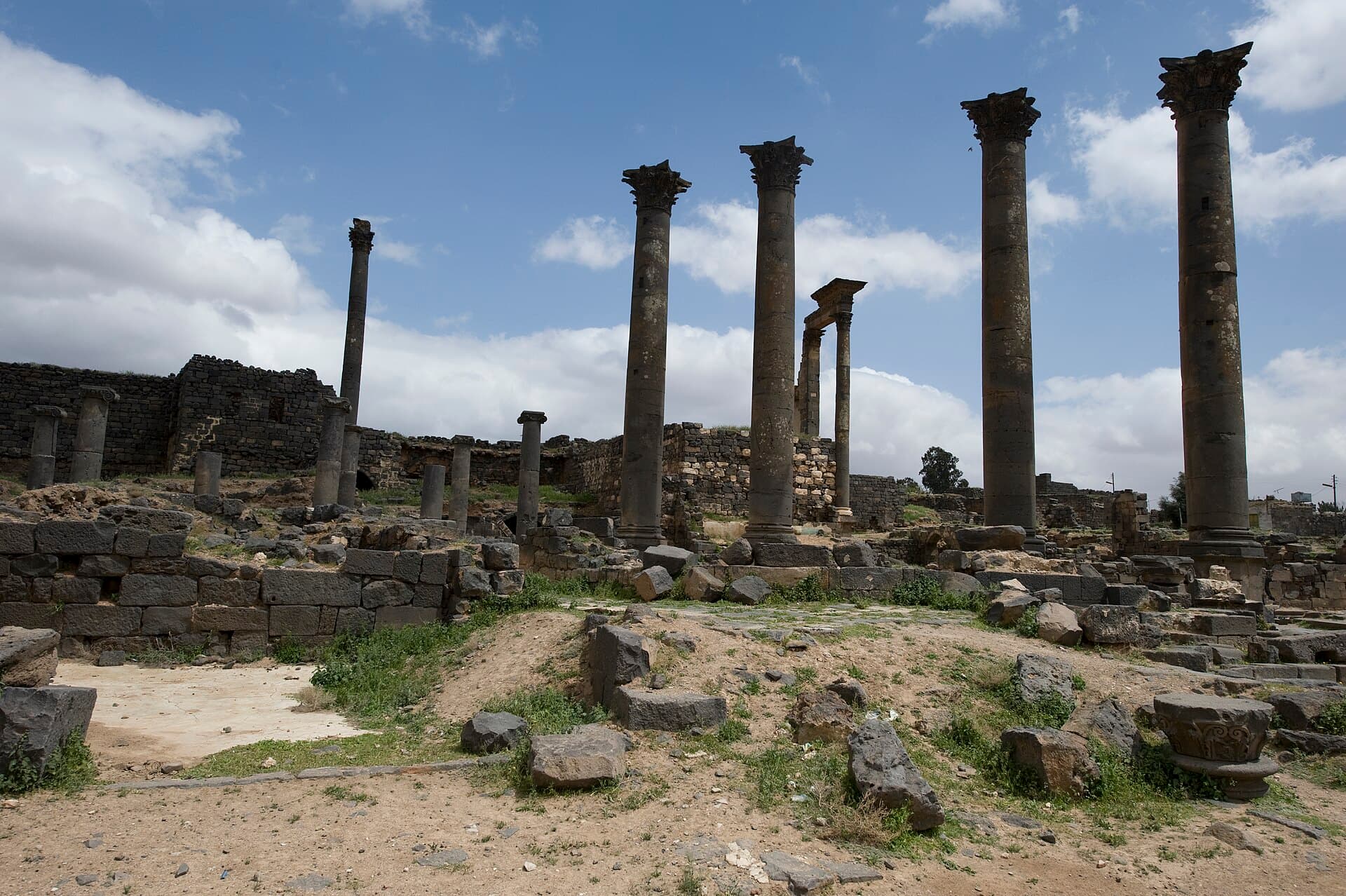
Where Bosra’s colonnaded main street reaches a crossroads, two Roman monuments face each other. One is fronted by four tall Corinthian columns and is among the most photographed corners of the town. Most tourist sources call those columns the nymphaeum, a monumental fountain. The Ifpo guide to Bosra says this is wrong: the four columns belong to an exedra, a crossroads monument with an apse behind it. The real nymphaeum is the low façade across the street. This page describes them one at a time.
Where it is
At the junction of the main east-west street and the north-south street that led to the Roman camp, near the Central Baths. Anyone walking the colonnaded street passes here. The north-south street from the crossroads up to the Al-Omari Mosque was opened in the 1990s; its ancient paving, laid on the diagonal, and two Ionic porticoes line that stretch.
What the four columns were
The columns face both streets at an angle of about 45 degrees. They stand on tall octagonal pedestals set on a carefully built stylobate, the stone platform beneath them. About 5 metres behind them stood a back wall with a large central apse; the whole monument was about 12 metres deep. Only the mortared core of that wall survives.
The pedestals and column shafts carry small, regularly spaced holes. They are traces of a cladding added later: marble or limestone slabs on the pedestals, and most likely metal ornament in plant designs on the columns. In the first phase the side openings between the columns could be closed with curtains or lattice panels hung from wooden beams. The first phase is dated to around 150-160, the second to the Severan period, the dynasty that ruled Rome from the end of the 2nd century.
Which one is the nymphaeum
Butler took the building across the street for a kalybe, a type of shrine found in the Hauran. In Arabic it is still called Sarir Bint al-Malik, the king’s daughter’s bed. Clearance in recent decades showed it to be a monumental fountain with a decorated façade. The façade is nearly 24 metres long. In front of it lies a rectangular basin of the same length and less than three metres wide, closed at its north and south ends by projecting walls.
The fountain went through at least three phases. At first eight evenly spaced spouts fed the water channel, and a semicircular basin sat on the axis. In the second phase the upper basin was raised by two courses of stone; the old spouts were blocked, and fewer new ones were cut 1 metre higher, lined up with the niches in the back wall. In the third phase the top of the basin wall was changed. Ifpo dates the first form of the building to between the end of the 1st century and the first half of the 2nd century.
Who corrected whom
In 1914 Butler drew a complete reconstruction of the four-column monument. C. Makowski disproved part of it with soundings in 1978 and 1979 and published the results in 1980. The Bosra antiquities department cleared the site in 1992, which is when the octagonal pedestals and the stylobate came to light.
What not to miss
Go close to the pedestals and look for the small holes. These columns look bare today, but they were once covered in marble slabs and metal ornament; the holes are the only trace left of it. Then cross the street and find the old spouts that were blocked up in the fountain’s basin wall.
Current state
The ancient city of Bosra is open to visitors; an Al-Watan article dated 3 September 2026 describes it as a tourist site. No current information specific to these two monuments could be found.
Tips
- Look at the small holes in the pedestals of the four columns; they held marble and metal cladding
- Cross to the low façade opposite; that is the actual fountain
- Follow the diagonal ancient paving on the street running from the crossroads to the Al-Omari Mosque
Transparency
- How this was chosen
- Written by hand; opening hours, entry fee and coordinates are kept as data. A field that is not known for certain is marked as variable rather than guessed.
- Facts checked
- September 2026
- Last updated
- September 15, 2026