The Roman Circus of Bosra, the Hippodrome South of the Theatre
South of Bosra’s theatre lies a U-shaped Roman circus over 440 metres long: a chariot track, 20 rows of seating and the short walk to it from the citadel.
- Opening hours
- Open-air site; no fixed timetable could be confirmed
- Entry
- Variable — confirm on the spot
- Duration
- 45 minutes
- Best time
- Morning or late afternoon; there is no shade on the track
- Period
- Roman
- Address
- South of the citadel and theatre, outside the walls, Bosra
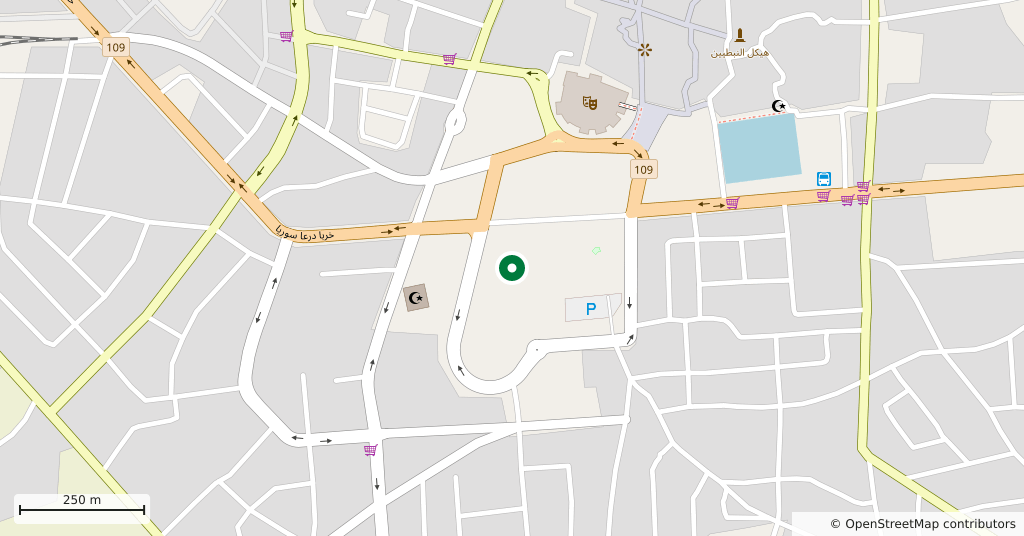
South of the Roman theatre and citadel of Bosra, outside the ancient city, a long U shape is drawn into the ground. This is the Roman circus, where chariots raced, usually called the hippodrome. It dates from the 2nd or 3rd century. It is a little over 440 metres long and close to 130 metres wide. No modern buildings cover it, so the whole outline shows up in aerial photographs; on the ground it reads best along the west wall. It has never been the subject of a detailed architectural or archaeological study.
Getting there
Walk round the citadel on its south side and follow the railway line for a few dozen metres. At the first junction on the left you see a new mosque; a gap there leads to the north-west corner of the circus.
The circus lies outside the walls. According to SANA on 10 September 2026, Daraa civil defence carried out controlled detonations of mines left from the war near Bosra. Stay on the clear path and keep out of the surrounding fields and empty ground.
How to read the track
The circus runs north to south. Two long parallel walls are closed at the south end by a semicircle. The arena is more than 420 metres long and 97 metres wide. At the north end of the west wall, the curved wall of the starting gates, the carceres, was uncovered recently. In the arena you can still make out the low rise of the spina, the central barrier that divided the track.
Butler recorded about 20 rows of seats. Each step is 68 centimetres deep and 45 centimetres high. There was no portico above them. A vaulted entrance lies on the axis of the southern semicircle. The west wall stands several courses high along its whole length; part of it is recent repair.
How big is it
The arena at Bosra is far wider than the circuses to the west at Tyre and Caesarea. Only two circuses in the region are known to have held more people: Antioch and Alexandria.
Who identified it
For a long time the site was covered with gardens and dry-stone walls. It was Howard Crosby Butler, the archaeologist who surveyed the Hauran, who identified the building and called it the hippodrome. The name stuck, but in Roman terms it is a circus: a long track built for chariot racing rather than for riders.
What not to miss
As you enter at the north-west corner, look at the north end of the west wall: the curved wall of the starting gates is there. Then walk just north of the circus, to the west of the theatre. An amphitheatre, part of its outer wall excavated, stands there. Theatre, amphitheatre and circus together formed the entertainment quarter of Roman Bosra.
Current state
In the flood of April 2018 the northern part of the circus went under water. No dated source on the present condition of the structure could be found. The ancient city itself is visited: in December 2025 a celebration attended by thousands was held in the theatre.
Tips
- Enter at the north-west corner; the curved wall of the starting gates is at the north end of the west wall
- End to end the track is more than 440 metres; carry water and a hat
- Do not leave the clear path; the circus is outside the walls and mines have been cleared near Bosra
- The amphitheatre is just to the north, west of the theatre; add it to the same walk
Transparency
- How this was chosen
- Written by hand; opening hours, entry fee and coordinates are kept as data. A field that is not known for certain is marked as variable rather than guessed.
- Facts checked
- September 2026
- Last updated
- September 15, 2026