The Queiq River
The river of Aleppo runs 129 kilometres and never reaches the sea. The water that explains why the city stands here now runs at the bottom of a concrete channel.
- Opening hours
- The channel banks at any hour
- Entry
- Free
- Duration
- 45 minutes
- Best time
- Spring, when the weeds in the channel bed are in flower
- Address
- The channel through Aleppo; between the public park and Bustan al-Qasr
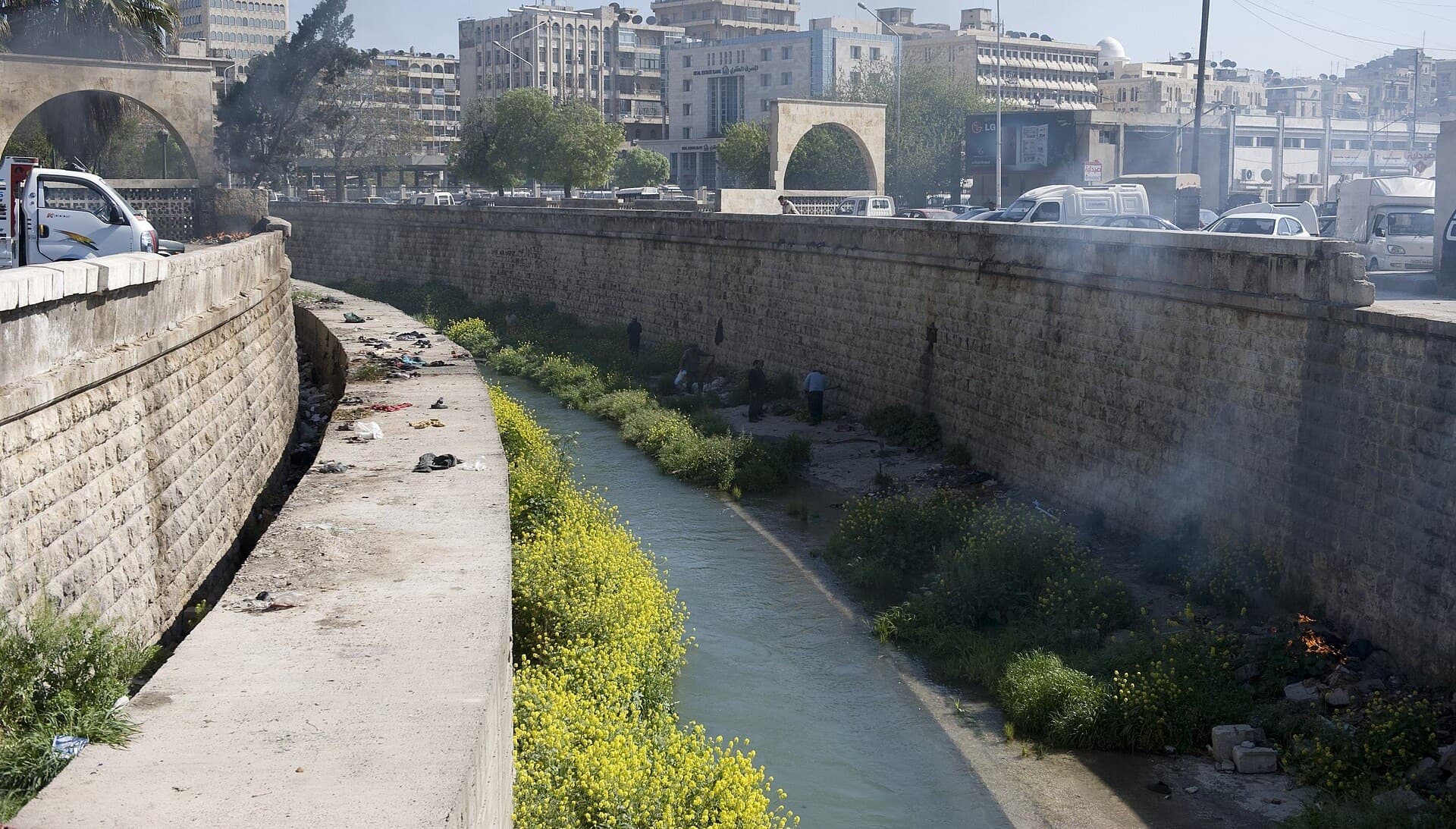
Aleppo has a river. Most visitors leave without seeing it. The Queiq runs 129 kilometres and is endorheic: it never reaches the sea but spills into the plains and swamps south of the city and ends there. Inside Aleppo it runs at the bottom of a concrete channel. There is not much water in it. It is still the answer to why the city stands exactly here.
Where it comes from and where it goes
It rises in the Taurus mountains and runs south parallel to the Euphrates. From there it crosses the Aintab plateau, follows the western rim of the Matah depression, passes through Aleppo and ends in the plains beyond. The name comes from the croaking of frogs, which filled its banks. The Greeks knew it as the Belus. In English it has also been called the Aleppo River.
The Romans brought the water
Nineteenth-century surveys showed that the water comes from copious springs near Aintab, and that those springs would naturally drain into the Euphrates basin. The Romans turned the water south through aqueducts instead and gave it to Aleppo, then a city on the Silk Road. The aqueducts feed a natural wadi, which after joining the Akpinar stream near Kilis carries the water down to Aleppo and to ancient Qinnasrin. The valley has been settled for thousands of years and is known for its flint working and pottery.
Why the river dried up
The Queiq dried out completely in the late 1960s, because of irrigation schemes on the Turkish side of the border. Water from the Euphrates has since been diverted to revive the river and the farming south of the city. The Tal Hasel pumping station was opened for that purpose in 2008, closed during the war, and was repaired and put back into service in July 2022. Average rainfall in the region is 325 millimetres a year, and the water table keeps falling under heavy pumping.
Why the name came up in 2013
Between January and March 2013, in the period when the war had cut Aleppo in two, more than 100 bodies were recovered from the river at Bustan al-Qasr. The episode made the name Queiq known well beyond Aleppo, and a large share of searches for the river still lead there.
Where to see it in the city
The easiest place is Aleppo Public Park, where the river cuts straight across. The second is the channel in the city centre. A narrow strip of water between stone walls, with yellow flowering weeds filling the bed in spring. The gardens that gave Bab al-Jinan its name were on this bank too. The gardens are gone and so is the gate; the river is still here.
Tips
- The easiest place to see the river is Aleppo Public Park, where it cuts across
- Look at the city-centre channel from a bridge, there is no need to climb down
- Come in spring; in summer the channel bed is dry and dusty
- Read the Bab al-Jinan entry too; the gardens that named the gate were on this bank
Transparency
- How this was chosen
- Written by hand; opening hours, entry fee and coordinates are kept as data. A field that is not known for certain is marked as variable rather than guessed.
- Facts checked
- September 2026
- Last updated
- September 15, 2026