Refade, a Merchants’ Village of the Dead Cities
The oldest dated inscription in the limestone massif was found here: 73/74. Merchants’ houses among olive groves and a 6th-century tower, never lived in again.
- Opening hours
- Open site, daylight hours
- Entry
- Variable — confirm on arrival
- Duration
- 45 minutes
- Best time
- Spring and autumn; there is no shade at all on the ridge
- Period
- Roman — Byzantine
- Address
- Refade, north of Sitt er-Rum, Jebel Halaqa, Daret Azze subdistrict, Aleppo
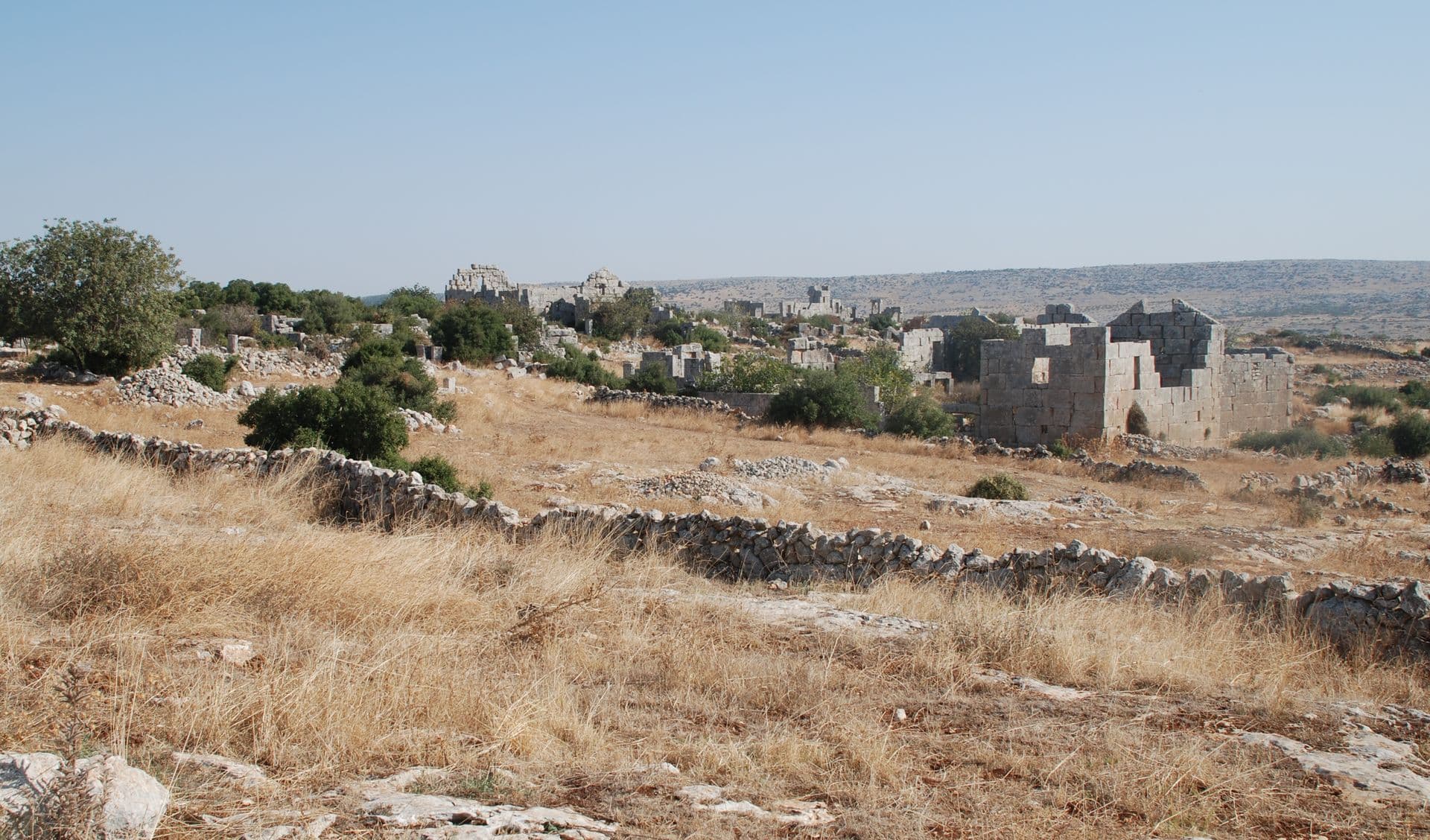
A field of ruins on the broad ridge of Jebel Halaqa, at the edge of the Qatura plain, west of the road to Saint Simeon and 33 kilometres north-west of Aleppo. In the 5th and 6th centuries this was a trading village that grew rich among olive groves. The oldest dated inscription found anywhere in the limestone massif of northern Syria also came from here: AD 73/74. Unlike its neighbours, Refade was not resettled in the 19th century, so no houses have been built on top of the ruins.
Getting there
3 kilometres north-west of Daret Azze a road turns left and reaches Qatura after 1 kilometre. Just before the village a dirt track heads north to Sitt er-Rum after 2 kilometres and to Refade 500 metres later. Look north-east from Refade and you see Saint Simeon 3 kilometres away; a stony 3500-metre footpath drops through a rocky valley to Deir Semaan. There is no public transport.
How long it takes
Forty-five minutes. If you plan to walk the path down to Deir Semaan, add another hour.
What you see
In the middle of the village stands the ruin of a 6th century tower, still 8 to 9 metres high. Nobody is quite sure what these tower houses were for: storage or a lookout are possibilities. Another view sees them as retreats for monks, halfway between the pillar-dwelling tradition of Saint Simeon and life in a monastery.
The houses of the landowners and merchants are mostly in ruins; about half a dozen still have walls two storeys high. A house inscription dated 489 names the owner as Kosmas. Lintels from the early 6th century carry Christian blessings. Melchior de Vogüé was the first to study the site. In the 19th century he published a drawing of a villa dated 510: a two-storey façade with a portico of piers below and columns above, and a moulding along the whole front that ends in spirals. The masonry was careful, and the decoration followed the motifs of the church at Saint Simeon.
Refade has no church ruin. It is thought to have shared the church at Sitt er-Rum, 500 metres south, with Qatura.
The village’s story
The area was settled in Roman times, and Refade was one of the first Roman settlements around. Up to the 4th century there were small villages here that grew olives. The Christian population went on living in their villages after the Arab conquest. From the 8th century Refade lost its economic importance and emptied. Today there is nothing lived in except two simple farmsteads built of rubble into the ruins. The thin soil makes the land fit only for grazing goats and sheep, with a few olives and grain fields in the valleys.
How it stands today
Refade is among the sites that entered the UNESCO list in 2011 within the Jebel Sem’an archaeological park. No recent damage report is known. Unexploded ordnance is a reported hazard in the countryside: stay on the path and do not touch metal lying on the ground.
Don’t miss
The lintels of the houses. Christian blessings from the early 6th century sit above the doorways; if you come across a lintel among the fallen walls, look at its face. Turn north-east from the same spot and the hill of Saint Simeon is in view.
Tips
- Walk it together with Qatura and Sitt er-Rum; Sitt er-Rum is 500 metres south
- The 3500-metre path down to Deir Semaan is stony; bring firm shoes and water
- The two farmsteads in the ruins are lived in; do not enter courtyards uninvited
- Look for crosses and blessings on the lintels of the houses
Transparency
- How this was chosen
- Written by hand; opening hours, entry fee and coordinates are kept as data. A field that is not known for certain is marked as variable rather than guessed.
- Facts checked
- September 2026
- Last updated
- September 15, 2026