The Sharaf Mosque, Aleppo
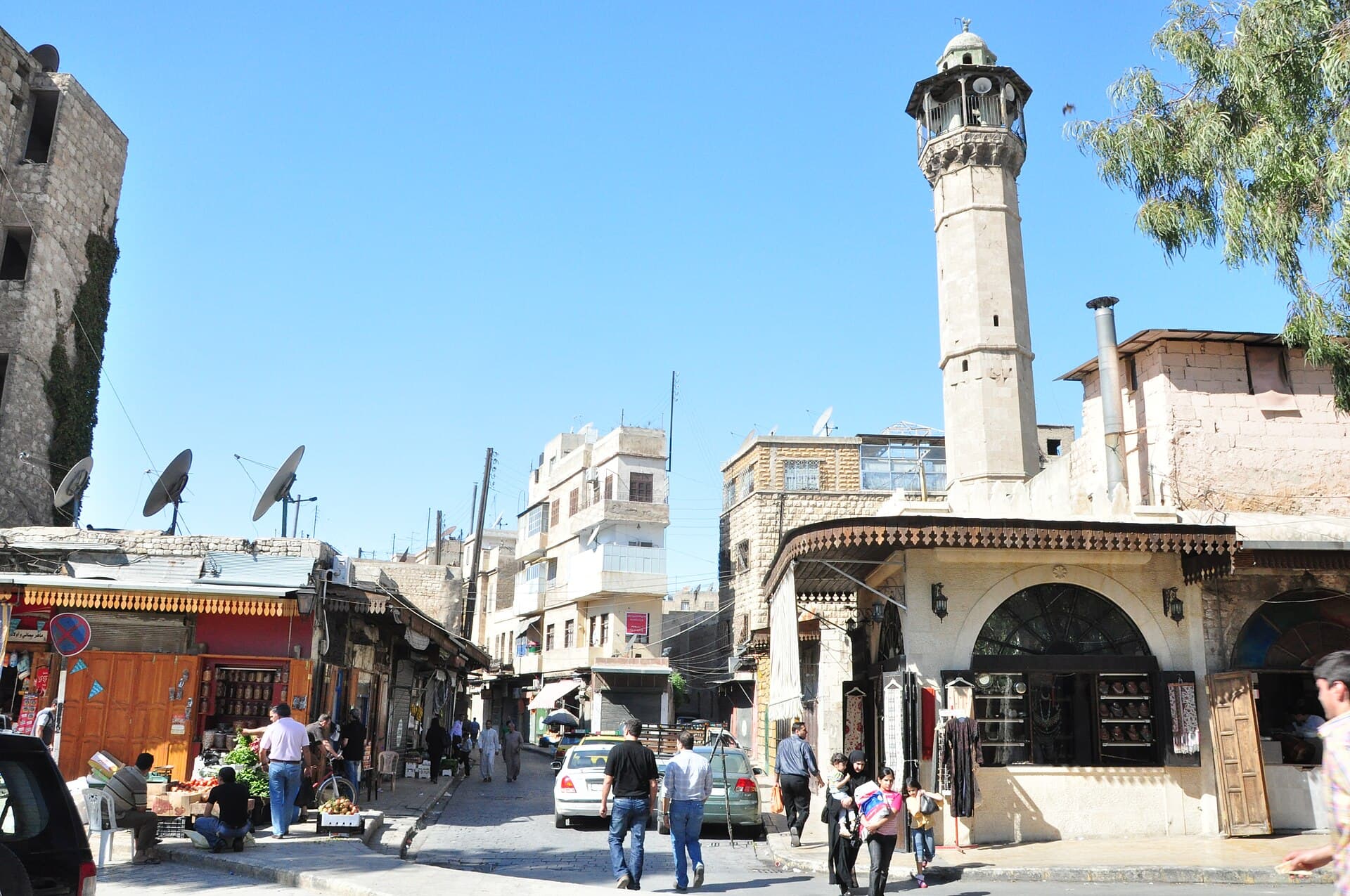
A Mamluk mosque in the Abd al-Hayy quarter of Jdayde. The building you see is from the reign of Qansuh al-Ghuri; the gravestones in its court are older.
- Opening hours
- Open at prayer times; otherwise confirm at the door
- Entry
- Free
- Duration
- 20 minutes
- Best time
- Morning, before the shop lane fills up
- Period
- Mamluk, under sultan Qansuh al-Ghuri
- Address
- Abd al-Hayy quarter, north of Jdayde, Aleppo
Jdayde is remembered for its churches, its merchant houses and Al-Hatab Square. Its Muslim building is this mosque, standing among the shop lanes of the Abd al-Hayy quarter, and from the street you see the minaret first.
When it was built
What stands today came out of a thorough rebuild under the Mamluk sultan Qansuh al-Ghuri, between 1500 and 1517; the inscription above the entrance records the work. The mosque was not founded then, though: gravestones of 1393 in the courtyard show that a religious building already stood here at the end of the 14th century.
Where the name comes from
The name is thought to come from Hajji Sharaf ibn Baba Faraj. There is no firm record of it, but the building and the corner both go by that name.
Getting there
Walk north from Al-Hatab Square; the lane towards Abd al-Hayy takes you past the front of the mosque. A few minutes from the square.
How long it takes
Twenty minutes. The mosque is small and its street front is tangled with shops; what you came for is the minaret and the domed prayer hall.
What to see
Two pieces survive from the Mamluk work: the minaret and the domed prayer hall. The minaret is stone, slender, and rises alone above the roofs. Next to the mosque stands a kastal of 1491 — a public fountain feeding the street.
Don’t miss
The inscription on the fountain. It ties the kastal to a slave merchant named Burdbek, the same man who founded the Kastal al-Harami Mosque elsewhere in Aleppo. One fountain text lays out the trading network of Mamluk Aleppo in a single line.
How it stands now
The mosque still serves its quarter. Its war damage is measured in its own section of the Aleppo Heritage Catalogue, the record kept by the Museum für Islamische Kunst in Berlin. This page carries no coordinates: only one independent source places the building, and a wrong pin is worse than none.
Tips
- Look at the minaret from the far pavement; from close up the shop eaves hide it
- Look for the old gravestones in the court; they predate the building around them
- Read the inscription on the fountain next door; the name and the date are cut into the stone
- Al-Hatab Square is a few minutes away; join the two in one walk
Transparency
- How this was chosen
- Written by hand; opening hours, entry fee and coordinates are kept as data. A field that is not known for certain is marked as variable rather than guessed.
- Facts checked
- September 2026
- Last updated
- September 15, 2026