Sitt er-Rum: Byzantine Church and Roman Tomb
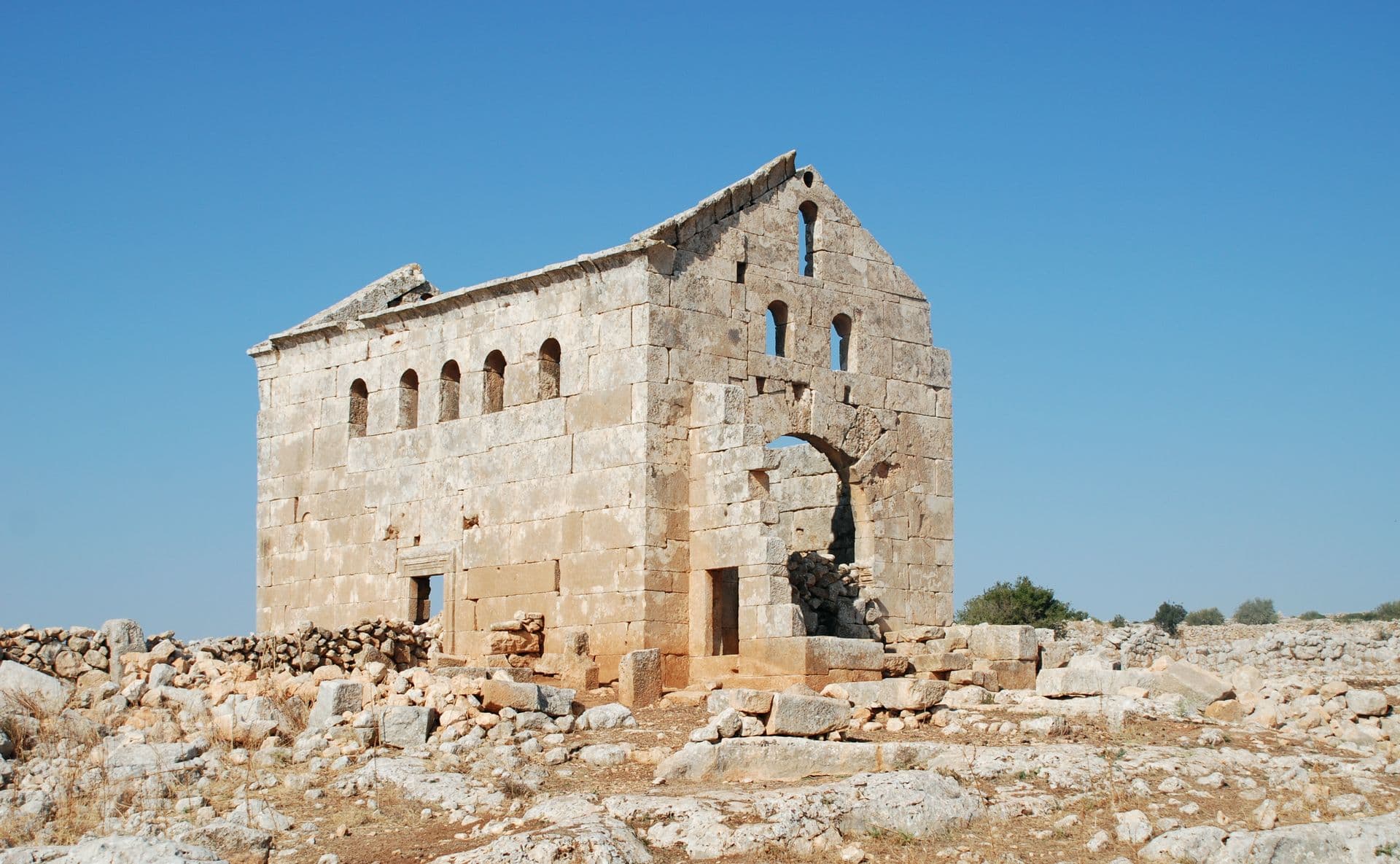
South-west of Saint Simeon: a single-nave Byzantine church still standing to its gables, and a Roman family tomb dated 152 that held fifteen sarcophagi. Now empty.
- Opening hours
- Open site, daylight hours
- Entry
- Variable — confirm on arrival
- Duration
- 45 minutes
- Best time
- Spring and autumn; there is no shade on the slope
- Period
- Roman — Byzantine
- Address
- Sitt er-Rum, between Qatura and Refade, Daret Azze subdistrict, Jebel Sem'an district, Aleppo
A hillside at 480 metres in southern Jebel Sem’an, in the Daret Azze subdistrict. A single-nave Byzantine church stands here with its outer shell almost complete; next to it are a Roman tomb dated 152 and the remains of a monastery. The site borders the villages of Refade and Qatura and is now almost uninhabited. Neither of those villages has a church ruin, so Sitt er-Rum is thought to have been the church they shared.
Getting there
3 kilometres north-west of Daret Azze a road turns left and reaches Qatura after 1 kilometre. Just before the village a dirt track heads north and arrives at Sitt er-Rum after 2 kilometres. Refade is 500 metres further north. From Refade a 3500-metre footpath drops through a rocky valley to Deir Semaan, so the church sits on a line you can walk together with Qatura and Refade. There is no public transport.
How long it takes
Forty-five minutes for the church, the tomb and the monastery ruins. Add Refade and it goes past an hour.
What you see
The church was most likely built in limestone at the end of the 4th century or the start of the 5th. The plan is a plain rectangle with a single nave. The outer shell stands, gable walls included. Only two parts have fallen: the rectangular sanctuary that projected on the east, and the west porch that rested on two piers. Those piers now lie on the ground. There are doors in three façades, plus one south of the ruined sanctuary. Five tall windows open in each of the south and north walls, and three in each of the east and west. In the middle of the nave is a raised bema, the platform for the clergy. On the walls you can make out the stone framework of the pitched roof and the sockets that held its beams.
The church belonged to a group of monastery buildings. Of the others nearby, only the stone posts of a two-storey entrance porch still stand.
The Roman tomb
Near the church stands a monument of two tall piers, each a single stone, carrying a lintel. It marks the entrance to an underground family tomb. The inscription on the lintel names one of the dead as Isidotos, son of Ptolemaios, and dates the tomb to October 152. The burial chamber, cut into the rock, held fifteen sarcophagi.
The name and protection
Sitt er-Rum means “the lady of the Rum”, the Byzantine Greeks. Some Syrian archaeologists link the name to the Virgin Mary, others to a Greek abbess of the monastery. The site was registered in 1945 by decision 220 of the Minister of Education. In 2011 it entered the UNESCO list within the Jebel Sem’an archaeological park, and in 2013 it was placed on the danger list along with every World Heritage site in Syria.
How it stands today
Satellite images taken by the UN Institute for Training and Research (UNITAR) in 2013 and 2014 show two new buildings next to the church. The ruined structure to the west is hard to recognise compared with 2011, which suggests stone may have been removed. The effect of the construction on the ruins is not known; check the church’s present state on the spot.
Don’t miss
The beam sockets in one of the façades. The roof itself is gone, but its stone framework and the holes where the beams rested remain; they are the only trace of how the pitched roof was built.
Tips
- Walk Qatura, Sitt er-Rum and Refade together; Refade is 500 metres north
- The 3500-metre path from Refade down to Deir Semaan is stony; carry water
- Read the inscription on the lintel of the Roman tomb; the date is there
- There are new buildings nearby; do not walk into anywhere lived in uninvited
Transparency
- How this was chosen
- Written by hand; opening hours, entry fee and coordinates are kept as data. A field that is not known for certain is marked as variable rather than guessed.
- Facts checked
- September 2026
- Last updated
- September 15, 2026