Souq as-Souf
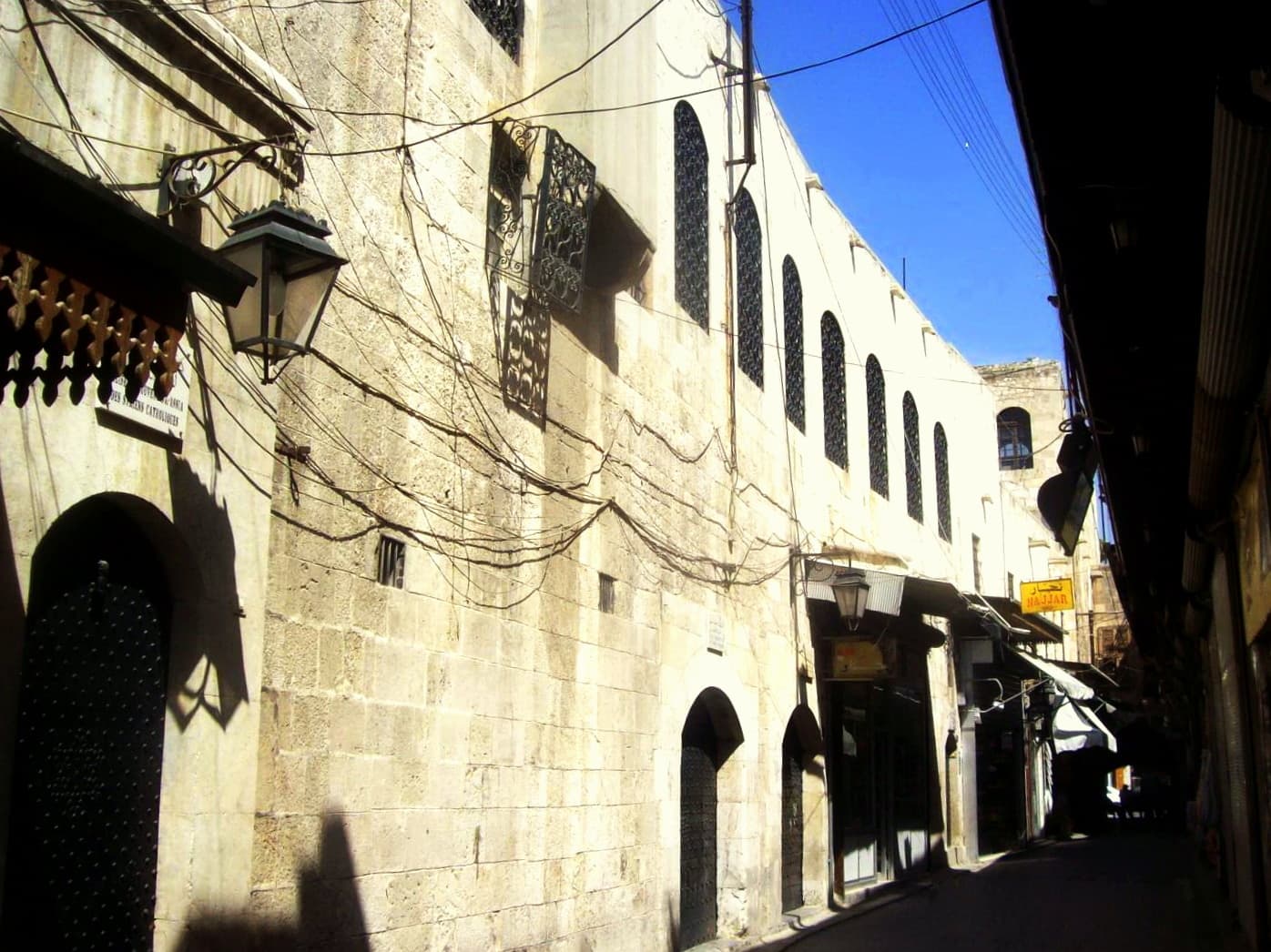
The wool market of Aleppo, outside the walls. It runs along Salibeh street in Jdeydeh, ringed by the old churches of the quarter, market and church side by side.
- Opening hours
- Daylight hours — a quarter market, quiet on Sunday morning
- Entry
- Free
- Duration
- 25 minutes
- Best time
- Morning, while the church wall still throws shade
- Period
- Ottoman
- Address
- Salibeh street, Jdeydeh, Aleppo
The wool market of Aleppo, and unlike the other market records on this site it does not lie inside the walls. It stands on Salibeh street in the Jdeydeh quarter, surrounded by the old churches of the neighbourhood. Trade and worship share one street here.
A market outside the walls
Aleppo’s commerce outgrew its walls. New quarters were laid out to the north, beyond the gates, and Jdeydeh is the best known of them; the stone houses of the quarter are 16th and 17th century work. Souq as-Souf is the commercial face of that expansion. Where Al-Madina Souq carried the goods of distant trade, silk and spices and soap, what is sold here is wool: local, heavy, everyday.
Church and market on one street
Along Salibeh street, church façades stand between the rows of shops. Mar Assia al-Hakim is one of them and meets the street with a long stone wall. A door, a run of windows, a shop awning, one after another. That is exactly the fabric of Jdeydeh: the churches of the quarter do not stand back from the street, they sit inside the market.
Getting there
Jdeydeh lies north of the old city and you walk to it out through the gates. Once inside the quarter, Salibeh street is not hard to find; it is one of the main lines through the neighbourhood, and the church façades work as markers.
How long it takes
Twenty-five minutes. Walking the street takes less, but Souq as-Souf belongs to a walk through Jdeydeh, seen along with the churches and the fronts of the merchant houses. It is not somewhere to come on its own.
What most people miss
The wool itself. The market is named after a raw material, and in Aleppo wool is still bought for quilts, mattresses and handweaving rather than as anything for visitors. If you see baled wool in front of the shops, the name still holds. Then look at the walls: church stone and shop shutter sit on the same street, a pace apart.
Tips
- Add it to a walk through Jdeydeh; the market alone leaves the quarter half seen
- Use the church façades as markers; Salibeh street is followed from one to the next
- If bales of wool are standing outside a shop, ask the trader before photographing them
Transparency
- How this was chosen
- Written by hand; opening hours, entry fee and coordinates are kept as data. A field that is not known for certain is marked as variable rather than guessed.
- Facts checked
- September 2026
- Last updated
- September 15, 2026