Taybat al-Imam Mosaic Museum
A museum built over the floor of the Church of the Holy Martyrs, laid in 442, 18 km north-west of Hama. Jerusalem, Bethlehem and the four rivers of Paradise.
- Opening hours
- Variable — check on arrival
- Entry
- Variable — check on arrival
- Duration
- 60 minutes
- Best time
- Morning, to carry on to Mhardeh or Shayzar the same day
- Period
- Byzantine (5th century)
- Address
- Centre of Taybat al-Imam, 18 km north-west of Hama
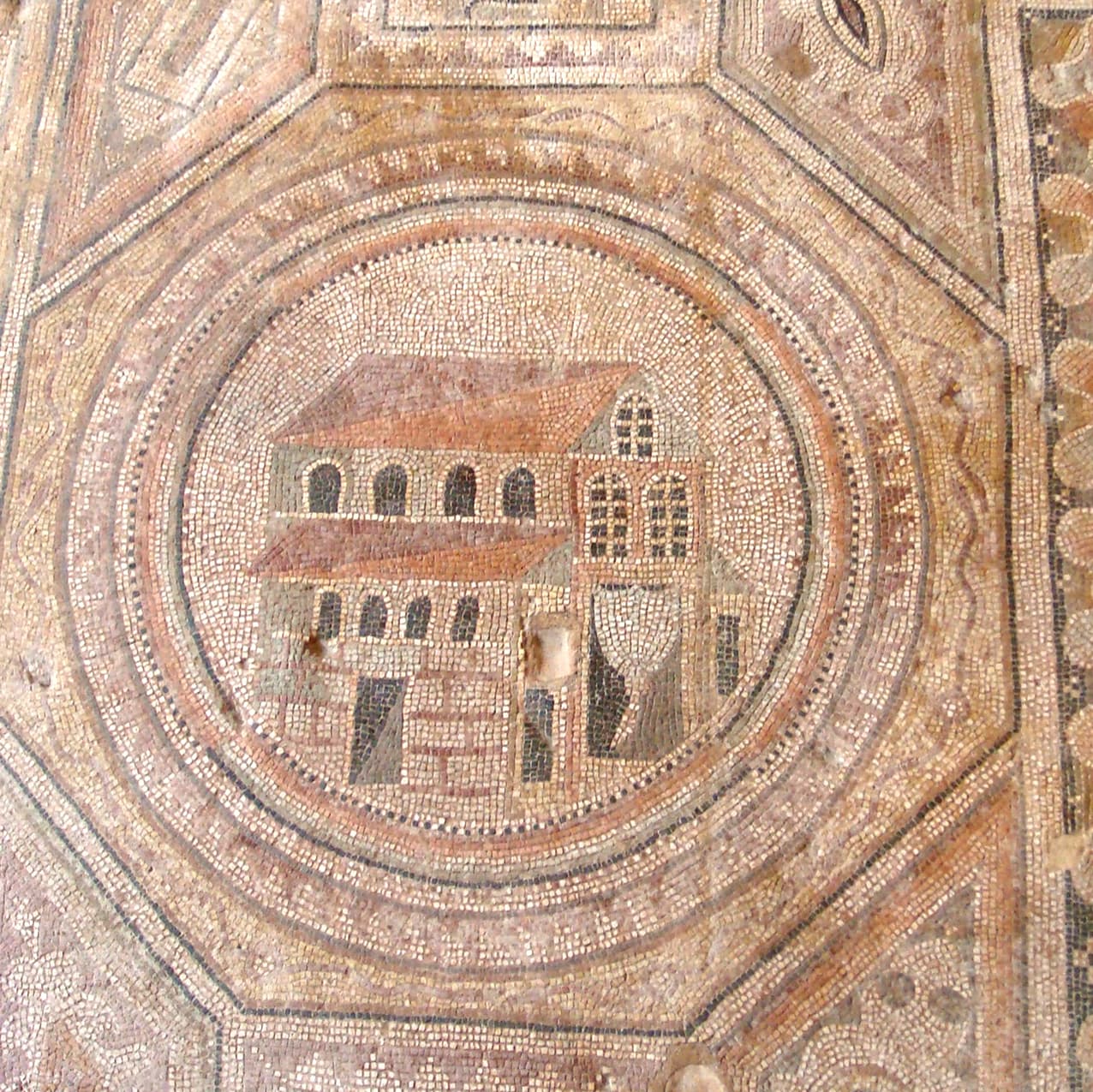
The Taybat al-Imam museum is a protective building put up over a church mosaic laid in 442, in a town 18 kilometres north-west of Hama. The whole floor of the three-aisled Church of the Holy Martyrs is mosaic: pictures of towns and churches, the four rivers of Paradise with their names written in, and the Lamb shedding light at the centre. The floor came to light by chance in 1985, during road works.
Getting there
Taybat al-Imam lies 3 kilometres west of the Hama–Aleppo road, and the museum is in the centre of town. You reach it by turning off the road north out of Hama. Mhardeh and Shayzar castle are on the same stretch of country, further west.
How the mosaic was found
It turned up in 1985 while a road was being cut through the town. Between 1985 and 1987 the Hama antiquities directorate and the Franciscan Archaeological Institute excavated it, led by Michele Piccirillo. The Syrian Directorate-General of Antiquities, the Italian government and the Franciscan institute then built a shelter around the mosaic. Construction took 9 months and cost about 13 million Syrian pounds; information panels and a reconstructed plan of the church went inside.
What is on the floor
According to the dedication, the floor was finished in 442 under Domnus, bishop of Hama. The inscription names the priests Epiphanios and Valens and the donors Alexandra and Theodosios with their families. There are six Greek inscriptions in all: three in the north aisle and one in the south aisle.
In the eastern part are the cities of Jerusalem and Bethlehem with a scene of Paradise, and at the centre the Lamb shedding light and a phoenix. The four rivers of Paradise are labelled by name: Gihon, Pishon, Tigris and Euphrates. The floor carries a large number of buildings: basilicas, cross-shaped structures, domes and towers. English-language sources say that among them are the Basilica of Saint Simeon and the twin towers of the church at Qalb Loze. The mosaic covers around 600 square metres.
The north aisle shows the relics of the martyrs being brought to the church on two mules, alongside scenes of herding, hunting and birds.
How long it takes
About an hour. Walking the whole floor and finding the inscriptions and the cities in the eastern part takes that long.
What most people miss
The mule scene in the north aisle. The two mules carrying the martyrs’ relics tie directly to the dedication that gave the church its name, and the scene draws less attention than the cities in the east.
Current state
Sources do not say whether the museum has been open since 2024 or on what terms; check before you go. The town’s Imam Mosque, known for its “swaying” rectangular minaret, was completely destroyed at the end of 2016.
Tips
- Ask whether the museum is open before leaving Hama; its status since 2024 is not in the sources
- The names of the four rivers of Paradise are written into the floor; look for them near Jerusalem and Bethlehem in the eastern part
- The north aisle has the mule, hunting and bird scenes; it is worth more than a glance at the east end
- Mhardeh and Shayzar castle are to the west and fit the same day
Transparency
- How this was chosen
- Written by hand; opening hours, entry fee and coordinates are kept as data. A field that is not known for certain is marked as variable rather than guessed.
- Facts checked
- September 2026
- Last updated
- September 15, 2026