Yabroud
A Qalamoun town at 1400 metres, 77 kilometres north of Damascus. A temple that became a cathedral, Palaeolithic rock shelters and tombs from the Bronze Age.
- Opening hours
- An open town, all day
- Entry
- Free
- Duration
- 150 minutes
- Best time
- April to June and September to October; snow and frost in winter
- Period
- Bronze Age — Roman Iabruda — today
- Address
- Yabroud, 10 km south of Nebek, Rif Dimashq
A town in the Qalamoun, on the eastern side of the Anti-Lebanon range, at about 1400 metres. Damascus is 77 kilometres to the south and Homs 91 kilometres to the north; the M5 motorway runs east of the town, and the Lebanese border is about 16 kilometres away. What makes Yabroud a stop in its own right is the way its ages sit on top of each other: Palaeolithic rock shelters, Bronze Age tombs, a temple turned cathedral, and a crowded mountain town today.
Getting there
North from Damascus on the M5, or 10 kilometres south from Nebek. You turn west off the motorway into the town. To get around the Qalamoun villages you need a car; Deir Atiyah and Qara are further north on the same road.
How long it takes
Two and a half hours, for the cathedral, the streets of the centre and a look at Tell al-Qawz.
The lie of the land
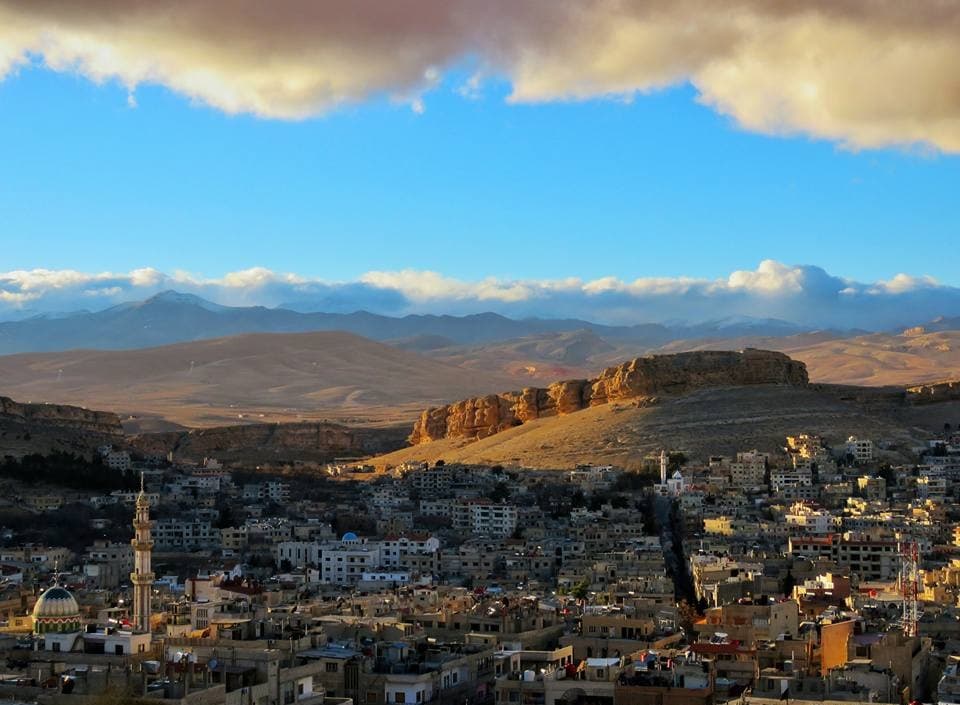
Two mountains ring Yabroud: Mount Mar Maroun, rising to about 1900 metres, and Jabal al-Arid. In the middle of the town stands Tell al-Qawz, a limestone hill 1445 metres high that the townspeople planted with trees on their own initiative. The valleys around it are called Mashkouna, Iskafta, Qurayna, Harayya, Flita and al-Majar. Water comes from Ain Kushel and from the Deir spring at Qurayna. The climate is hard. In winter the temperature drops to minus 16°C, snow falls almost every year, and rainfall stays under 150 millimetres a year.
The name and the distant past
Under Rome and Byzantium the town was called Iabruda, and Ptolemy lists it under that name in his Geography. Older traces lie north of the Iskafta valley, at a place called Khabiyat al-Rashida. A farmer came across tombs there by chance, and they were excavated in 1964 and 1965 under Ali Abou Assaf and Qassem Toueir. Nine Canaanite-Amorite tombs came out, dated to between 1950 and 1500 BC. They are cist graves that look like dolmens, 240 by 135 centimetres on average, each holding at least five people. In tomb 3 a skeleton had a bronze spearhead lodged in its spine. Tomb 4 held ten skeletons and a haematite cylinder seal from around 1800 BC.
In the town
Large blocks from the temple that stood before the church survive in the outer wall of the Cathedral of Saints Constantine and Helen, which has its own page. The rock shelters of the Iskafta valley gave their name to the Levant’s Yabrudian stone tool culture, and they have a separate page too. Records from 1838 list Sunni Muslims, Melkite Catholics and Greek Orthodox in the town, and the 2004 census counted about 26 thousand people. The parents of Carlos Menem, former president of Argentina, came from Yabroud.
What most people miss
Tell al-Qawz. The hill in the middle of town is not a monument but the work of its people: a bare limestone slope that the people of Yabroud planted by hand. It can be seen from most of the town, which makes it the easiest landmark for finding your way.
How it stands now
Yabroud changed hands in March 2014 during the Battle of Yabroud. The town is lived in today. There are checkpoints on the Qalamoun roads and the state of side roads can change, so ask in Nebek or Yabroud before setting out.
Tips
- You are at about 1400 metres; bring a light layer for the evening even in summer
- Look at the big blocks in the cathedral's north wall; they come from the temple
- Ask in town whether the track to the Iskafta valley is open before you go
- Keep your passport ready at checkpoints and do not take photos there
Transparency
- How this was chosen
- Written by hand; opening hours, entry fee and coordinates are kept as data. A field that is not known for certain is marked as variable rather than guessed.
- Facts checked
- September 2026
- Last updated
- September 15, 2026