Aleppo Pepper
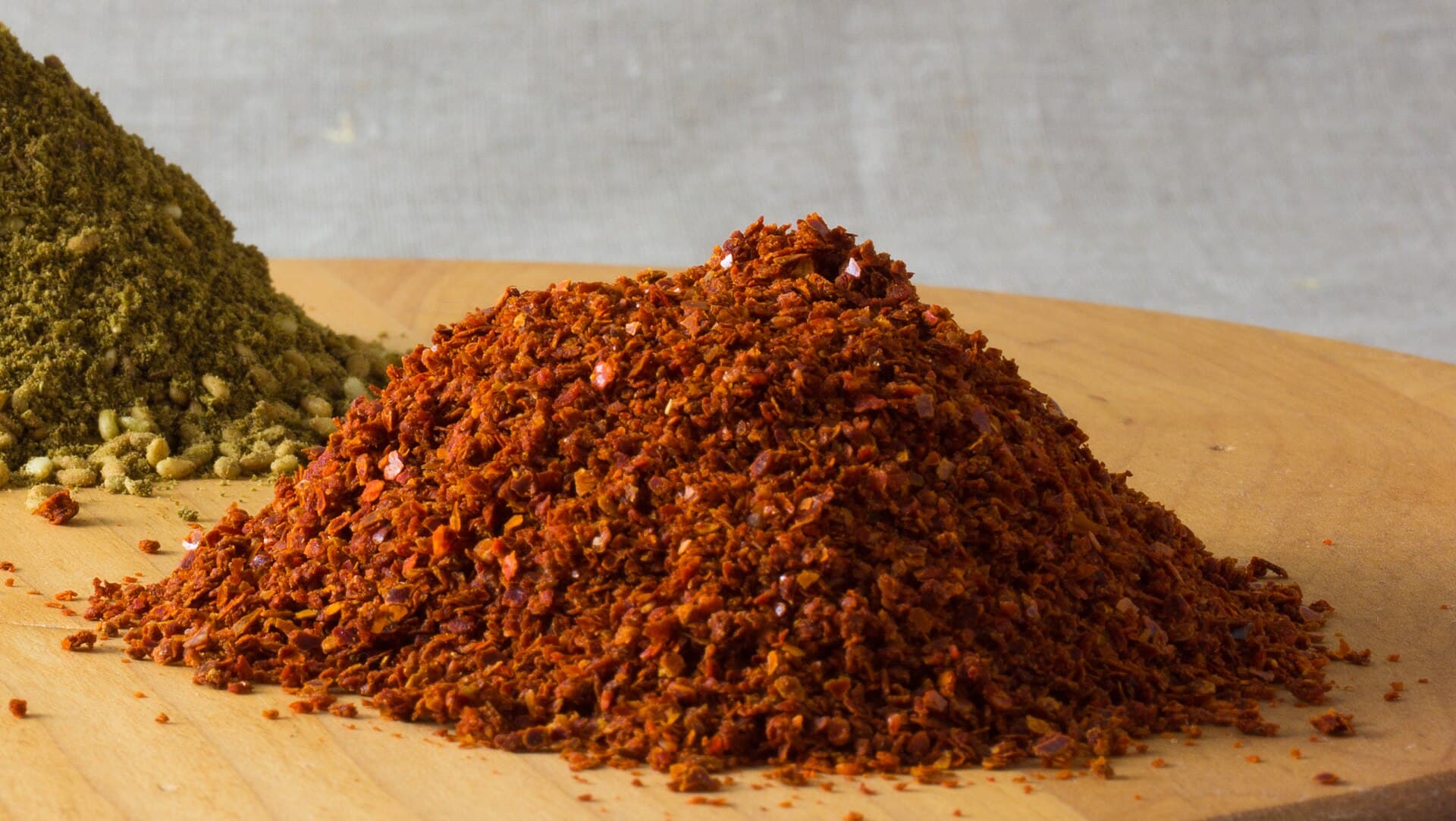
Dark burgundy flakes, oily, faintly salty, with heat that arrives late. Known for a raisin-like sweetness — and here is how to pick a good batch at a stall.
- Where to eat it
- Sold by weight at spice merchants and apothecaries; on the table inside muhammara, dusted over hummus, alongside breakfast eggs.
- Price
- Variable — ask the price per kilo; jarred versions cost more
- When it is eaten
- All year, with the new batch arriving in the autumn months
Aleppo pepper is a variety of Capsicum annuum named after the city on the Silk Road. It grows in northern Syria and across the border in Turkey; the chilli itself came from South America among the New World crops, alongside potatoes and tomatoes. The pods are ripened to a burgundy colour, semi-dried, de-seeded and coarsely crushed into flakes. In Turkey the same product is called pul biber, and in Armenian halebi bibar.
What the taste does
The heat sits around 10000 on the Scoville scale, which is moderate. It does not hit at once but builds slowly. There is a fruity, raisin-like sweetness to it and a mild cumin-like undertone; it is compared to the ancho chilli, but oilier and slightly salty, because salt is often used in the drying. The flakes contain no seeds or inner flesh, one of the reasons the heat stays measured.
Where it belongs on the table
It is the standard spice of the mezze table: muhammara takes both its colour and its taste from it, it is dusted over hummus, it lands on toasted bread and on eggs. It substitutes directly for crushed red pepper or paprika almost anywhere. In Turkey pul biber counts as the third most used spice after salt and black pepper, and it holds a comparable place in an Aleppo kitchen.
Buying it and carrying it home
Put your hand into the flakes at the stall. A good batch feels damp and oily and leaves a faint mark on the fingers; anything dusty, dry and pale in colour has been sitting too long. The name describes a style and a variety rather than one field. The pepper grows on both sides of the border, so “Aleppo” on a label does not by itself say where it came from — ask at the counter. As a dry spice it travels without trouble, but seal it in a zip bag, because the smell gets everywhere.
Its reputation abroad grew after Paula Wolfert’s book on eastern Mediterranean cooking in 1994; outside the region it sells under the name Aleppo pepper.
Tips
- Damp and oily flakes are fresh; dusty, dry and pale ones are old
- "Aleppo" on a label names a variety, not one field — ask where it came from
- Seal it in a zip bag; the smell transfers to everything else in the case
- It stands in directly for crushed red pepper or paprika
- The heat is moderate and slow — use less the first time and taste before adding
Transparency
- How this was chosen
- Two kinds of record live here: the dish itself, and the place that serves it. Both are chosen and written by hand; ranking is not for sale and there are no sponsored entries. If a price range is not known for certain, it says so. Venues that serve alcohol are not listed on this site at all.
- Facts checked
- September 2026
- Last updated
- September 15, 2026