Aleppo Pistachio
In Arabic the word for pistachio is already “Aleppo nut”. How the tree works, how to tell a good kernel from a bad one, and what to ask at the counter.
- Where to eat it
- Sold by weight at nut sellers in Aleppo and Damascus, and used across pastry counters on barazek, knafeh and halawet el-jibn.
- Price
- Variable — in-shell and kernels are priced separately, ask the price per kilo
- When it is eaten
- Available all year; the two-year bearing cycle makes the price move from season to season
Ask for pistachios in Arabic and the city is already in the name: fustuq halabi, the Aleppo nut. The word goes back to Aramaic fistqa, and the tree is native to Central Asia and the Levant. Pliny listed the pistachio among the trees particular to Syria and recorded how it reached Italy: Lucius Vitellius, then Roman governor of Syria, carried it west around AD 35.
How the tree works
Pistachio trees are male or female, never both, so an orchard bears nothing unless it holds the two together; pollen from one male covers 8 to 12 females. A young tree needs 7 to 10 years before it gives a serious crop, and it can live for 300 years. Yield swings on a two-year cycle. Heavy one season, thin the next.
How the harvest happens
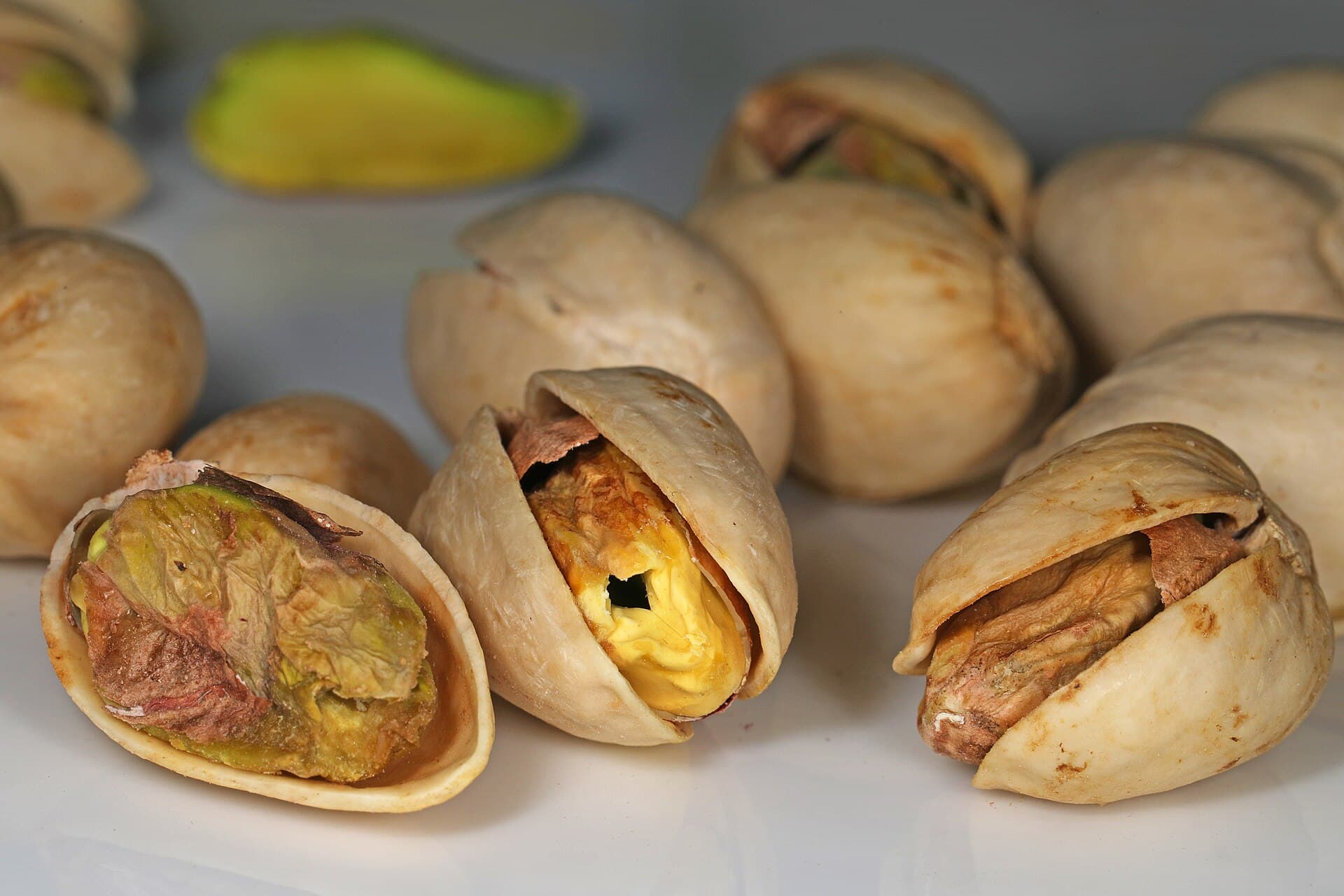
As the fruit ripens the outer hull turns from green to yellow and red, and the hard shell splits open by itself with an audible pop. After picking, the hull is stripped, the kernels are dried, then sorted into open-mouth and closed-mouth. A closed shell is hard to crack by hand, and the proportion of them on a tray tells you what the price is really buying.
How to tell a good kernel
The skin should be mauve. The flesh under it is a pale green. If you see shells dyed red or green, ask about it: the dye was there to hide the stains left by hand picking, and it serves no purpose today. Never take nuts with grey or black mould markings, because badly dried or damply stored pistachios carry a real aflatoxin risk. Buying in the shell is safer than buying kernels, since the shell keeps damp and other smells away from the nut.
Where it appears on the table
The pastry trade of Aleppo and Damascus runs on this nut: crusted over barazek biscuits, scattered on knafeh, rolled inside halawet el-jibn, pressed against a scoop of ice cream. On the savoury side it is simply roasted and eaten with tea or coffee. Nut sellers keep raw and roasted apart. Say which you want, or roasted goes on the scale.
Tips
- Buy in the shell — the shell keeps damp and other smells off the nut
- Avoid dyed shells; the colour was used to cover stains from hand picking
- Skip anything with grey markings or a musty smell, a sign of bad storage and aflatoxin risk
- Say whether you want them raw or roasted, or roasted goes on the scale by default
- Rules on carrying nuts home differ by country — check yours before the flight back
Transparency
- How this was chosen
- Two kinds of record live here: the dish itself, and the place that serves it. Both are chosen and written by hand; ranking is not for sale and there are no sponsored entries. If a price range is not known for certain, it says so. Venues that serve alcohol are not listed on this site at all.
- Facts checked
- September 2026
- Last updated
- September 15, 2026