Syrian Cheeses
Braided mshallaleh, brined akkawi, baladi that lasts three days. What is really on the breakfast cheese plate, and how to buy it at the market counter.
- Where to eat it
- Sold by weight at dairy stalls in the market; on the breakfast table with bread, olives and tea, and inside knafeh and halawet el-jibn at pastry shops.
- Price
- Variable — ask the price per kilo and how salty the batch is
- When it is eaten
- All year, though fresh baladi can only be eaten where it is made
A Syrian breakfast does not put one cheese on the plate: a braid, a brined block and a fresh white one turn up together. The names get tangled in the market, because one cheese can carry two names and two cheeses can share one. The four below are the names that work when you ask at the counter.
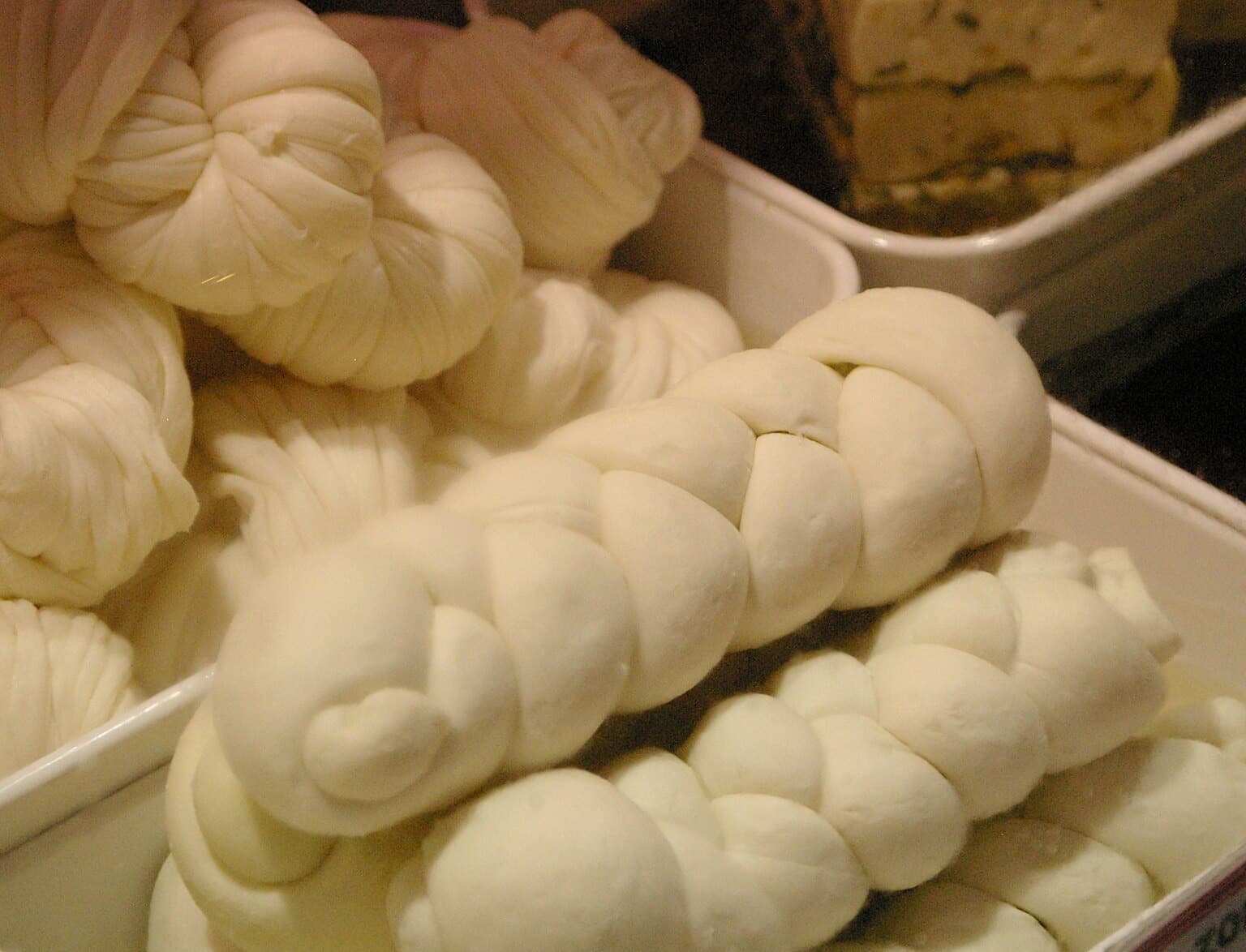
Mshallaleh, the braided one
A string cheese of Syrian origin whose name means braided. In northern Syria it is called majdouli and counts as one of the region’s cultural foods. It is usually made from cow’s milk, with sheep and goat versions around. Mahleb goes into it, and nigella, anise or caraway seeds go on it. It sits in brine for several weeks before it is plaited. The texture is close to mozzarella, white and springy and semi-soft, with a nutty aroma. If the salt is too much, it is soaked in cold water, which softens it and draws the excess out.
Akkawi, the brined one
Named after the city of Acre and now made across the region, Syria included. It is generally made from pasteurised cow’s milk, hand-packed into square hoops and cured in salted whey brine for 2 days. White, smooth and mildly salty, it does not melt easily, which is what makes it a cooking cheese. Manakish, sambousek, fatayer and knafeh all run on it. Sealed, it keeps for up to a year.
Baladi and shanklish
Baladi is fresh, soft and unpasteurised, made from a mix of goat, cow and sheep milk, and for exactly that reason it has a shelf life of 3 days. Baladi does not travel; it is eaten where it is made, at breakfast. Shanklish, the aged ball rolled in thyme or chilli, has its own entry on this site — that one belongs to the coast.
Buying it and getting it home
The first question at the counter is salt: asking whether a cheese is salty or lightly salted is routine for any cheesemonger, and the answer matters as much as the price. Brined cheese leaks, so ask for a vacuum pack or your case will smell of whey. And check your own country’s rules before the flight: many states, the European Union among them, do not allow dairy products in personal luggage.
Tips
- Ask about salt: "salty or lightly salted" is a routine question at any dairy stall
- If mshallaleh is too salty, soak it in cold water — it softens and loses the excess
- Brined cheese leaks; ask for a vacuum pack
- Baladi keeps for 3 days — a breakfast cheese, not a travelling one
- Check your country's dairy rules before flying; many do not allow it in luggage
Transparency
- How this was chosen
- Two kinds of record live here: the dish itself, and the place that serves it. Both are chosen and written by hand; ranking is not for sale and there are no sponsored entries. If a price range is not known for certain, it says so. Venues that serve alcohol are not listed on this site at all.
- Facts checked
- September 2026
- Last updated
- September 15, 2026