Evenings: when the streets fill up
The market shuts as the street opens, and the sweet shop becomes the busiest door of the night. Where the evening happens city by city, and when it ends.
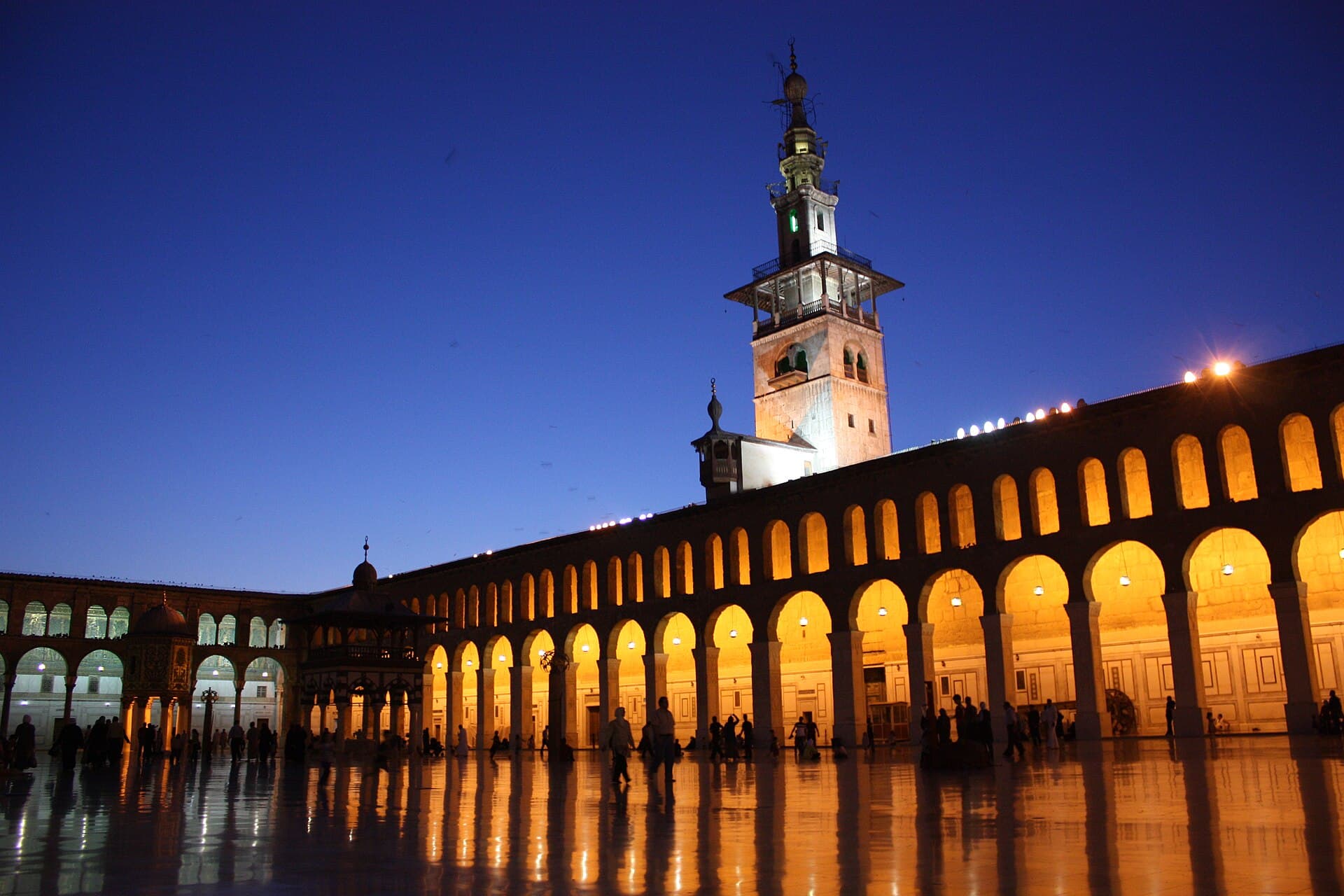
In Syrian cities the real crowd comes out in the late afternoon. A street seen by day and the same street in the evening read as two different places, and a traveller whose plan ignores that misses half the city. This page is about where the evening happens and when it ends.
When the evening starts
The starting time is set by the heat rather than by the clock. Through the midday heat inland the street empties and some shops pull their shutters down; the second opening comes after mid-afternoon. Once the sun softens the pavements fill, and the crowd holds until late at night.
The season splits this in two. In summer the evening runs long and the cool air keeps people out until midnight; in winter it is dark by half past five, the street packs up early and the evening moves indoors. See the same city in August and in January and you see two different lives.
The market shuts, the street opens
The old covered markets close early in the evening. The Souq al-Madina in Aleppo and Hamidiyeh and Bzouriyeh in Damascus stay dark under their vaults, so they belong to the morning and the middle of the day rather than to the evening.
The streets just outside them do the opposite. Nut sellers, juice counters and carts of corn and kaak come out with the dark. So the market closing does not mean shopping is over; the trade simply moves to the open air.
The sweet shop drives the evening
The busiest door of the night belongs to the sweet shop. Families come out after dinner for knafeh, booza or a boxed tray of something with pistachio, the queue reaches the street, and waiting in it counts as part of the outing. Juice and fruit cocktail counters stand alongside — pomegranate, banana and avocado turning in the glasses in the cool of the evening.
The ice cream shop is a performance of its own. Booza is made with mastic and beaten with wooden mallets, and the whole process is watched standing at the counter. All of this is easy for a traveller: you order in one word, sitting down is optional, and standing alone in the crowd draws no attention.
The evening city by city
In Damascus the evening happens in the narrow lanes of the old city and in courtyard restaurants, and the streets around Bab Touma stay open late. The slope of Qasyoun above the city is the other address: the lights of Damascus open out below and tea stands line the road.
In Aleppo the evening gathers around Aziziyeh and Jdeideh, with the citadel square and the streets near Saadallah al-Jabiri at the other end of it. On the coast the corniche takes over: in Latakia and Tartus the evening walk runs along the sea, the benches are full and ice cream goes from hand to hand. In Homs and Hama the evening closes down earlier and stays on the central streets and around the parks; in Hama the water wheels are best heard after dark.
In Palmyra, Bosra and the desert towns, expect no evening life at all. The day there ends before dark and the evening is spent inside the hotel or the guesthouse.
Where women and families go
Many restaurants and cafes keep a family section, a separate room or floor for women and families. For a woman travelling alone this is often the most comfortable option, and asking at the door is enough. The traditional coffee house remains largely male, while in newer cafes mixed tables are ordinary.
Parks, the corniche and the sweet shop are the most mixed places of the evening and are full of families, which also makes them the easiest addresses with children. As long as the walk stays inside the crowd the hour causes no trouble; a side street away from the crowd is another matter.
Power, light and distance
The practical question of the evening is light. Power cuts are daily and scheduled, street lighting does not work in many places, and one stretch of a road can be lit by a generator while the next is dark. A small torch, or the one on your phone, is the real equipment of an evening out.
Darkness also plays with distance. A walk that took fifteen minutes by day looks longer and more complicated at night, and broken pavement stops being visible. Walking the way back once in daylight is the cheapest preparation there is.
When the night ends
The city evening runs late, but a traveller’s day should end earlier. There are three reasons. Nobody drives the intercity roads at night; checkpoints are more careful after dark and road lighting does not work. Shared taxis and minibuses thin out in the evening, which leaves the ride home to negotiation. And curfews are declared from time to time in different parts of the country, often without notice.
One rule covers it: decide in the morning where you will be in the evening, and ask the hotel about getting back. Reception knows that week’s situation better than you do, and the hour to be home is best learned there.
Tips
- See a neighbourhood in the evening; the same street is dead at midday and full at dusk
- The old covered markets close early while the streets outside open up
- The sweet shop and the juice counter are the busiest and easiest evening addresses
- Ask for the family section in a restaurant; often the easiest room for a woman alone
- Carry a torch; street lighting does not work everywhere
Transparency
- How this was chosen
- This page carries the fastest-ageing information on the site: visa rules, exchange rates, border crossings and SIM prices change several times a year. The verification date above says when the facts were last put through their sources; for anything later, check your own foreign ministry travel advice and a Syrian consulate. No figure that is not known for certain is written here.
- Facts checked
- September 2026
- Last updated
- September 15, 2026