The gates of old Damascus
The Roman wall had seven gates and each was tied to a planet. Most of what stands today is Ayyubid work. Where each one is, which to enter by, what to look for.
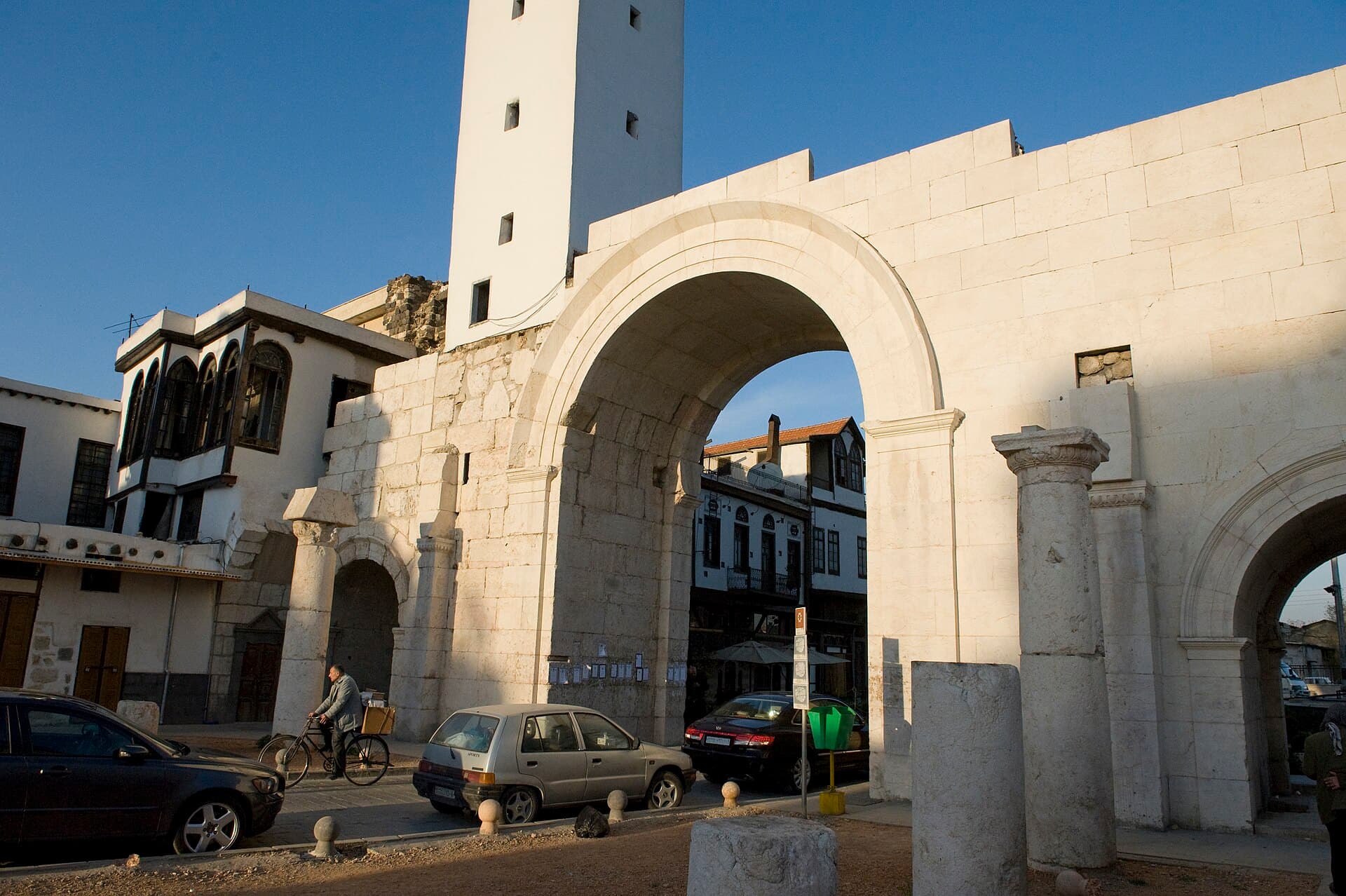
Old Damascus sits on a Roman grid and the gates of that grid are still in place. In Roman times the wall had seven of them, each linked to a planet: Bab Sharqi belonged to the Sun, Bab Tuma to Venus, Bab Kisan to Saturn, Bab al-Faradis to Mercury. Most of the stone you see is not Roman. The gates were rebuilt in the 13th century under the Ayyubids and reached us in that form. Bab Sharqi is the only one that still lets you read the Roman plan.
East: Bab Sharqi, Bab Tuma, Bab Kisan
Bab Sharqi dates from the 3rd century AD and had three openings: carts through the middle, pedestrians down either side. One of the side openings still stands. Straight Street begins here, which makes this the place to start if you want the city in chronological order. At the north-east corner is Bab Tuma, which gives its name to the Christian quarter behind it; the arched passage and the thick tower on either side are 13th-century Ayyubid work. In the south-east corner Bab Kisan carries the oddest fate of the set: since 1939 walking under its arch puts you not on a street but inside the church of Saint Paul.
North: Bab al-Faradis, Bab al-Salam
Bab al-Faradis takes its name from the market gardens that lay outside it — faradis means gardens. The Ayyubid ruler al-Salih Imad al-Din Ismail renewed it in 1241. The gate does not face a square; it stands inside the Amara market, and shop awnings cover the stone so completely that it is easy to walk past. A few hundred metres east is Bab al-Salam, renewed by al-Malik al-Salih Ayyub in 1243 and, because the Mamluks never rebuilt it, the most legible of the group. West of these two is one more gate, Bab al-Faraj, which is not on the Roman list and was added in the medieval period.
West and south
Bab al-Jabiya was the main western entrance. Today you meet it as part of the market rather than as a monument: the space under the arch is filled with shoe stalls and shops are stuck to both sides. The road it opens is the Midhat Pasha souq, the western half of Straight Street. In the south stands Bab al-Saghir, known less for the gate than for what lies outside it: the oldest and largest cemetery in Damascus, with the shrines of companions of the Prophet inside.
How to walk it
There are two lines. The east-west line enters at Bab Sharqi, runs the length of Straight Street and ends at Bab al-Jabiya: about a kilometre and a half, half an hour if you do not stop. The northern line leaves the Umayyad Mosque on its north side, links Bab al-Faradis and Bab al-Salam, and drops down to the square at Bab Tuma. Both fit into one day, but the quarters between the gates are what actually eat the time.
What to look for
The colour and size of the stone. The large blocks in the lower courses are usually older; the neat work above them comes from later repairs. Inscription panels sit slightly above eye level on most of the gates and that is where the date is. And notice how many are still in use: the gates of Damascus are not museum pieces, with traffic and shopping passing under them.
Tips
- Enter at Bab Sharqi and walk west; the city falls into chronological order that way
- To find Bab al-Faradis look up at the stone above the souq, not for a sign
- The inside of Bab Kisan is a church; ask about visiting hours at the door
- Inscriptions sit just above eye level, and the dates are on them
- The gates alone will not fill half a day; plan the quarters between them
Transparency
- How this was chosen
- This page carries the fastest-ageing information on the site: visa rules, exchange rates, border crossings and SIM prices change several times a year. The verification date above says when the facts were last put through their sources; for anything later, check your own foreign ministry travel advice and a Syrian consulate. No figure that is not known for certain is written here.
- Facts checked
- September 2026
- Last updated
- September 15, 2026