How Islamic architecture developed in Syria
From the courtyard of the Umayyad Mosque to Mamluk street fronts and Ottoman complexes. Which building brought which idea first, and how to see it in one walk.
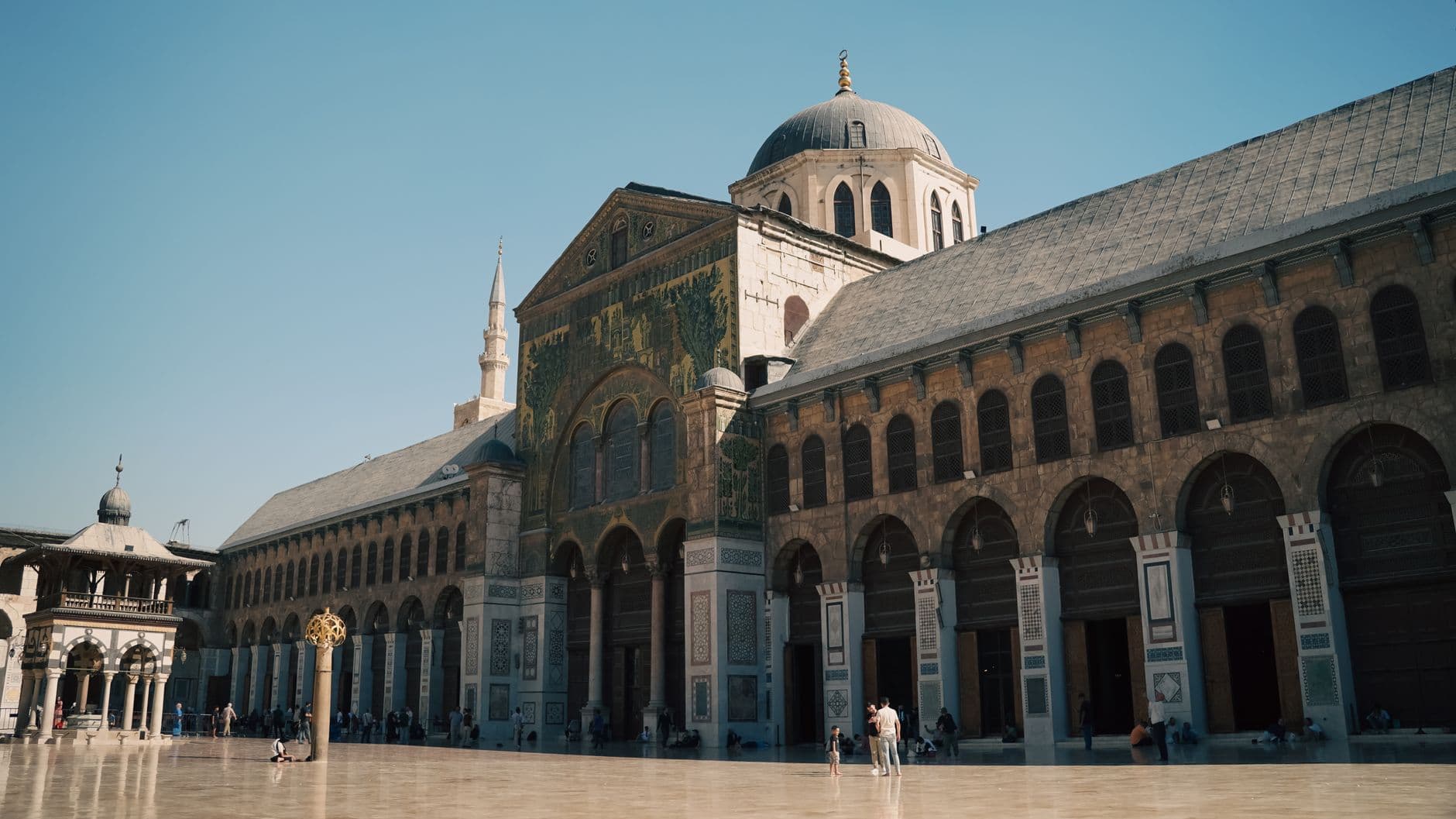
Islamic architecture in Syria does not jump from one style to the next. Each period takes over the problem the last one solved and adds a new one. The vocabulary of the buildings, and the method for dating a stone by eye, are on separate pages of this site. The question here is about sequence: which building did what first.
Umayyad · the courtyard and the reused column
The Umayyad Mosque in Damascus was completed in 715, and two more layers lie beneath it: a church first, and a temple before that. The gold mosaics on the western wall of the courtyard are the surviving piece of its original state. The arrangement it introduced can still be read in every great mosque: a wide courtyard with a prayer hall spread broadside onto it. The columns were taken from older buildings; reusing stone was a method in this period rather than a necessity.
The Great Mosque of Aleppo was founded in the eighth century, from the same generation. The foundation of the Omari Mosque at Bosra is dated by Umayyad inscriptions and it counts as one of the rare mosques surviving from the first century of the Hijra. The Great Mosque of Hama shows the chain itself: a Roman temple, then a Byzantine church, then a mosque.
A second type stands out in the desert. Qasr al-Hayr al-Gharbi was founded in 727 and al-Sharqi in 728, and neither is a castle: both are farm and hunting estates inside a walled enclosure. Their towers are round, showy and without embrasures — they stand as an architectural gesture rather than a defence.
Fatimid and before · the age of plaster
The tenth and eleventh centuries left no great building, but they left a mark in ornament. The Hammam Malik al-Zahir in Damascus was built in 985 and is among the oldest working baths in the city. The Fulus Mosque in Midan is a small neighbourhood prayer hall; what it is known for is the Fatimid vegetal plasterwork on its mihrab, and the rest is plain. In Aleppo the Nuqta Mosque belongs to the same generation, from the Hamdanid period.
Zengid · the madrasa and the muqarnas
What the twelfth century brought was a new building type: the madrasa. The Nur al-Din Bimaristan in Damascus was founded in 1154 — a hospital and a school of medicine — with a four-iwan courtyard and a muqarnas portal. The Nuriyya Madrasa was founded in 1172 and took its founder’s tomb inside the building; its pointed muqarnas dome has been written about for centuries. Burying the founder in his own foundation begins here and runs on for three hundred years.
The same move shows in Aleppo. The Muqaddamiyya was turned from a church into a mosque in 1124 and into a madrasa in 1168, and the writing on its door lintel is the earliest known naskh inscription. The Halawiyya Madrasa was built over a fifth-century cathedral, and the cathedral’s Byzantine capitals still stand in the prayer hall. The Shuaybiyya Mosque was built in 1150, and what stands today just inside Bab Antakya is a single facade.
Ayyubid · gathering everything into one courtyard
The innovation of the thirteenth century is not a type but a combination. At the Sultaniyya Madrasa in Aleppo, a madrasa, a mosque and the tomb of al-Malik al-Zahir Ghazi stand around a single courtyard. The Firdaws Madrasa was built in 1235 for Dayfa Khatun: eleven domes, a mihrab in marble mosaic and a long inscription running round the courtyard — writing here is not ornament but an architectural band.
In Damascus the Adiliyya Madrasa carries the same logic, with its portal of pendant stone and its chequer-paved courtyard. Saladin’s tomb was built in 1196 against the north wall of the Umayyad Mosque. The same period is also the peak of military building: the citadel of Aleppo is Ayyubid work, and the citadel of Damascus is Ayyubid on a Seljuk foundation.
Mamluk · ablaq and the street front
The Mamluk period brought the building out to the street. The main theme is ablaq: alternating bands of black basalt and white limestone, now not in the courtyard but on the long front seen from the road. In Aleppo the Utrush Mosque was begun in 1393 and finished in 1408, and the most deeply carved facade in the city belongs to it.
The sequence reads like this:
- 1303 Mahmandar — a zigzag band round the minaret shaft.
- 1317 Tankiz.
- 1318 Altun Bogha — the dome covered inside with muqarnas.
- 1350 Sahibiyya.
- 1354 Bimaristan Arghuni — a fountain pool in the iwan courtyard.
- 1372 The Manjak bath.
- 1420 Tawrizi — its minaret added in 1430 as a separate mass.
- 1458 Muallaq.
- 1491 Hammam Yalbugha — a black and yellow banded front.
- 1515 Sibaiyya — among the last Mamluk buildings of Damascus.
At the Zahiriyya Madrasa in Damascus the band of gold-ground mosaic that wraps Baybars’ tomb chamber reads as a continuation of the one in the Umayyad Mosque.
Ottoman · dome, lead and khan
The scheme changes in the sixteenth century: instead of a broadside hall, a single large dome, a domed arcade in front of it, a pencil-thin minaret beside it and lead on top. In Aleppo the Khusruwiyya was founded in 1546 to a plan by Sinan; the building was destroyed in August 2014. The Adiliyya Mosque of Aleppo was endowed in 1556, and its Iznik-tiled tympana and double arcade are the marks of the period. In Damascus the Takiyya Sulaymaniyya was finished in 1560, Sinan’s only work in the city. The Darwish Pasha Mosque followed in 1574, its Iznik panels visible from the street. Then Bahramiyya in 1583, and the Sinan Pasha Mosque in 1590 with its green-glazed minaret.
The real change of scale in this period is not in the mosque but in the commercial building. Khan al-Khayyatin was built in 1552 as the first Ottoman khan in Damascus, with twelve rooms around its courtyard. Khan al-Gumruk has 53 storerooms. In Aleppo the Ipshir Pasha foundation of 1652 gathered a khan, a market and a carved-fronted coffee hall into one endowment; Khan al-Wazir followed in 1682. The peak is in Damascus: Khan Asad Pasha was completed in 1753 and carries nine domes on four heavy piers. On the domestic side, the Azm Palace was built in 1749, and the Azm Palace in Hama comes before it.
The band reaching the present
Ablaq did not close with a period. Souq Midhat Pasha was reorganised in 1878, and the arched tin roof of Souq al-Hamidiyah is late nineteenth-century work. The Khalid ibn al-Walid Mosque in Homs was built at the start of the twentieth century and its front is still banded black and white. In the same city the Atassi Mosque opened in 2009: a square minaret, rows of domes, white stone. A four-hundred-year-old theme still in use.
Seeing the development in one walk
In Damascus a single line gives you five periods in order. Start at the Umayyad Mosque; the Zahiriyya and Adiliyya face each other just north of it. Then the Nuriyya Madrasa in the tailors’ souq and the Nur al-Din Bimaristan. Last, Khan Asad Pasha and the Azm Palace in Bzuriyya. Half a day on foot.
Aleppo has its equivalent: the Great Mosque, the Halawiyya at its western door, the Sultaniyya at the citadel gate, Utrush to the south, then Bahramiyya and Khan al-Wazir.
One rule that keeps you from being wrong
The stone you are looking at may be telling you the age of the last repair rather than the age of the building. The Great Mosque of Hama was levelled in 1982 and rebuilt by about 2001; the Tankiz Mosque as it stands is a twentieth-century rebuilding, and what is original are the minaret and two portals. If you want a building’s date, the inscription is the most dependable source: the date is written on the stone, and repairs usually leave it where it is.
Tips
- The Umayyad scheme — wide courtyard, broadside hall — recurs in every later great mosque
- The madrasa and the muqarnas portal arrive with the Zengid period
- Ablaq banding is the Mamluk street front; Ayyubids led with the courtyard, Ottomans with the dome
- The Ottoman change of scale is in the khan, not the mosque
- Read a date off the inscription; the stone may report the last repair
Transparency
- How this was chosen
- This page carries the fastest-ageing information on the site: visa rules, exchange rates, border crossings and SIM prices change several times a year. The verification date above says when the facts were last put through their sources; for anything later, check your own foreign ministry travel advice and a Syrian consulate. No figure that is not known for certain is written here.
- Facts checked
- September 2026
- Last updated
- September 15, 2026