Khans of Syria: the architecture of trade
Storage below, merchants’ rooms above, a courtyard in the middle. The khans of Damascus and Aleppo repeated that one plan for centuries, and some still work.
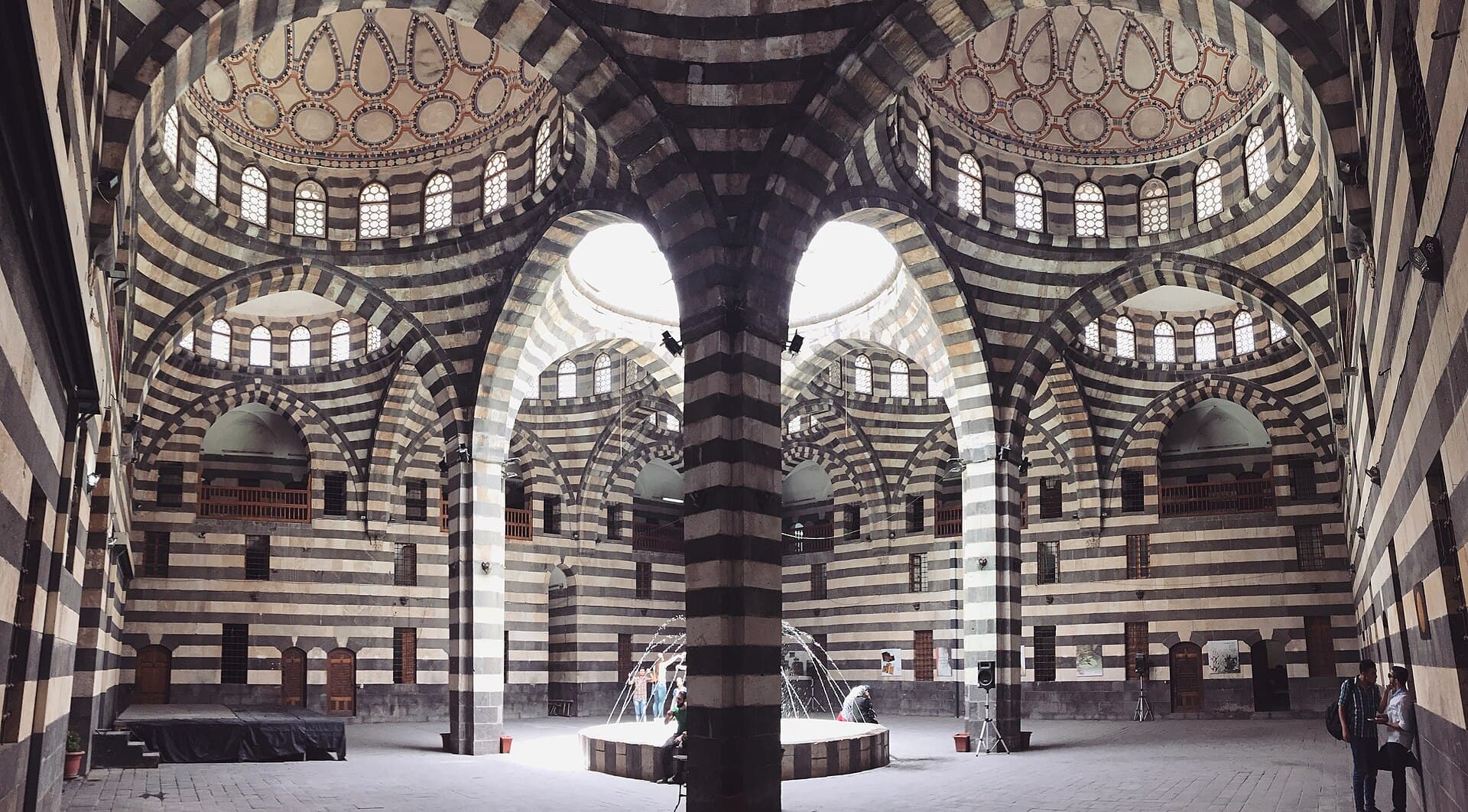
A khan is trade turned into a building. The plan is the same everywhere: a courtyard closed on four sides, storerooms and stables on the ground floor, rooms for merchants above. The caravan comes into the courtyard, the goods go down, the merchant goes up. The gate shuts at dusk and the khan becomes a small fortress for the night. The two densest concentrations in Syria are the Bzuriye and Midhat Pasha line in Damascus and the Medina souq in Aleppo.
Which ones in Damascus
Khan As’ad Pasha is the largest in the city, finished between 1751 and 1753. Nine domes cover the courtyard and they rest on only four heavy piers, which is why the floor looks so surprisingly empty. Khan Jaqmaq is older: the Mamluk emir Sayf al-Din Jaqmaq built it in 1421 and it was largely renewed in 1601. Khan al-Khayyatin, dated 1552, was the first Ottoman khan in Damascus; the name means the tailors’ khan and four hundred years later it is still in cloth and traditional dress. Khan al-Jumruk does not look like the other three: instead of a rectangular courtyard it runs as a long arm bent at a right angle, and 53 large storerooms are counted inside it.
Which ones in Aleppo
Khan al-Jumruk was built in 1574 and was the commercial centre of the souq; French, English and Dutch merchants and their consuls lived here for centuries. Inside there are 50 storerooms on the ground floor and 77 above, plus stables, a qaysariyya, two water cisterns and a small mosque. Khan al-Wazir dates from 1682 and its portal is one of the showiest pieces of Aleppo stonework: black basalt and white limestone interlock in a pattern over the arch. Khan al-Harir was built for the silk trade. Khan al-Shuna has worked since 1989 not as a khan but as a crafts market — 49 separate trades under a single stone vault.
How they worked
A khan was not only storage. Goods came in here, customs was cleared here and deals were closed here, which is why one khan in Aleppo and one in Damascus both take their name from the customs house. The khan was also the foreign merchant’s address in the city, with the consul living around the same courtyard. Some were founded as part of a charitable complex: in 1652 the governor of Aleppo, Ipshir Mustafa Pasha, endowed a khan, three qaysariyyas, weaving looms, a dye house, bakeries and a coffee house hall together in Jdeideh.
Where they stand now
There are three outcomes. Some stayed in the trade they were founded for — cloth is still woven in the courtyard of Khan al-Khayyatin. Some changed jobs and became warehouses, car parks, workshops, or a crafts market like Khan al-Shuna. And some were damaged in the war; repair in the Aleppo souq is going on section by section, and the stone gate and courtyard of Khan al-Harir are among the parts renewed. New stone and old stone do not yet match in colour, and the difference is plain.
How to find them
Looking for a sign will not help, because most khans do not have one. Look for the door instead: a stone entrance too tall and too worked for the street around it, often set back a little. In Aleppo the marker is a muqarnas hood, in Damascus alternating courses of black and white stone. Once you have found the door, go in — most khans are working premises and the courtyard needs no permission, though the inside of a shop is private.
Tips
- Do not look for a sign; look for a stone door too tall and worked for its street
- Stand in the middle of the courtyard and look up — the architecture is on the upper floor
- Khan al-Khayyatin and Khan al-Shuna are working places; mornings are busier
- New stone does not match old; that is how you read where repair has reached
- The courtyard is open to you, the shop interior is not; greet people first
Transparency
- How this was chosen
- This page carries the fastest-ageing information on the site: visa rules, exchange rates, border crossings and SIM prices change several times a year. The verification date above says when the facts were last put through their sources; for anything later, check your own foreign ministry travel advice and a Syrian consulate. No figure that is not known for certain is written here.
- Facts checked
- September 2026
- Last updated
- September 15, 2026