Madrasas in Syria: who built them, what survives
A madrasa was a school, but very often a grave stood in the same courtyard. The Zengid, Ayyubid and Mamluk eras can be read stone by stone in these buildings.
A madrasa was a law school: the jurisprudence of one legal school was taught here, students lived in rooms in the same building, and the costs were met by an endowment. In most Syrian examples there is also a tomb in a corner of the courtyard — the founder’s own. That is not incidental: the endowment kept his name standing alongside the lesson being read.
The Zengid period: converted buildings
The earliest examples are not new buildings but conversions. The Halawiyya in Aleppo was the city’s great cathedral in the 5th century; it became a mosque in 1124 and a Hanafi madrasa under Nur al-Din Zengi in 1149, and the cathedral’s Byzantine capitals still stand in the prayer hall. The Muqaddamiyya belongs to the same chain: church first, then mosque, then madrasa in 1168. The Nuriyya in Damascus, dated 1172, is Nur al-Din’s own building, and his grave is inside it.
The Ayyubid period: madrasa with a tomb
Under the Ayyubids the madrasa and the tomb become a single building. Sultan al-Malik al-Adil began the Adiliyya in Damascus in 1215 and his son al-Mu’azzam Isa finished it in 1222; the sultan is buried inside. Emir Rukn al-Din Mankurus al-Falaki built the Rukniyya between 1224 and 1227, endowed it for the Hanafi school and attached a tomb. In Aleppo the Sultaniyya, directly opposite the citadel gate, gathers a madrasa, a mosque and the tomb of al-Zahir Ghazi around one courtyard.
Who founded them
Not only sultans. Aleppo’s largest Ayyubid madrasa, the Firdaws, was founded in 1235 by Dayfa Khatun, widow of al-Zahir Ghazi and regent of the city. She endowed the income of the village of Kafr Zayta and two thirds of the income of a nearby mill; the staff is written into the deed as well, with Quran reciters, jurists and sufis. The Shadhbakhtiyya was founded by a man brought from India as a slave: Nur al-Din freed him, and by 1174 he was deputy of the Aleppo citadel. Behind the Umariyya in Damascus stands a refugee family — the Maqdisis, who reached the city in 1156 from Jamma’il near Nablus. The quarter they founded is Salihiyya.
Mamluk and Ottoman: the facade comes forward
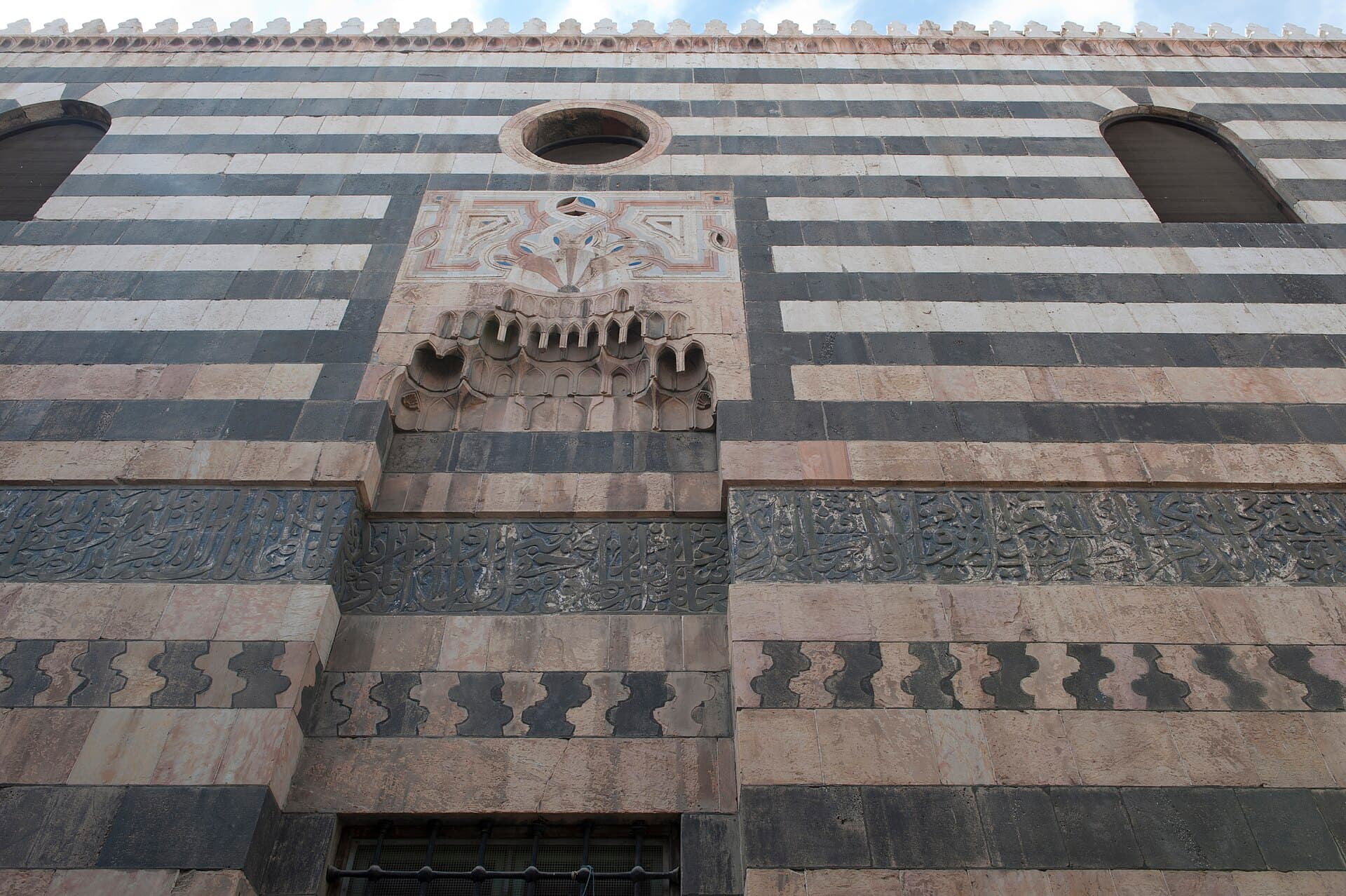
Under the Mamluks the building turns to face the street. The Sibaiyya in Damascus dates from 1515 and its facade is banded end to end in light and dark stone, with a muqarnas hood over the portal. The Jaqmaqiyya stands directly opposite the north gate of the Umayyad Mosque with a black and white front. Under the Ottomans the scale grows: the Uthmaniyya in Aleppo was built between 1730 and 1738, 42 student rooms surround its courtyard, and its minaret is cylindrical.
What they are used for now
Most are still standing but have changed jobs. The Zahiriyya in Damascus was first the tomb of Sultan Baybars, then a madrasa, then the library holding the largest manuscript collection in the city. The Jaqmaqiyya is now the Museum of Arabic Calligraphy. Some go by another name in the neighbourhood: the Shadhbakhtiyya is called the Sheikh Maruf mosque. And of some, little is left — the Umariyya is said to have had 360 rooms once, and only the ground floor stands today.
Tips
- Look for the tomb in the corner of the courtyard; the founder's name is there
- The door inscription carries the date, usually just above eye level
- Many are still in use for prayer; shoes, dress and prayer times apply
- The Halawiyya's capitals are from the cathedral; look at the west row in the prayer hall
- The Zahiriyya and the Adiliyya face each other; see them in one stop
Transparency
- How this was chosen
- This page carries the fastest-ageing information on the site: visa rules, exchange rates, border crossings and SIM prices change several times a year. The verification date above says when the facts were last put through their sources; for anything later, check your own foreign ministry travel advice and a Syrian consulate. No figure that is not known for certain is written here.
- Facts checked
- September 2026
- Last updated
- September 15, 2026