Museums of Syria: what is kept where
Ugarit’s alphabet is in Damascus, Tell Halaf’s basalt figures guard Aleppo’s door, the Dead Cities’ mosaics sit in Maarat. Where each site’s finds ended up.
In Syria, visiting an excavation is not the same as seeing what came out of it. There is no alphabet tablet at Ugarit; it is in Damascus. There are no statues at Mari; they are in Aleppo and Deir ez-Zor. There are no mosaics in the churches of the Dead Cities; they are in a caravanserai courtyard at Maarat al-Numan. This page sets out those matches. Tickets, opening hours and closing days are on a separate page; the question here is a different one — what is in which room.
Damascus · National Museum of Syria
The whole known past of the country under one roof. The clay tablet from Ugarit is here, with the earliest known alphabet written on it, and in the same section stands the oldest piece of music ever written down. The synagogue of Dura Europos was lifted with its walls and brought here. Palmyra’s funerary reliefs and the Mari and Ebla tablets are in this building too.
The entrance itself is an exhibit: the facade of the desert palace of Qasr al-Hayr al-Gharbi, dated 727, was taken down stone by stone and rebuilt as the museum door. The museum was founded in 1919, closed in 2012, reopened four sections in 2018. It reopened on 8 January 2025 after a brief closure in December 2024, and was presented in its restored form in December 2025; confirm opening hours before planning a 90-minute visit.
Aleppo · National Museum
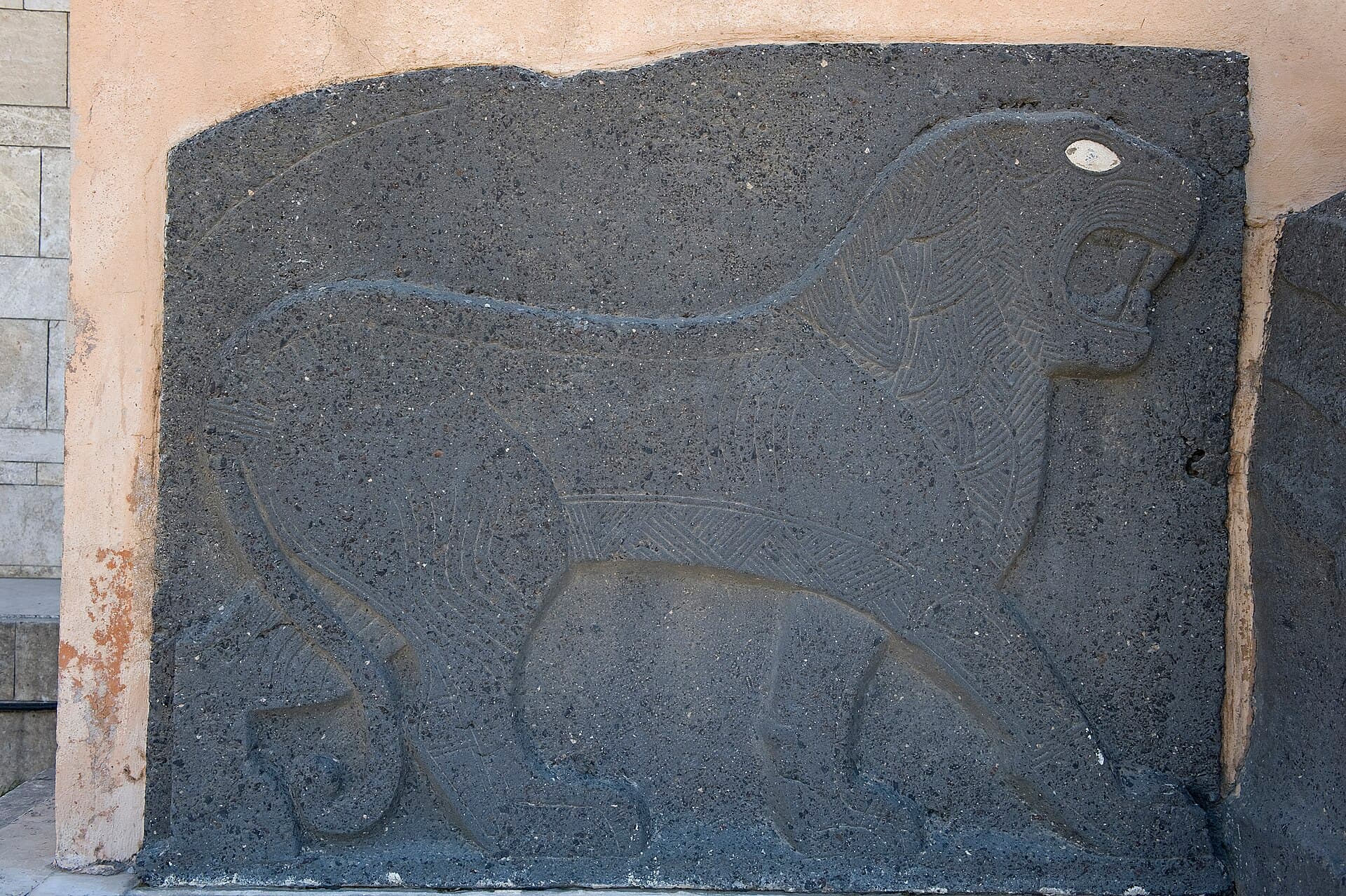
Where everything dug up in the north was gathered. Its best-known piece is not inside: the entrance is a reconstruction of the temple-palace gate of Tell Halaf. Three colossal basalt figures stand on a lion, a bull and a sphinx, and you climb the steps directly beneath them.
The ground floor belongs to the ancient Syrian civilisations: Mari, Ugarit, Ebla, Tell Halaf, Arslan Tash, Tell Ahmar. Mari’s cuneiform tablets and statues are here. The upper floor carries the classical period, the Arab-Islamic period and Aleppine painters. The museum was founded in 1931 and the present building went up in 1966; 120 minutes.
Deir ez-Zor · the museum of the Jazira
The archaeology of northeastern Syria under one roof. Most of the cuneiform tablets found at Mari are here, and so are the finds from the Upper Khabur digs at Tell Beydar, Tell Brak, Tell Leilan and Tell Mozan. Material from Dura Europos sits in these cases. The gate of Qasr al-Hayr al-Sharqi was rebuilt here as well.
What sets it apart is the full-scale reconstructions: they show an object in its setting rather than in a case. The museum opened in 1974 with 140 pieces and the collection now runs to twenty-five thousand objects; 90 minutes.
Maarat al-Numan · the mosaic museum
Roughly 1300 square metres of mosaic lie in the courtyard of the Khan Murad Pasha. The caravanserai was built in the 16th century and became a museum in 1987. The collection was gathered from the churches of the Dead Cities and from digs nearby. The best known is the Birth of Hercules panel. Another is dated 510 and shows the she-wolf with Romulus and Remus. A floor from the Church of Saint George at Hawad is dated 568. The building was badly damaged in the war and is open all the same.
Homs · Kadesh and Qatna
The Bronze Age finds of the region are here. On the ground floor stands a marble statue twice human height, found at Rastan; there are mosaics, one showing the Orontes; and an altar from a sun temple. Upstairs is third-millennium pottery from the mounds around Lake Qattinah and from Tell Shairat. Glass, Venus figurines and gold jewellery from the underground tombs of Roman Emesa are in these rooms too. 60 minutes; whether it is open varies from year to year.
Suwayda · a museum of basalt
It tells the story of a region through its stone. The main material is basalt sculpture, and the region’s stonework can be followed from the Nabataean period to the Byzantine in a single hall. Important panels from the mosaics uncovered at Shahba were moved here; the Nabataean coins are here too. The garden is an open-air museum in its own right: 3650 square metres of inscribed blocks and architectural fragments. The building opened in 1990 and was clad, again, in local basalt.
Latakia · a museum inside a khan
The building opposite the port is a 16th-century Ottoman khan, known as Khan al-Dukhan because it served the tobacco trade; it opened as a museum in 1986. Inside are finds from Ugarit and Ebla, and the garden holds sarcophagi and statues. The halls were closed in 2011 to protect the collection against trafficking and stayed closed for a long time, while the garden remained open. Ask in town before you go.
Tartus · from cathedral to museum
Tartus Cathedral was restored and turned into the Tartus Museum, so visiting the church and visiting the museum are the same visit. Inside, the excavations of the Syrian coast are displayed: finds from Ugarit, Amrit, Tell Sukas and Tell Kazel, Roman mosaics, a Baal figure carved from basalt, and Roman sarcophagi with relief.
Raqqa · an honest gap
The museum opened in 1981 in an Ottoman government house dated 1861. At its fullest it held some seven thousand objects: finds from Tell Sabi Abyad, Tell Bia, Tell Chuera and Tell Munbaqa, and Islamic material from the age of Harun al-Rashid. During the war most of the collection was stolen or destroyed, and what remains today cannot be verified. That is all this page can say; ask before you go.
Five places that hold collections without calling themselves museums
- Jaqmaqiyya Madrasa, Damascus. The Mamluk madrasa opposite the north gate of the Umayyad Mosque is now the Museum of Arabic Calligraphy.
- Nur al-Din Bimaristan, Damascus. The Museum of Arab Science and Medicine works inside the medieval hospital founded in 1154.
- Azm Palace, Damascus. A folk arts collection fills the rooms of the 1749 mansion.
- Damascus History Museum. The city’s documents and manuscripts, in an 18th-century house in Souq Saruja.
- Qalaat al-Mudiq. Apamea’s museum sits in the khan inside the castle; the site’s mosaics came from there.
Site and find: the matches
- Ugarit. The alphabet tablet in Damascus; other finds in Aleppo, Latakia and Tartus.
- Ebla. Tablets in Aleppo and Idlib; part of the material in Latakia too.
- Mari. Most of the tablets in Deir ez-Zor; tablets and statues in Aleppo and Damascus.
- Dura Europos. The synagogue in Damascus; fragments in Deir ez-Zor.
- Tell Halaf. The temple-palace gate in Aleppo; part of the sculpture was shattered in a fire in Berlin and rebuilt from the fragments.
- The Upper Khabur mounds. Most finds from Tell Brak, Tell Beydar, Tell Leilan and Tell Mozan in Deir ez-Zor; some in Berlin and London.
- Qatna and Kadesh. The Homs museum.
- Qasr al-Hayr al-Gharbi. Its facade is the entrance of the Damascus museum.
- Qasr al-Hayr al-Sharqi. Its gate in Deir ez-Zor, decorated fragments in Damascus.
- Shahba. The mosaics in Suwayda.
- The Dead Cities. The church mosaics at Maarat al-Numan.
- Amrit, Tell Sukas, Tell Kazel. In Tartus.
Museum first, or site first
Either can be right, and the material decides. At mudbrick sites — Mari, Tell Brak, Tell Leilan, Ebla — what you see on the ground is a wall section and a trench; if you have already seen the objects in a museum, the section starts to read. That is exactly why the Deir ez-Zor museum comes before the Euphrates and Khabur sites.
At stone sites the order reverses. Palmyra, Apamea, Bosra and the Dead Cities give you standing architecture already; going to the museum afterwards fills in the missing pieces — mosaic, relief, inscription. Reverse it and the mosaic in the case stays a picture of a floor with nothing attached to it.
Tickets and hours
This page gives no prices or opening times, because both are learned at the gate and a wrong figure is worse than none. The four questions to ask at the door, the closing days and the photography rules are on the museums and admission page.
Tips
- Ugarit's alphabet tablet is not on site — it is in the Damascus museum
- The Aleppo museum's key piece is its door: the basalt figures of Tell Halaf
- See the Deir ez-Zor museum before the mudbrick mounds; the trenches read only after
- The Dead Cities' church mosaics are in the khan at Maarat al-Numan
- What the Raqqa museum holds today cannot be verified; ask before going
Transparency
- How this was chosen
- This page carries the fastest-ageing information on the site: visa rules, exchange rates, border crossings and SIM prices change several times a year. The verification date above says when the facts were last put through their sources; for anything later, check your own foreign ministry travel advice and a Syrian consulate. No figure that is not known for certain is written here.
- Facts checked
- September 2026
- Last updated
- September 15, 2026