Reading Syrian architecture: a glossary
Sahn, iwan, ablaq, muqarnas, qaysariyya, qa’a. The words for naming what you are looking at, each one with a single example that has a record on this site.
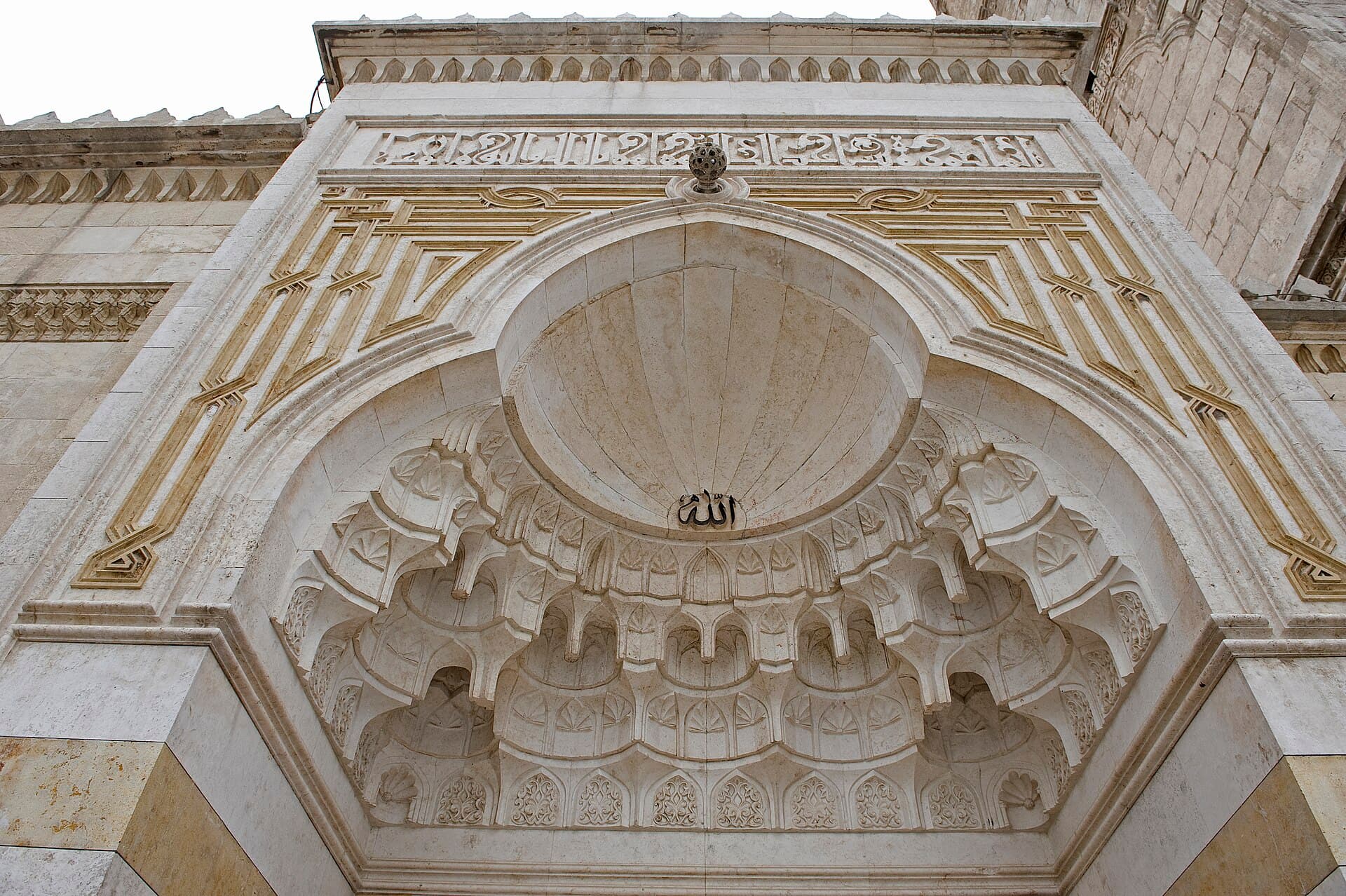
The difference between standing in front of a building and saying “beautiful” and saying “a portal with a muqarnas hood” is a difference of vocabulary. This page supplies the vocabulary. Working out which century a building belongs to is a separate job, covered by the periods page in this section; here there are only the names of the parts, each with an example that has a record on this site.
The courtyard: sahn, riwaq, iwan
Sahn means courtyard, and in a mosque plan the courtyard is the centre, not the prayer hall. A riwaq is the arcaded gallery running around it: shade, passage and boundary at once. The Umayyad Mosque has both at their largest — a courtyard finished in 715, a marble floor, gold mosaic on the west wall.
An iwan is a space closed on three sides and completely open on the fourth, usually vaulted. The form comes from pre-Islamic Iran. In Syria you meet it in two different settings. The courtyard of the Nur al-Din Bimaristan has four iwans and each one is a department of the hospital; in the courtyard of the Azm Palace, the open south-facing hall is an iwan too. Same word, two jobs.
The wall: ablaq and spolia
Ablaq is the laying of light and dark stone in alternating courses. In Syria the dark one is basalt and the light one limestone. The purpose is decorative, and the origin goes back to the alternating stone and brick of Byzantine walls in the region. The 1491 facade of Hammam Yalbugha in Aleppo, and the Sibaiyya Madrasa and Darwish Pasha Mosque in Damascus, are the textbook cases.
Spolia means a piece taken from an older building and set into a new one: a column, a capital, a lintel. The vine-carved lintel over the main door of the Great Mosque of Hama comes from a pre-Islamic building; the columns inside the Halawiyya Madrasa are left from a fifth century cathedral. Reuse was not something to hide, it was ordinary building practice.
The ceiling: muqarnas, vault, dome
Muqarnas is a three-dimensional transition built from tiers of small niches set over one another. In English it is often called honeycomb or stalactite work. Its job is to solve a corner: it puts a soft intermediate surface between a square room and the round cover above it. It is thought to have developed in Iraq in the 11th century. The 1154 portal of the Nur al-Din Bimaristan is the most famous example in Damascus.
A vault covers a length — it is what roofs the souq lanes, and in Aleppo the Souq al-Madina is stone vaulting from end to end. A dome covers a single room. At Khan Asad Pasha the courtyard is roofed with nine domes and they rest on only four heavy piers, which is why the floor stands so remarkably empty.
The qibla wall: mihrab and minbar
A mihrab is the niche in the qibla wall; it indicates a direction and is not a sacred object. A minbar is the stepped pulpit for the sermon and it stands to the right of the mihrab. The pair also gives away when a building was turned into a mosque: in converted churches the mihrab is cut later and its relation to the wall usually shows. At the Halawiyya Madrasa you see this at a glance.
A minaret says one of three things
In Syria the cross-section of a minaret shaft carries a date. A square, thick, stone shaft is the Syrian type and belongs to the early Islamic centuries. An octagonal shaft that tapers upward, with a muqarnas balcony, is Mamluk. A pencil-thin polygonal shaft with a pointed cap is Ottoman, imported from Istanbul.
The Great Mosque of Hama shows all of this in one courtyard: the square minaret is dated 1124, the octagonal one 1427. The twin minarets of the Tekkiye Suleymaniye have no counterpart anywhere in Damascus; they were built between 1554 and 1560 to a plan by Mimar Sinan and look nothing like the city’s own minaret tradition.
Script: Kufic and Thuluth
Kufic is angular and horizontal; the letters are built from right angles and read more like weaving than writing. It takes its name from Kufa in Iraq and was used heavily on stone in the early period. Thuluth is cursive and oblique, with curved letters, and turns up in portal bands and around the base of domes. Roughly: angular is early, cursive is late.
Trade and the house
A khan is a courtyard trading building sunk into the souq: storage and stabling below, rooms above. The same institution is called funduq or wikala elsewhere in the Arab world, and caravanserai when it stands on a road. A qaysariyya is a small section inside the souq that can be locked separately, for valuable goods.
In a house the key word is qa’a, the reception hall. There is a sunken central area called the durqa’a, usually with a fountain in the middle, and raised seating platforms on either side called the tazar. A guest enters the durqa’a, leaves his shoes there and steps up onto the platform to sit. Beit Ghazaleh and Beit Nizam both have this plan. The painted and relief woodwork on walls and ceilings is called ajami; part of the panelling at Beit Ghazaleh was stripped out during the war and is missing.
Using the glossary in the street
You do not have to memorise the whole list. Six questions do the work.
- Courtyard or prayer hall: sahn and riwaq are outside, the haram is inside.
- Is the wall banded: if it is, that is ablaq.
- Is the door hood stalactited: a muqarnas hood, the signature of a portal.
- What is the minaret’s section: square, octagonal or pencil.
- Is the script angular or cursive: Kufic or Thuluth.
- Is the hall floor on two levels: durqa’a and tazar, so a qa’a.
None of this tells you which century a building comes from. What it does tell you is smaller and more useful: the name of the thing in front of you.
Tips
- Sahn is the courtyard, riwaq the arcade around it, iwan an open-fronted hall
- Banded light and dark stone is ablaq; basalt and limestone are Syria's two stones
- The stalactite texture in a door hood is muqarnas — the mark of a portal
- Minaret sections date a building: square, octagonal, pencil
- A two-level reception hall is a qa'a; the sunken part durqa'a, the platform tazar
Transparency
- How this was chosen
- This page carries the fastest-ageing information on the site: visa rules, exchange rates, border crossings and SIM prices change several times a year. The verification date above says when the facts were last put through their sources; for anything later, check your own foreign ministry travel advice and a Syrian consulate. No figure that is not known for certain is written here.
- Facts checked
- August 2026
- Last updated
- September 15, 2026