Table manners in Syria
Bread does the work of a fork, an empty plate gets refilled, and the bill starts a short fight. How to refuse an offer politely and when to get up from the table.
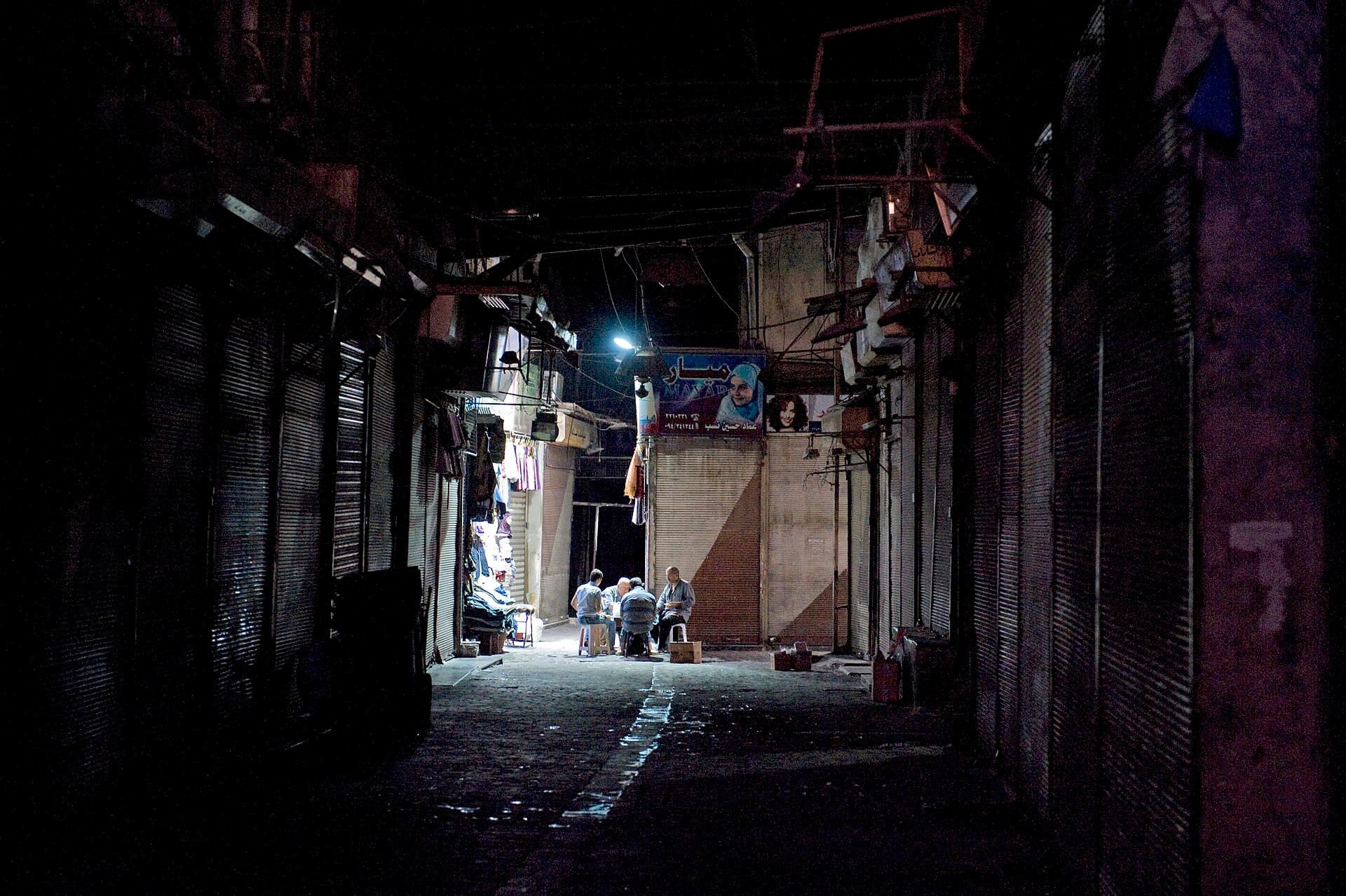
Eating in Syria is about the table rather than the plate. The dishes sit in the middle, bread does the work of a fork, your host treats filling your plate as his own job, and when the bill arrives there is a short fight over it. All of this has rules, and without them a visitor trying to be polite ends up being rude.
Asking prices, bargaining and tipping have their own page, and so do dress and general manners. This one is only about the table.
A table, not a plate
There is no single plate per person. Food comes to the middle and everyone takes from it. Ordering follows the same logic: it goes by how full the table is, not by how many people are sitting at it, and eight or ten dishes for four people is normal.
What this means for you is that ordering something separate for yourself breaks the table. If you are taking from the same dish as the person next to you, you are already inside the invitation. Even eating alone you will get several small dishes, and finishing them all is not expected.
Bread
Bread is at the centre of the table and it is used as a tool. The round flatbread is torn, a piece is folded over, and it works as a spoon: hummus, mutabbal, kishk and ful are all lifted with bread. For most dishes a fork is beside the point.
Bread carries its own respect. A piece dropped on the floor is picked up, touched to the lips and set aside rather than thrown away, and what is left over at the end is not binned either. If you see this, do not find it odd. The price of bread and the queue for it are recent memory in this country.
Mezze first, and the order looks after itself
The meal opens with small cold dishes: hummus, mutabbal, tabbouleh, fattoush, makdous, pickles, olives, labneh. Hot mezze follow, then the grill or the pot dish. Dessert is usually eaten afterwards at a sweet shop rather than at the table.
The pace is slow. The mezze course can run to an hour, and hurrying reads as a signal. Asking for the main course early is the polite way of saying you would rather not be sitting here. Plan for two hours in one place.
Eating by hand, and which hand
Many dishes are eaten by hand, and that is a method rather than a lapse. Makdous is not cut with a knife, because cutting spills the filling; it is bitten whole. Kishk is taken by dipping bread, not with a spoon. Kibbeh nayyeh is lifted on bread.
The hand used is the right one. The left does not go to food or to a shared dish; the distinction is settled here, and even if you are left-handed the expected thing is to reach into a common plate with your right. Tearing bread takes two hands. Taking is done with the right.
Insistence, and how to say no
Your host, or whichever Syrian is at the table, will fill your plate. He will fill it whether or not you asked, and once more after you say enough. This is not pressure, it is the hospitality itself, and refusing has a form of its own.
What works is to cover the plate lightly with your hand and thank him. Leaving a little food on the plate helps too, rather than saying no with your mouth full; a completely empty plate reads as still hungry, and it gets refilled. Two rounds of insistence are normal, and most hosts step back at the third.
There are words for it as well. Sahtein is said when a meal starts or when you come across someone eating, and daimeh is said to the host afterwards. Both are short and both are noticed.
The guest’s portion
The good piece belongs to the guest. The best of the meat, the leg of the chicken, the middle of the tray get pushed towards you, and refusing that is not taken well. Take it and say thank you.
The same logic runs in a house: the family may not fill their own plates until you are full. If you notice it, do not speed up. They are eating with you and you set the pace. Finishing early and waiting closes the table early.
The bill
When the bill comes there is a short struggle over it, and the struggle is serious. Whoever invited you pays; a guest paying reads as a slight to the host.
Insisting once or twice is courtesy, giving way at the third time is correct. Return it somewhere else: buy the next coffee, bring sweets for the children, come back with a small gift. Letting the Syrian side pay and then doing nothing at all is worse than winning the argument.
Tea, and when to get up
Tea or coffee arrives after the meal and belongs to the table rather than being a separate event. Say how you take your sugar when you order; it is not adjusted afterwards.
The moment to leave does not come when the tea is finished, but after the second or third glass. Getting up after the first reads as haste. If you really do have to go, give the reason: the bus, an appointment, the road. Leaving without one means walking out of the middle of a meal, and with one nobody keeps you.
Tips
- Do not clear your plate; an empty plate reads as still hungry and gets refilled
- Reach into a shared dish with your right hand, even if you are left-handed
- Insist twice over the bill, then give way — return it with the next coffee
- Bread is not thrown on the floor, and leftovers are not binned
- Do not get up after the first tea; if you must go, give the reason
Transparency
- How this was chosen
- This page carries the fastest-ageing information on the site: visa rules, exchange rates, border crossings and SIM prices change several times a year. The verification date above says when the facts were last put through their sources; for anything later, check your own foreign ministry travel advice and a Syrian consulate. No figure that is not known for certain is written here.
- Facts checked
- September 2026
- Last updated
- September 15, 2026