Water in Syria: channels, wheels and cisterns
Hama’s wooden wheels, Palmyra’s underground channel, the Barada branches of Damascus and the cisterns of the Dead Cities. How water is found, moved and stored.
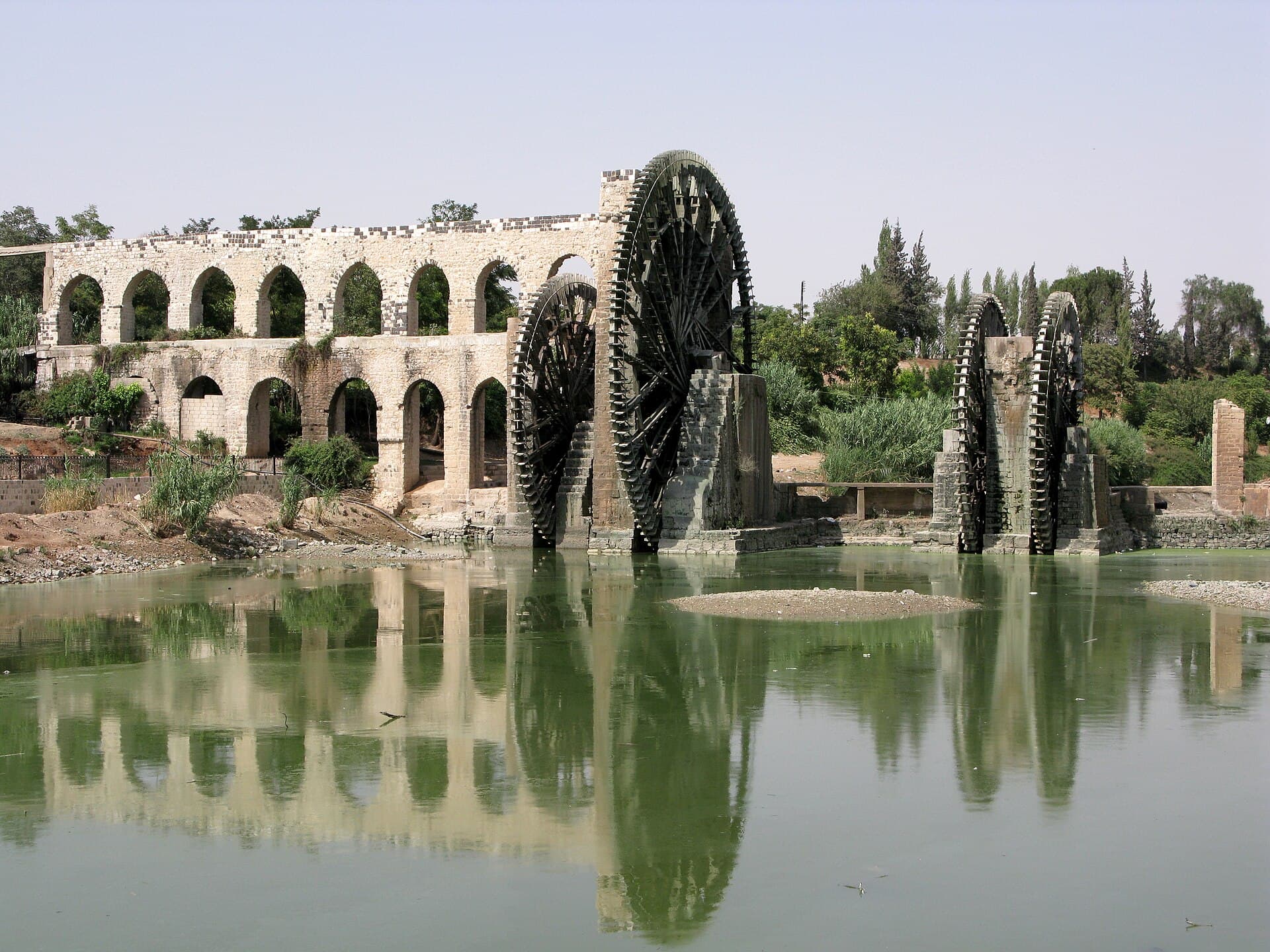
In Syria water is a question of timing as much as of quantity. The rain falls in winter and the irrigating is needed in summer. The difference between one end of the country and the other is as sharp as the mountains between them: Damascus gets 130 millimetres a year, Aleppo 330, the coast 760. A surprising share of the buildings you visit were put up to close that gap. This page reads them together.
Spring and underground channel
The Efqa spring is the answer to why Palmyra stands in the middle of a desert. Warm sulphurous water comes out of the limestone of Jabal al-Muntar, nine hand-dug wells gather it into an underground channel 400 metres long, and the channel distributes it across 420 hectares of date and olive gardens. The water emerges at about 33 degrees. A stair cut into the rock goes down and opens onto the mouth of the channel. Inside are rock niches with incense altars: maintaining the spring was an act of worship, and the “head of the spring” was chosen each year in the name of the god Yarhibol. The spring dried up in 1994 — drought, over-extraction and neglect together — and was reported flowing again after repair work. The flow varies from year to year.
Ain al-Fijeh is where the water in the Damascus tap comes from: the spring bursts out at the foot of Jabal Qalaa in Wadi Barada and supplies most of the capital’s drinking water on its own. Its name comes from the Greek word for spring. There was a Roman temple at the spring head and its statues are now in the Damascus museum; the remains of an old water tunnel also survive in the valley. The plant was hit in 2016 and the city’s mains water was cut for weeks; it was repaired and supply resumed. This is above all a working water plant, not a place to visit.
Rock-cut road and aqueduct
At the narrowest point of the valley, at Suq Wadi Barada — ancient Abila — Roman engineering is on open display. About 30 metres above the river a road 180 metres long was cut into the cliff. Latin plaques were carved into the wall above it: one gives the name of the place, the longer one records that the emperors Marcus Aurelius and Lucius Verus had the road repaired. An aqueduct runs beneath the road, part of it tunnelled through the rock, part covered with stone slabs. This is not a managed archaeological site; climbing is dangerous and looking from below is enough.
Qasr al-Hayr al-Sharqi is the desert version of the same logic. The Umayyad estate was fed from the water of a distant Byzantine structure through a channel about 5700 metres long. What made a palace in open steppe possible was not the walls but that channel.
The noria: the river’s own power
The norias of Hama are the most visible piece of water engineering in the country. The buckets of the great wooden wheels, set on a horizontal axle, dip into the river, fill as they turn and empty at the top into a stone aqueduct. The power source is the current itself; there is no motor, only the river. The largest surviving wheels are over twenty metres across.
The wheels have been maintained since the Mamluk period and their timber is renewed at intervals — so the wheel you are looking at is old and its wood is new. The sound is part of it: the axle turns on wet timber and gives out a constant low creak. When the water drops some wheels stop, and that usually happens at the end of summer.
Cisterns: holding the water back
On the limestone plateau in the north there is water only in winter, which is why every village in the Dead Cities has a cistern. The one at Barisha is the most legible: cut into the ground and covered by a vault that rises above it, with the top of the vault three metres above the surrounding land. Inside, a single-piece stone stair set against the wall goes eight metres down. That a village at Serjilla had a bath says the same thing: the water could be gathered.
The order is the same in a castle. The ground between the two ends of Saladin Castle is full of cisterns and stores; the cisterns of Qalaat Burzey still stand. What decides a siege is more often the volume of the cistern than the thickness of the wall.
Dam and lake
Lake Qattinah lies west of Homs, and the bank holding it is ancient; it has fed farming here for thousands of years. Because the lake sits at the mouth of the gap, sea air comes through and the water stays cool even at midsummer. It is on the road to Krak des Chevaliers, half an hour from the city.
On the Euphrates the scale is different. The Tabqa dam sits at the centre of the irrigation and power system, and Lake Assad behind it feeds the farmland running from Raqqa to Hasakah. The place that shows in one frame what the dam did to the past is Qalaat Jabar: when the lake filled, the hill the castle sits on became an island.
A network of channels: the Ghouta
Damascus was built at the edge of an oasis, and the oasis is called the Ghouta. After the Barada flows east of Mount Qasioun it splits into seven branches; the channels carry the water east and south of the city and a green belt appears inside dry steppe. Most of the apricots, walnuts, mulberries and olives in the Damascus markets come from here.
The area shrank for two reasons. The first is urban growth: from the eighties housing and industry spread over farmland, and the irrigated area, once reaching 370 square kilometres, retreated. The second is the war. The gardens of the western and southern Ghouta are working today.
Water inside the city
A working bath means a working water system, and Syria still has both. In Damascus the Hammam Malik al-Zahir was built in 985, and the Nur al-Din bath dates from the twelfth century and is a place where people genuinely wash, inside Bzuriyya souq. In Aleppo the Hammam al-Nahhasin is twelfth-century as well; it was repaired and reopened in 2022, and Hammam Yalbugha was built in 1491.
The courtyard pool is not decoration either. The iwan courtyard of the Bimaristan Arghuni in Aleppo has a fountain pool at its centre, and the building treated patients with light, running water and music. The stone basin in the middle of a Damascus house does the same work: evaporation cools the courtyard.
Where to see what
- Water wheels. Hama, in the centre, on the riverside walk.
- Underground channel and spring. Efqa, on the western edge of modern Palmyra.
- Roman aqueduct and rock-cut road. Suq Wadi Barada, northwest of Damascus.
- Cisterns. Barisha and the other Dead Cities; Saladin Castle and Qalaat Burzey.
- Ancient bank and lake. Qattinah, west of Homs.
- A channel-fed oasis. The Ghouta, along any road running east or south out of Damascus.
- A palace at the end of a long channel. Qasr al-Hayr al-Sharqi, northeast of Palmyra.
Where this stands today
Most of the works on this page are a current matter rather than history. Efqa dried up through over-extraction and its flow still varies year to year; Ain al-Fijeh is not a stop on a tour but the city’s water plant; the irrigated Ghouta has retreated. Ask before photographing at a spring or a plant, and ask permission before stepping into a field — water here is a livelihood, not a view.
Tips
- In Hama go down beneath the wheels; the moment the buckets empty reads best from below
- When the water drops at the end of summer some wheels stop turning
- Suq Wadi Barada is not a managed site; do not climb the rock, look from below
- Ain al-Fijeh is a working water plant; ask about the road and access before going
- At Palmyra, visit Efqa and the oasis before entering the ruin field
Transparency
- How this was chosen
- This page carries the fastest-ageing information on the site: visa rules, exchange rates, border crossings and SIM prices change several times a year. The verification date above says when the facts were last put through their sources; for anything later, check your own foreign ministry travel advice and a Syrian consulate. No figure that is not known for certain is written here.
- Facts checked
- September 2026
- Last updated
- September 15, 2026