Al-Jami al-Jadid and the Tomb of Ismat al-Din Khatun, Salihiyya
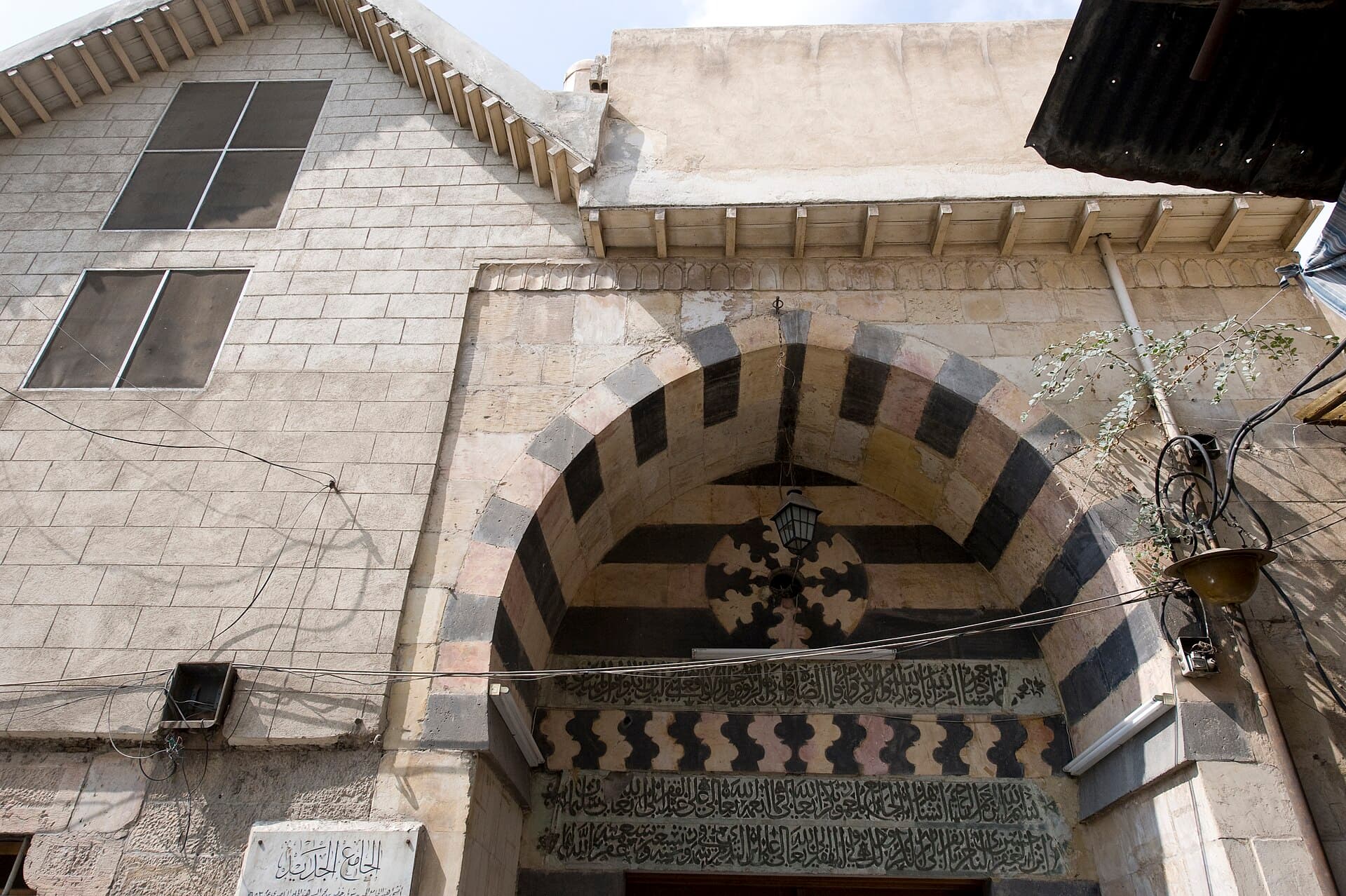
A small mosque in Salihiyya, Damascus, built as one complex with the tomb of Ismat al-Din Khatun, wife of Nur al-Din and then Saladin. Striped stone portal.
- Opening hours
- Variable — current visiting arrangements not verified, ask on site
- Entry
- Variable — confirm at the door; the portal is visible from the street
- Duration
- 20 minutes
- Best time
- Early morning, before the market stalls block the front of the door
- Period
- Ayyubid
- Address
- Street of madrasas (Souq al-Juma), beside the Jaharkasiyya Madrasa, Salihiyya, Damascus
A small mosque in the southern part of the street of madrasas in Salihiyya, the quarter on the slopes above Damascus. The street is known today as Souq al-Juma. The mosque’s name means “the New Mosque”, yet it carries one of the oldest stories on the street. Commons captions based on Ross Burns’s guide to the monuments of Syria say it was part of a complex with the Turba Khatuniyya, the tomb of Ismat al-Din Khatun: the woman who married Nur al-Din Zengi and then Saladin.
Who lies in the tomb
Ismat al-Din Khatun was the daughter of Mu’in al-Din Unur, who governed Damascus for the Burid dynasty. In 1147 she married Nur al-Din as part of an alliance her father struck with him. After Nur al-Din’s death Saladin took Damascus and married her in 1176, a match that helped his claim to the city. She died in Damascus in January 1186. Saladin was recovering from a long illness at the time and wrote to her every day. News of her death was kept from him for three months. English Wikipedia records that she funded a madrasa in Damascus and a tomb for her father, and that she was buried in the Jami al-Jadid.
Why the dates do not match
English Wikipedia’s list of mosques in Damascus dates the mosque to 1255 and calls it Ayyubid — the dynasty Saladin founded. The woman in the tomb died in 1186, nearly seventy years earlier. The tomb may have come first, with “new” describing a prayer hall added later, or 1255 may be the date of a rebuilding. We found no source that settles it, so both dates stand here.
Getting there
The street of madrasas runs along the foot of Mount Qasioun, from the end of the Muhajirin quarter towards Rukn al-Din. The Jami al-Jadid is in its southern part, right beside the Jaharkasiyya Madrasa; twenty paces separate the two doors. By day the street fills with vegetable and food stalls, by evening with clothes. A stone plaque with the mosque’s name hangs on the wall left of the door.
What to see
The portal is the reason to stop. Its arch is built of alternating dark and pale stones, a technique called ablaq in Damascus. In the tympanum inside the arch sits a large knot-shaped medallion of black and white stone. Below it run two bands of inscription, and between them a strip of interlocking, wave-cut black and white stones. The storey above the door and the side wall were later rebuilt in plain dressed stone, and old and new are easy to tell apart on the same wall. One street photo on Commons shows the mosque’s minaret rising above the stall awnings.
What state it is in today
The most recent dated record we have is a set of photographs from 2008. We found no newer source showing whether the mosque opens outside prayer times or whether the tomb chamber can be entered. Ask locals or the mosque’s caretaker on the spot. The portal can be seen from the street either way.
Don’t miss
Directly opposite the mosque is a neglected grave behind a wall carrying an inscription. It belongs to Emir Sabiq al-Din Mithqal, a jamdar — a household officer — of Saladin, who died in 1224. The grave once had a dome, which has collapsed. Saladin’s wife and one of his officers lie facing each other across the same narrow street. Turn round as you leave the door.
Tips
- Look at the portal from the opposite pavement; from the foot of the door the knot medallion does not fit in the frame
- The domes of the Jaharkasiyya Madrasa are twenty paces away, so both stops fit one walk
- The grave of Emir Mithqal opposite is ruined and walled; its inscription can be read from the street
Transparency
- How this was chosen
- Written by hand; opening hours, entry fee and coordinates are kept as data. A field that is not known for certain is marked as variable rather than guessed.
- Facts checked
- September 2026
- Last updated
- September 15, 2026