Al-Safa Volcanic Field: Syria’s Youngest Lava Field
A young 220 km² lava field east of Shahba: at least 38 cinder cones, Safaitic inscriptions cut into basalt, and the place that named the script. No road, no village.
- Opening hours
- Open ground; current access not confirmed
- Entry
- No known ticket office
- Best time
- Spring or autumn; in summer the lava field heats up and there is no shade
- Period
- Holocene; Safaitic inscriptions (1st millennium BC – 4th century AD)
- Address
- East of Shahba, north-east of the Jabal al-Arab plateau
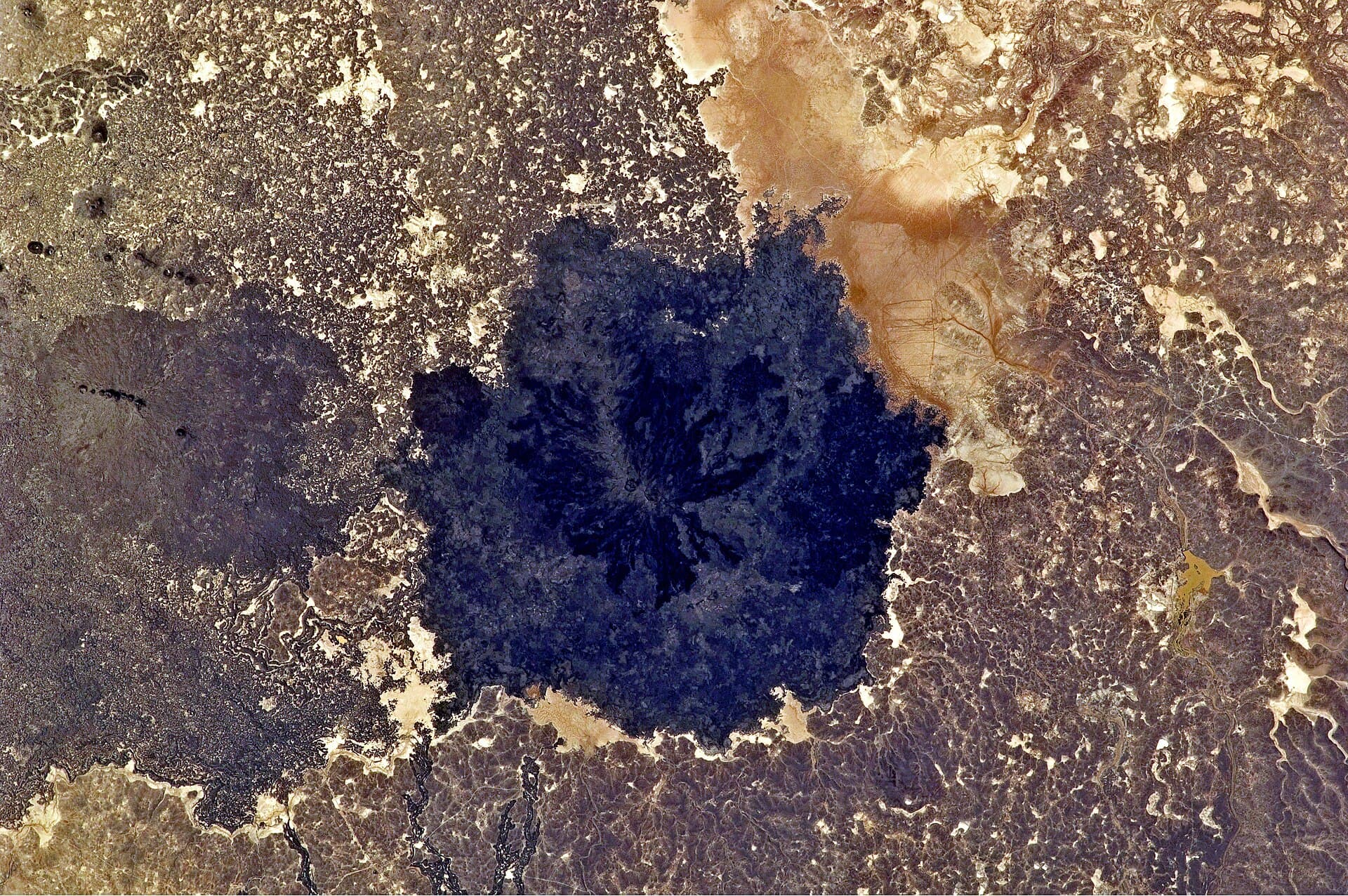
A lava field north-east of the Jabal al-Arab basalt plateau, about 95 kilometres south-east of Damascus and east of Shahba. It covers some 220 km² and holds at least 38 cinder cones. From space it shows as a dark stain in the middle of pale desert. It is also the place that gave the Safaitic script its name: in 1857 writing in an unknown alphabet was found on these rocks. There is no road, village or water, and today only Bedouin and archaeologists go there.
Where is it?
The Badia lies to the north, the Hamad desert to the south and the Ard al-Kira lava flow to the south-west. On its edge are the Bronze Age settlement of Khirbet al-Umbashi, its neighbour Khirbet al-Hibariya, and Jabal Says, known for its Umayyad palace. Tulul al-Safa is the northern part of Harrat al-Sham, a lava field of more than 50 thousand km² that reaches into Saudi Arabia. Because the area is so large, this page has no single map pin.
How young is it?
Some of its vents have been active during the Holocene, the last 12 thousand years or so. According to Arabic Wikipedia a boiling lava lake was seen here in 1850, the last recorded activity. A study presented in 2002 at the International Conference on the Geology of the Arab World identified 13 lava flows in southern Syria and named al-Safa as the youngest. Some of the cones and their heights: Tell al-Aqaas 889 metres, Tell al-Safa 739 metres, Jabal Says 692 metres.
The Safaitic inscriptions
In 1857 inscriptions in an unknown alphabet were found in the field, and the script came to be called Safaitic after the region. They date from the 1st millennium BC to the 4th century AD, are cut into basalt rocks and often sit next to drawings of camels. Arabic Wikipedia puts the number known from this area at over 2000; the figure may be low. According to the newspaper Al-Watan on 11 August 2022, the Suwayda Antiquities Directorate took delivery of basalt stones carrying Safaitic inscriptions. A red sandstone fragment from the region with Safaitic writing and a camel figure is now in the British Museum, a gift from Gertrude Bell.
What not to miss
The rock surfaces. At Tulul al-Safa the inscriptions are not in a museum case but on the lava stone itself. Camel drawings are the easiest marker to spot; where there is a drawing, the same rock often carries a name or a short line too.
Who has used it?
The area is very dry and has served as a refuge rather than a place to settle; the Druze withdrew here in years of war. In the Syrian civil war it was the last pocket held by ISIS in the region, and government forces retook it on 17 November 2018. Arabic Wikipedia mentions plans to turn the field into a geopark as an extension of the Lajat protected area.
Current situation and access
There is no road to the field and no village or services nearby. The area was a combat zone in 2018, and no source published in the last 12 months could be found on the risk of unexploded ordnance. On 23 August 2026 the newspaper Al-Watan reported that the Damascus–Suwayda road had been cut at the Umm al-Zaytoun checkpoint. On 2 and 10 September 2026 Snack Syrian wrote that entry to and exit from Suwayda governorate were effectively restricted. This page describes what Tulul al-Safa is; it does not say it can be visited today. Anyone thinking of going should first check the current situation with official sources.
Tips
- Before setting out, check with official sources whether the Damascus–Suwayda road and the governorate entry are open
- There is no road or water; do not enter without a local guide and without asking about unexploded ordnance
- Do not move inscribed stones; every stone carried off without record loses its context
Transparency
- How this was chosen
- Written by hand; opening hours, entry fee and coordinates are kept as data. A field that is not known for certain is marked as variable rather than guessed.
- Facts checked
- September 2026
- Last updated
- September 15, 2026