Urman, Suwayda: the Village Where the 1925 Revolt Began
A village 5 kilometres east of Salkhad whose inscriptions show pagan worship lasting to 517, and where the first shots of the 1925 Great Syrian Revolt were fired.
- Opening hours
- Inhabited village; current access not confirmed
- Entry
- None (village)
- Duration
- 60 minutes
- Best time
- April–June or September–October; basalt heats up in summer and winter nights freeze
- Period
- Roman — Byzantine; Ottoman
- Address
- About 5 kilometres east of Salkhad, Suwayda governorate
A village about 5 kilometres east of Salkhad and 35 kilometres south-east of Suwayda. Unlike the villages around it, Urman did not turn Christian in the 4th century: no late antique Christian symbol or building has been found, and its inscriptions show pagan worship lasting until at least 517. The village is also known as the place where the first shots of the Great Syrian Revolt were fired in the summer of 1925. The 2004 census counted 5735 people; most are Druze, with a Christian minority.
Where is it?
In the south of the Hauran, the basalt region south of Damascus, just east of Salkhad; about 5 kilometres separate the two. Because two independent sources do not confirm the village’s coordinates, this page has no map.
What is in the village?
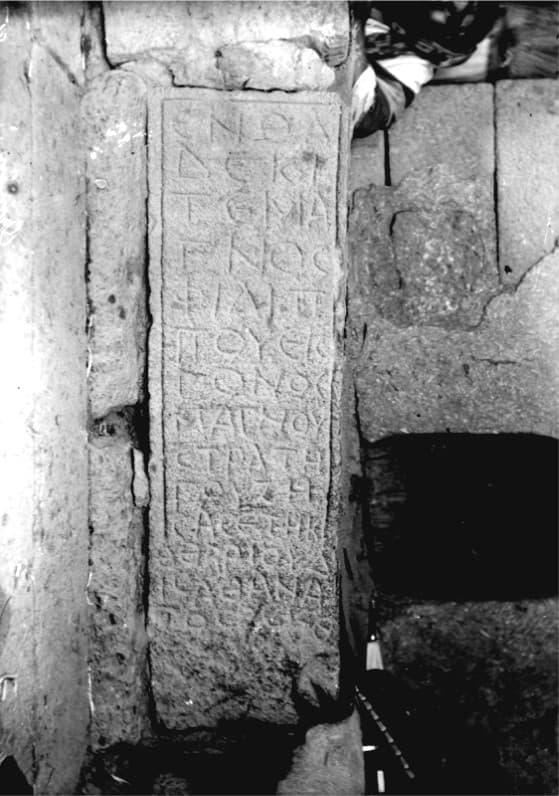
Arabic sources list Roman-era palaces, temples, cisterns, water channels and basalt houses carrying inscriptions. There are Byzantine remains and finds too. The German photographer Hermann Burchardt photographed a Byzantine-era Greek inscription in the village in 1895; that is the picture at the top of this page. Today the village also has the Greek Orthodox Church of Saint George. Whether the pagan inscriptions are still in place could not be confirmed.
The village’s past
In the Ottoman tax register of 1596, Urman appears in the subdistrict of Bani Malik as-Sadir: 17 households, 7 bachelors, a water mill and taxes of 16500 akçe. The Swiss traveller Johann Ludwig Burckhardt in 1810 and the American missionary Eli Smith in 1838 both found it abandoned. In the 1870s Druze arriving from Mount Lebanon made it a large village again. In the 1880s migrants from the village of Jarmaq in Galilee founded the al-Jarmakani family. During the Ammiyya uprising of 1889–1890, Urman was one of four villages in the southern Jabal that rose against the al-Atrash sheikhs. In June 1896 a clash between villagers and Bedouin grew into a revolt, which ended early in 1897.
The first shots of 1925
In the summer of 1925, 250 horsemen under Sultan al-Atrash fired on two French reconnaissance planes at Urman and brought one down. These are counted as the first shots of the Great Syrian Revolt. The next day Salkhad was taken. The revolt’s next major battles were fought at al-Kafr and al-Mazraa.
What not to miss
The stones of the houses. The inscribed basalt blocks that Arabic sources mention are to be looked for in the walls of village houses; the inscription Burchardt photographed in 1895 was also carved into a stone door jamb. The late pagan past that sets Urman apart from its Hauran neighbours sits in these Greek lines on the stone.
Recent times and the current situation
Between 1954 and 1958 a large wave of emigration took villagers to Venezuela; some of them came back in the 1980s. On 18 January 2024 the village was hit by an air strike and the village kindergarten lost two young pupils. Suwayda governorate has been caught up in armed conflict since July 2025. On 23 August 2026 the newspaper Al-Watan reported that the Damascus–Suwayda road had been cut at the Umm al-Zaytoun checkpoint. On 2 and 10 September 2026 Snack Syrian wrote that entry to and exit from the governorate were effectively restricted. This page describes what Urman is; it does not say it can be visited today. Anyone thinking of going should first check the current situation with official sources.
Tips
- Before setting out, check with official sources whether the Damascus–Suwayda road and the governorate entry are open
- Urman is a living village; ask the owner before photographing inscribed stones in house walls
- Think of it together with Salkhad Castle; the two are about 5 kilometres apart
Transparency
- How this was chosen
- Written by hand; opening hours, entry fee and coordinates are kept as data. A field that is not known for certain is marked as variable rather than guessed.
- Facts checked
- September 2026
- Last updated
- September 15, 2026