The Al-Sahiba Madrasa
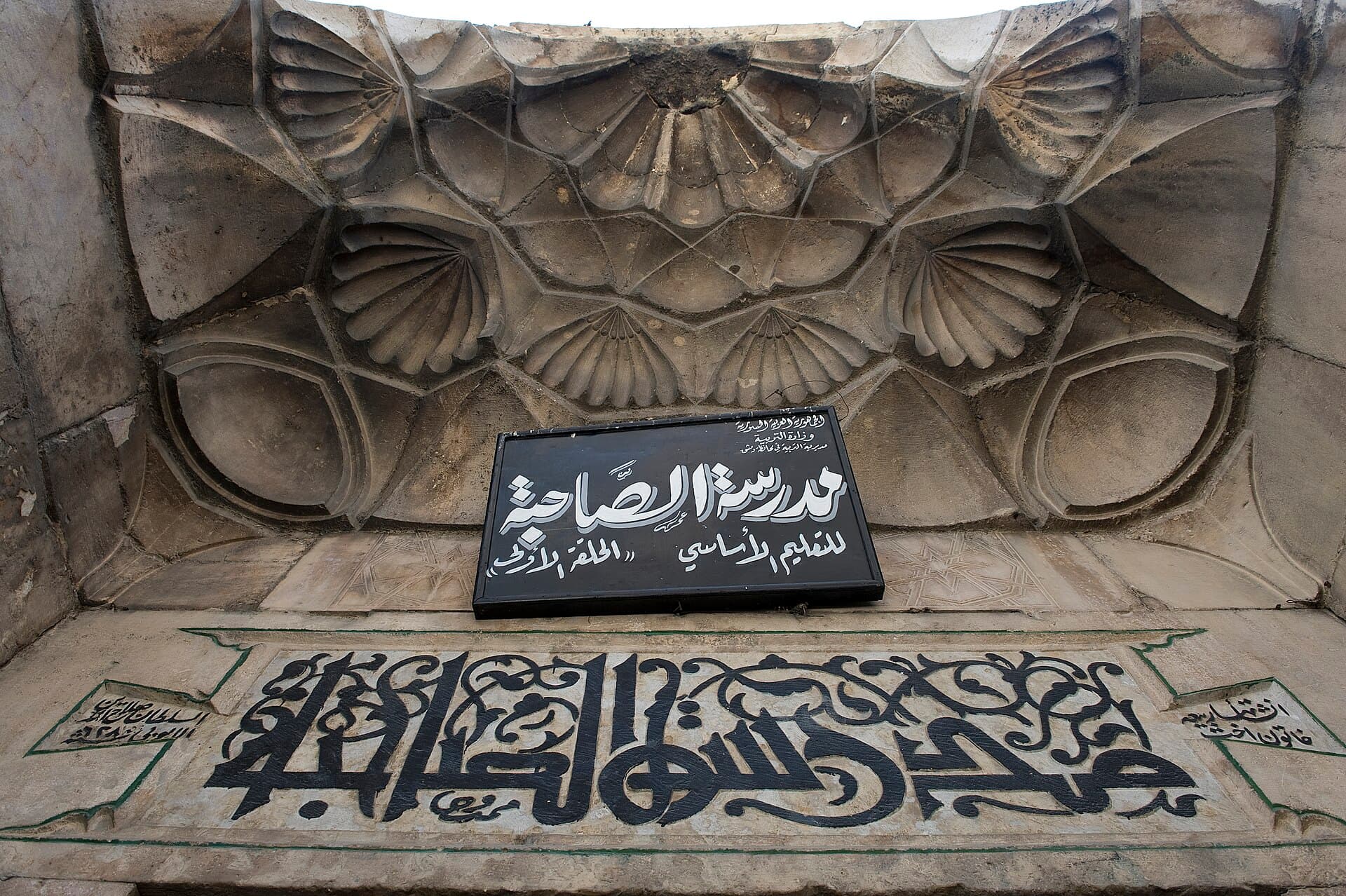
The madrasa Saladin’s sister Rabia Khatun built in Salihiyya in 1233: a shell-lobed muqarnas portal, four iwans, and a girls’ school working inside it today.
- Opening hours
- Variable — the building is in use as a girls' school, ask about access
- Entry
- Free — the facade is visible from the street
- Duration
- 20 minutes
- Best time
- Morning, while the street is still in shade
- Period
- Ayyubid
- Address
- Salihiyya, around Abd al-Ghani al-Nabulsi Street, Damascus
It stands at the foot of Mount Qasioun, at the northern end of the row of madrasas in Salihiyya. Rabia Khatun, Saladin’s younger sister, had it built in 1233 (630 AH). Her husband was Muzaffar al-Din Gökböri, the ruler of Erbil, who founded the Hanabila Mosque a few streets away. A girls’ primary school works inside the building today, and the sign by the door says so.
Getting there
You are in Salihiyya, around Abd al-Ghani al-Nabulsi Street, within walking distance of the Hanabila Mosque. The row starts here at its northern end: walk south and the Murshidiyya, the Atabakiyya and the Jaharkasiyya follow one after another. The street is narrow and climbs; market stalls go up along it in the morning, so you cross to the other pavement to see the facade at all.
What to see
The door is the thing. Three tiers of muqarnas carry a lobed half-dome, the lobes cut into the stone like shells, and this counts among the early pieces of Syrian stone carving. Under the hood there is an inscription in large letters. The plan is axial with four iwans, and the founder’s tomb sits in the western one. Since the building is a school, getting into the courtyard depends on class hours and on the head teacher.
How long it takes
Twenty minutes. Standing at the door and reading the facade is what this stop is for; half an hour if you are let inside. Walked together with the other madrasas of Salihiyya, the lot makes one morning.
Don’t miss
The French archaeologist Jean Sauvaget called this the only madrasa in Damascus whose plan has come down unchanged. The others became houses, or mosques, or were split up. This one kept its four-iwan order even while serving as a school, which is worth holding in mind while you look at the muqarnas over the door.
Tips
- Look at the facade from the opposite pavement; the street is narrow and the hood will not fit in the frame up close
- The courtyard is hard to enter during lessons; after school is easier
- Add the Hanabila Mosque to the same walk — its founder was Rabia Khatun's husband
Transparency
- How this was chosen
- Written by hand; opening hours, entry fee and coordinates are kept as data. A field that is not known for certain is marked as variable rather than guessed.
- Facts checked
- September 2026
- Last updated
- September 15, 2026