Al-Shaykh Saad: the Shrine of Job and the Job Stone
In al-Shaykh Saad, south of Nawa, a mosque dedicated to Job holds the Job Stone, in fact an Egyptian stele of Ramesses II. Its condition today is unverified.
- Opening hours
- Outside prayer times; current condition unverified
- Entry
- Free — a place of worship
- Duration
- 45 minutes
- Best time
- Morning, before midday prayer
- Period
- Bronze Age (stele) — Byzantine — Ottoman
- Address
- Al-Shaykh Saad village, south of Nawa, Daraa Governorate
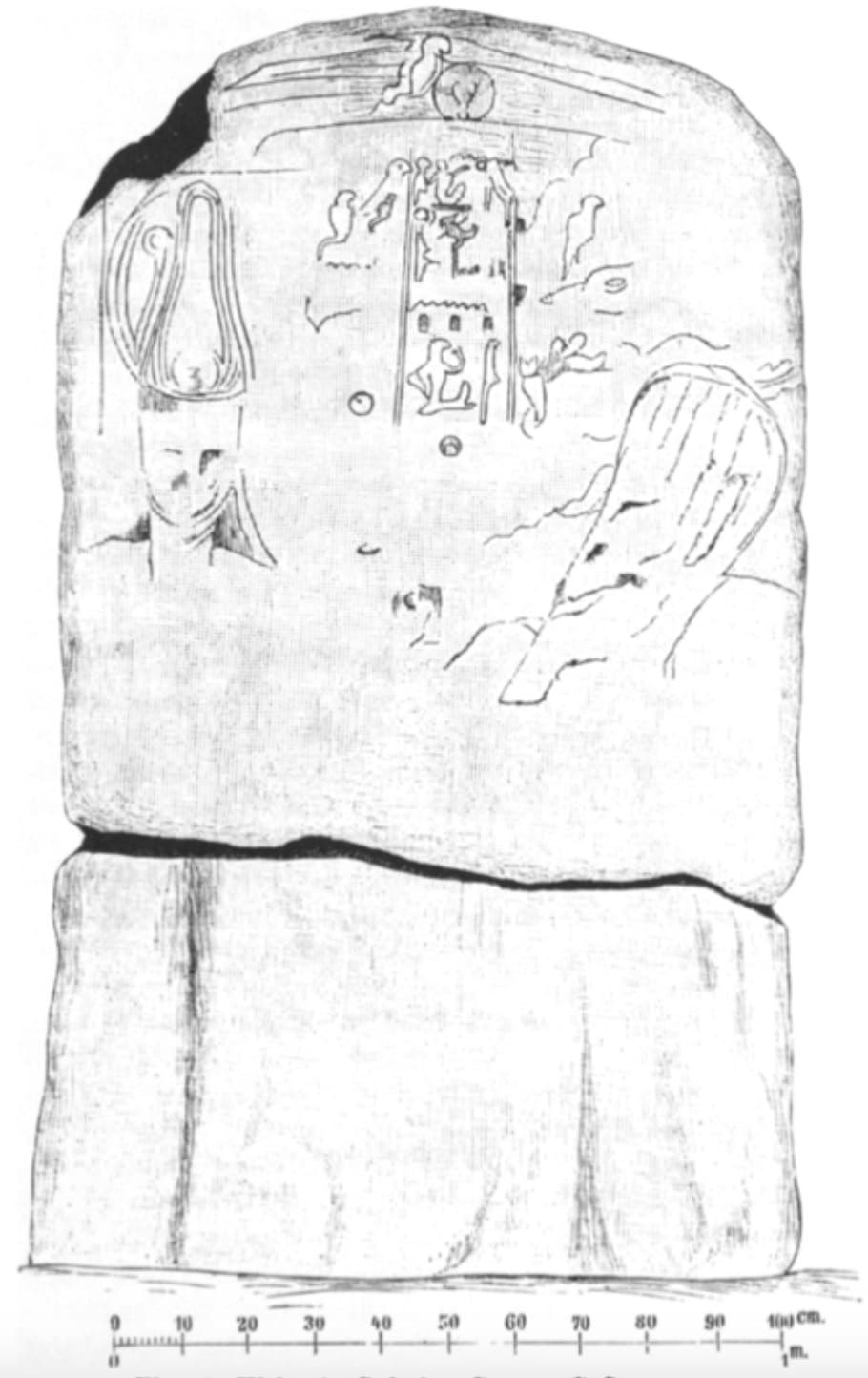
A small village south of Nawa. Inside a mosque dedicated to the prophet Job stands a basalt block that local people visit as the Job Stone. Tradition says Job sat on it during his illness. In 1891 Gottlieb Schumacher identified it as an Egyptian stele commemorating a campaign of Ramesses II. A spring, a tomb tradition and a Byzantine church record all sit on top of one another in this one place. The present condition of the shrine and the stone has not been verified.
What the Job Stone is
The block measures about 210 by 120 centimetres and is split in two by a horizontal crack. Schumacher’s drawing of 1891, the cover image of this page, shows the traces of the Egyptian relief on its upper face. The sources say nothing about when the shrine building went up or what its plan is; this page is about the stone, the spring and the written tradition, not the building.
The spring and the tomb tradition
The village spring called Hammam Ayyub is believed to be the water Job bathed in, and to heal. Yaqut al-Hamawi, writing early in the 13th century, calls the village Dayr Ayyub: the spring Job struck from the ground with his foot is here, and so is his tomb. The Christian record is older. Eusebius writes that Job’s house was shown at Karnein, and the pilgrim Egeria reports in 384 that a church had been built over the site, with Job’s body lying in a stone sarcophagus under the altar.
Layers of names
The old name of the village is Karnaim. When neighbouring Ashtaroth declined it became Ashtaroth-Karnaim, and in the Middle Ages Dayr Ayyub. Judas Maccabeus burned the sanctuary here around 165 BC. In 1129 the site was granted to the Abbey of St Mary of the Valley of Jehoshaphat, and in June 1187 Saladin gathered his army here before the Hattin campaign. Under the Ottomans the village was for a time the seat of the Hauran district. Today’s name comes from Shaykh Saad, said to have come from Sudan: tradition holds that he founded a zawiya, a small religious lodge, for the African slaves he had brought and set them free. In 1884 Schumacher counted 220 people in the village and wrote that all of them were African. The Arabic Wikipedia entry also places the tomb of Sa’d ibn Ubada, a companion of the Prophet, in the village. In 1918 the Arab army set out from here for its attack on Tafas.
Getting there
Al-Shaykh Saad lies south of Nawa and about 4 kilometres north-east of the mound of Tell Ashtara. The shrine itself is not marked on maps, so no coordinates are given; ask for the mosque in the village.
Its condition now
The village is west of Daraa, near the Yarmouk basin and about 20 kilometres from the Golan ceasefire line. Security incidents continued in the western Daraa countryside through 2025 and 2026. The present condition of the shrine, the Job Stone and the spring has not been verified. The mosque is a place of worship, so plan a visit outside prayer times.
Tips
- Don't walk in at prayer time; the stone is inside the mosque
- Women need a headscarf; knees and shoulders covered for everyone
- The relief on the stone is worn; looking at Schumacher's drawing first shows you what to look for
- Tell Ashtara is 4 km to the south-west; both fit into half a day
Transparency
- How this was chosen
- Written by hand; opening hours, entry fee and coordinates are kept as data. A field that is not known for certain is marked as variable rather than guessed.
- Facts checked
- September 2026
- Last updated
- September 15, 2026