Bab al-Hawa, the West Gate of Bosra
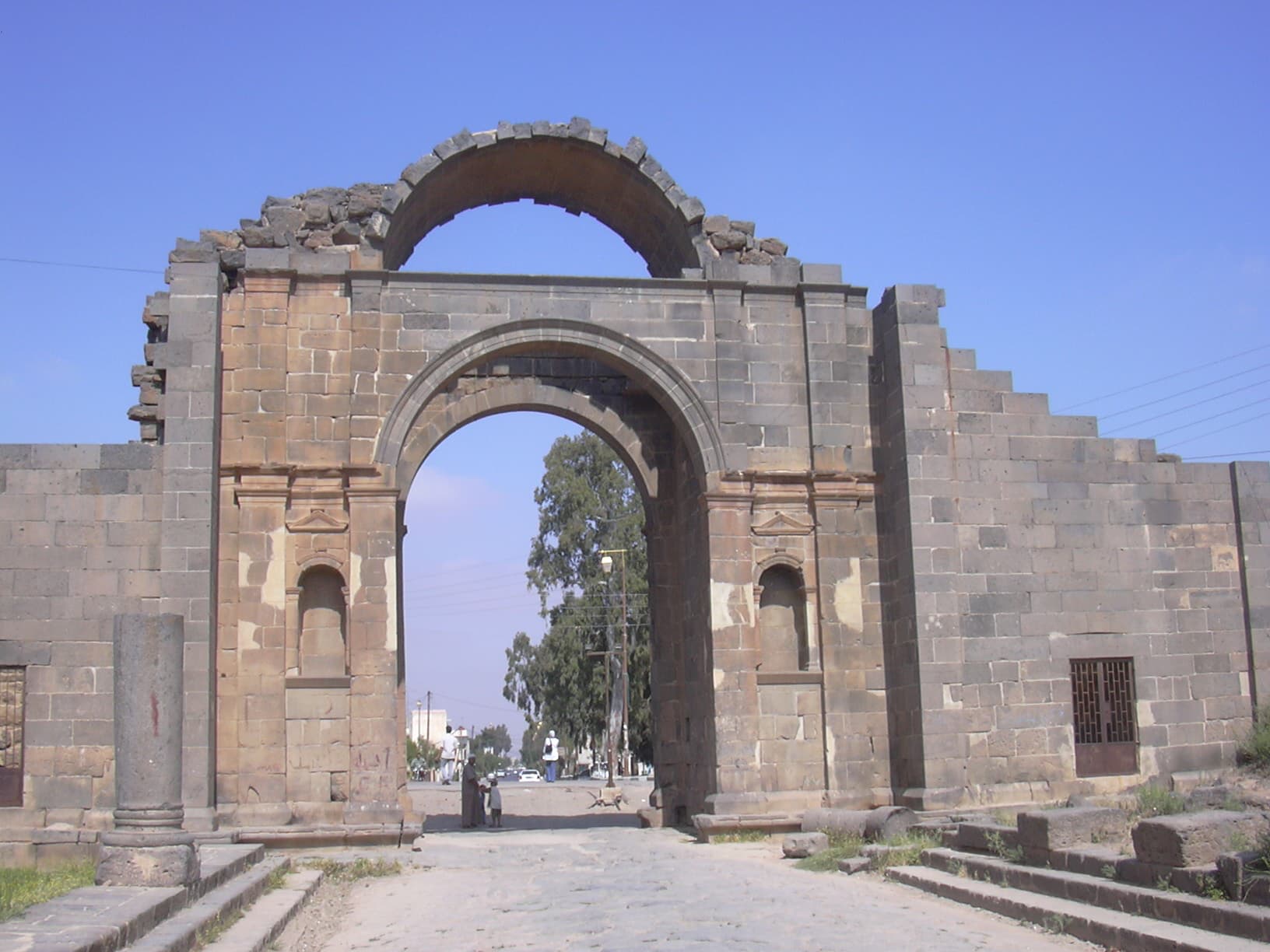
The single-bay Roman gate where Bosra’s main street meets the west wall: a heavy facade like the gates of Shahba, older wall layers and a 1955-1968 restoration.
- Opening hours
- Open-air; the gate stands on a road open to traffic
- Entry
- Free
- Duration
- 15 minutes
- Best time
- Late afternoon, when the west-facing side catches the light
- Period
- Roman
- Address
- West end of the main street, west wall of the ancient city, Bosra
Bosra’s main east-west street leaves the city at its west end through a gate cut into the city wall. It is called Bab al-Hawa, the Gate of the Wind. With a single arched opening under a high vault, it was built more for display than for defence, and today it stands inside the modern town, on a road that carries traffic. The Nabataean Arch closes the other end of the same street; the two gates frame one axis from either side.
Where it is and how to get there
At the west end of the ancient city, where the main street ends. Walk north from the theatre to the street, turn west and follow the street to its end. The gate marks the western edge of the historic core and sits among houses.
What to see
Two square blocks with corner pilasters flank the central body of the gate. There is a niche on each side of the opening. The pilasters have no capitals; the mouldings that outline the archivolt run on to the sides, and two rows of horizontal mouldings crown the upper storeys. The decoration is plain, the mass heavy. According to Arabic Wikipedia there are two arches, one inside the other, the passage is 5 metres wide and the facade 10 metres. The sockets for the door hinges survive, so the gate did actually close.
Why it is out of line with the street
The gate sits within the north-south wall, but it is set a few degrees off the axis of the street. The street widens at its west end into an oval plaza to soften that break. The wall is far older than the gate: a sounding in 2001 found a phase going back to the Middle Bronze Age, and rebuildings in the first Christian centuries and in the 6th century.
When it was built
The sources disagree. Ifpo, the French archaeological institute, compares the heavy look and unusual decoration of the gate with the gates of Shahba, the city Philip the Arab founded between 244 and 249, and links it to 3rd-century building in Bosra. Arabic Wikipedia gives the 2nd century instead. Suleiman Mougdad restored the gate between 1955 and 1968, together with the Nabataean Arch.
What not to miss
On the inner face of the gate, look for the hinge sockets at the edge of the opening. They are the one detail showing that a gate built for display was really shut. If you have seen Shahba, compare the two facades in your mind.
Tips
- Cars drive through the gate; stand at the roadside to take photos
- Look for the hinge sockets at the edge of the opening; the gate really did close
- Walk to the Nabataean Arch at the other end of the street and see both gates on the same day
Transparency
- How this was chosen
- Written by hand; opening hours, entry fee and coordinates are kept as data. A field that is not known for certain is marked as variable rather than guessed.
- Facts checked
- September 2026
- Last updated
- September 15, 2026