Bab al-Jabiya
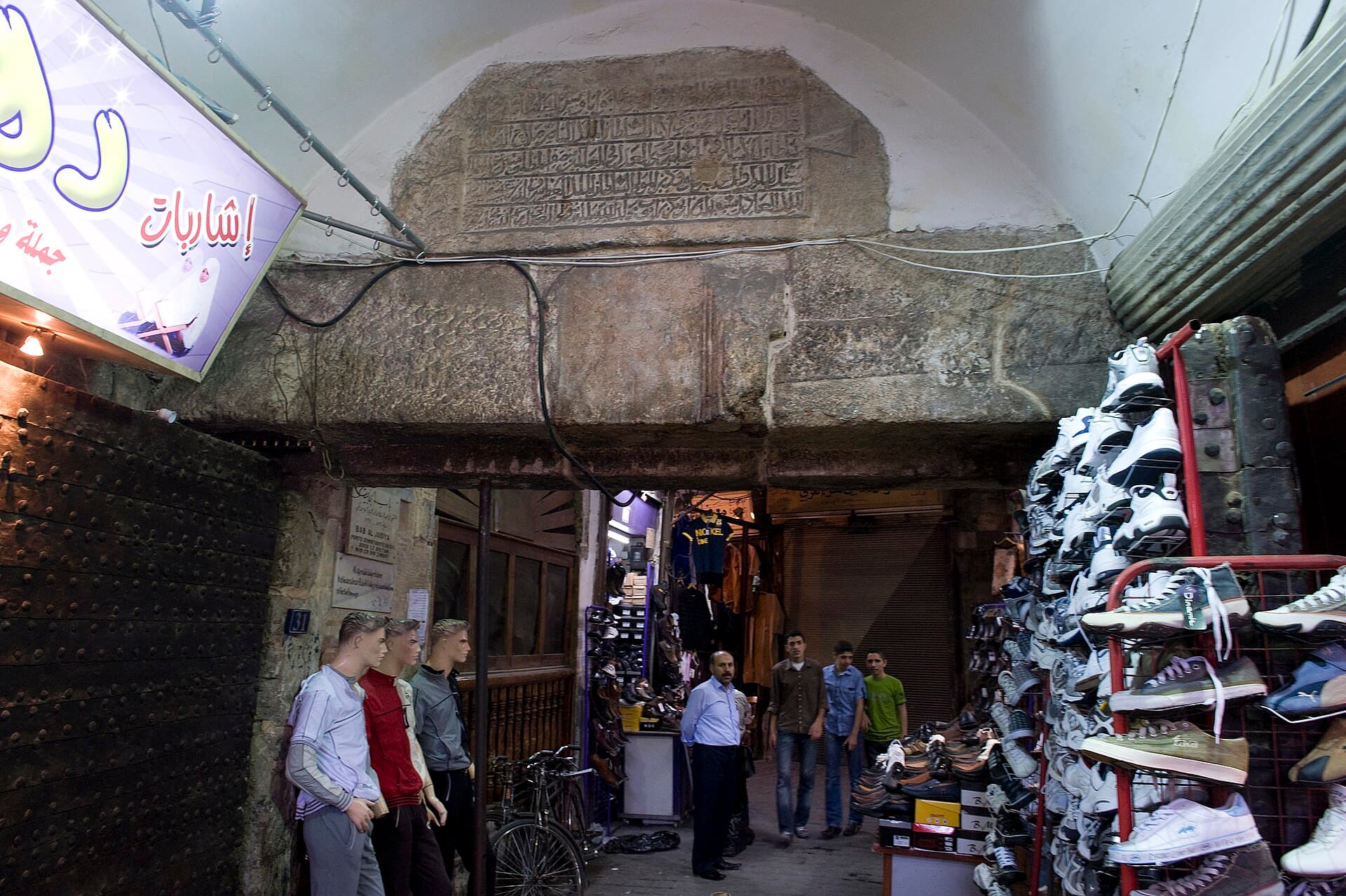
The western gate of old Damascus, at the far end of the Midhat Pasha Souq. Where the Roman street began, standing today among the shoe stalls with its inscription.
- Opening hours
- Open passage; busiest during souq hours
- Entry
- Free
- Duration
- 20 minutes
- Best time
- Morning, as the souq opens
- Period
- Roman — Zengid and Mamluk repairs
- Address
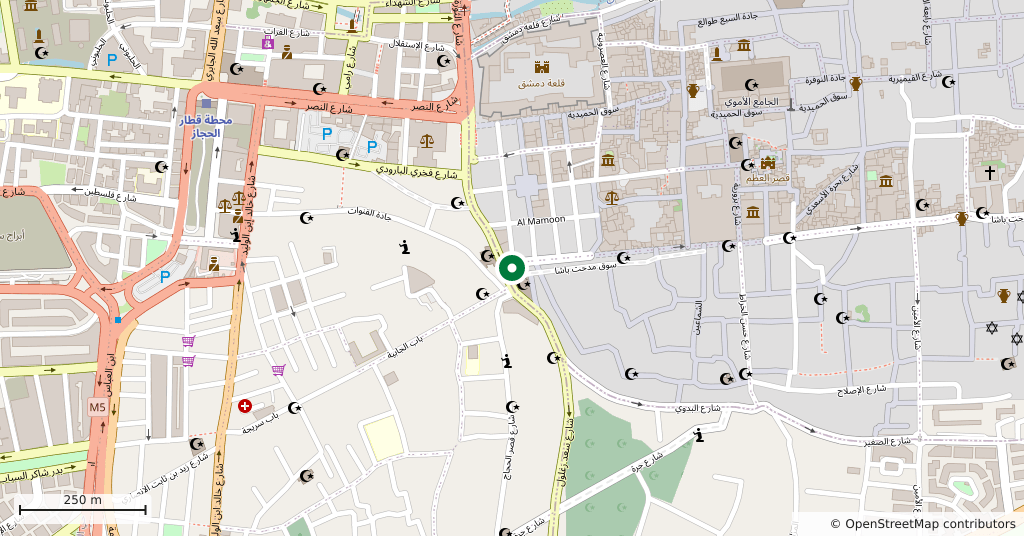
- West end of the Midhat Pasha Souq, Old City, Damascus
One of the seven gates of the old city, and its main entrance on the west side. You do not meet it as a monument but as part of the souq: the passage under the arch is lined with shoe and clothing stalls, and shops are built against both flanks. The street it opens onto is the Midhat Pasha Souq — the western half of Straight Street, the east-west axis of Roman Damascus, with Bab Sharqi at the other end.
Getting there
900 metres west of the Umayyad Mosque along the line of the souq, eleven minutes on foot. The gate is at the far western end, just behind the Sinan Pasha Mosque; if you can see that minaret you are in the right place.
What to see
A heavy stone lintel with a narrow passage beneath it, and above the lintel a stone slab carrying an Arabic inscription. The Roman gate had three openings: a central carriageway for wheeled traffic, flanked by two pedestrian passages. Under Muslim rule most of it was blocked and only the small pedestrian opening was left — which is the one you walk through today.
The gate’s history
In the Roman period the gate was dedicated to Mars. Its present name comes from the Umayyad period, after Jabiya in the Golan, the seat of the Ghassanids. When the Muslim army entered the city in 634, Abu Ubayda ibn al-Jarrah came in peacefully through this gate while Khalid ibn al-Walid forced an entry at Bab Sharqi; the two met halfway along Straight Street. The gate was rebuilt under Nur al-Din Zengi, and the inscription reads 567 in the Hijri calendar, that is 1171. Later repairs came under the Ayyubids and the Mamluks.
What most people miss
Look up before you leave the passage. Everyone walks under the lintel with their eyes on the stalls, and that inscribed slab, together with the outsized blocks around it, is the one surface that gives the gate’s age away.
Tips
- Find the minaret of the Sinan Pasha Mosque; the gate is right behind it
- Look up as you leave the passage — the inscribed slab sits above the lintel
- Walk the souq east and you come out at Bab Sharqi, the same Roman axis
- The passage is tight and crowded after noon; mornings are easier
Transparency
- How this was chosen
- Written by hand; opening hours, entry fee and coordinates are kept as data. A field that is not known for certain is marked as variable rather than guessed.
- Facts checked
- August 2026
- Last updated
- September 15, 2026