Babisqa, a Dead City in Jebel Barisha
Two Byzantine churches on Jebel Barisha, the one bath house certainly identified in the region, and a market dated 547. The west church is dated 609-610.
- Opening hours
- Open site, daylight hours
- Entry
- Variable — confirm on arrival
- Duration
- 60 minutes
- Best time
- Spring, while the ground between the stones is green and before the summer heat
- Period
- Roman — Byzantine
- Address
- Jebel Barisha, south of Bab al-Hawa, Dana subdistrict, Idlib
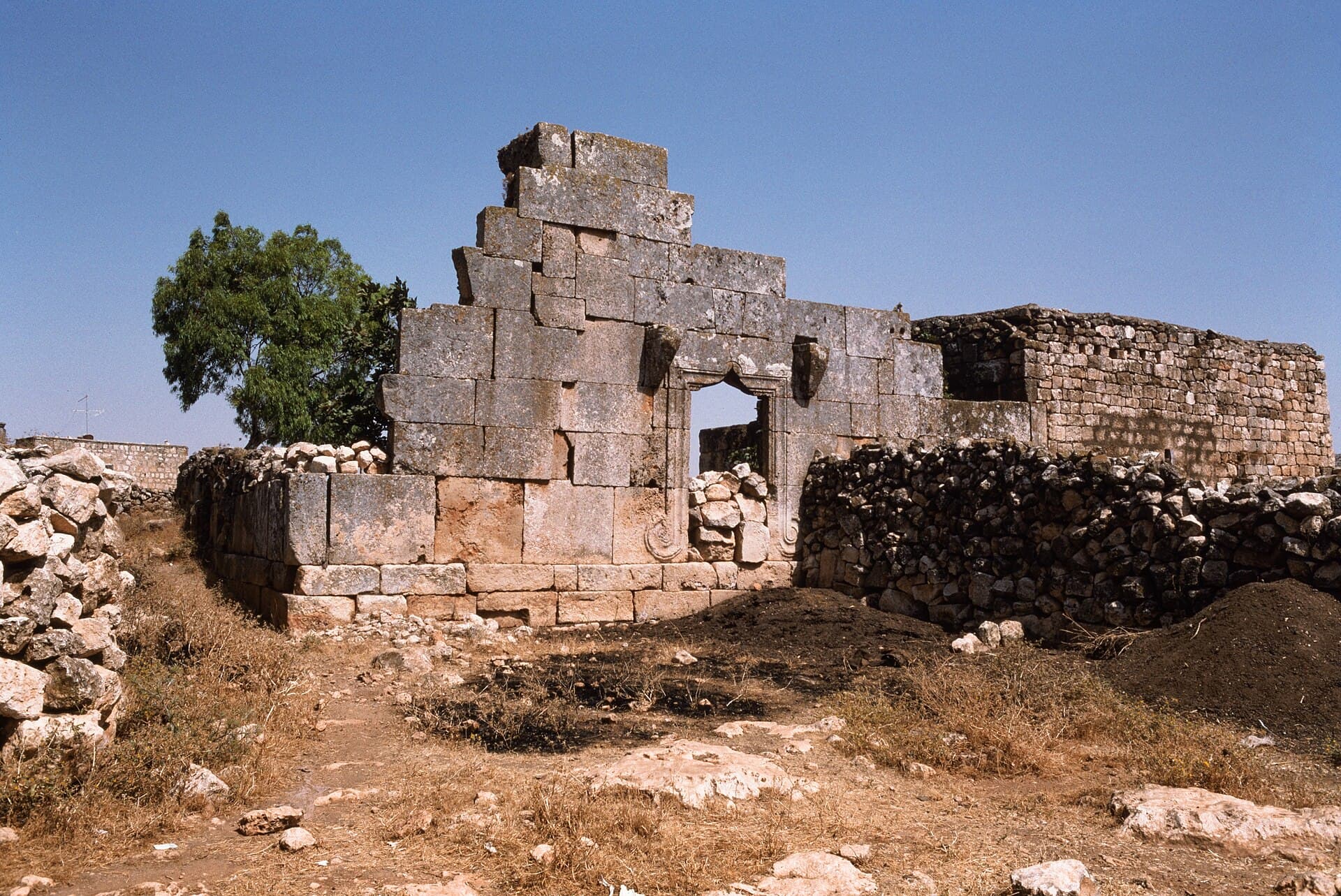
A stone settlement on the slope of Jebel Barisha, south of the Bab al-Hawa crossing. Babisqa grew rich on olive oil; what stands today is two churches, a bath house and a market building. Its calendar is not guesswork. The Greek inscriptions cut into the door lintels say, building by building, which year the work was finished.
Getting there
North of Idlib, west of Sarmada, just south of the road running from the Dana plain to Bab al-Hawa. There is no public transport; you hire a car with a driver in Idlib or Sarmada. The driver has to know the place, because nothing is signposted. Dar Qita and Baqirha lie 3 kilometres west, and the three fit into one half day.
How long it takes
An hour. The two churches, the bath house and the market stand within a few hundred metres and you walk between them. Allow two hours if you mean to read the inscriptions.
What you see
The larger church on the east side is known as the Markianos Church. One of its lintels carries the date 390 and another the date 401; the second names Markianos as the architect. The inscription over the atrium doorway credits Moses the presbyter with finishing the facade in 480. The smaller church to the west is dedicated to Saint Sergius and is dated 609-610 — the latest securely dated Byzantine church in northern Syria. The bath house is the one building in Jebel Barisha certainly identified as a bath; its vaults and the piers that carried the upper floors can still be read. The inscription on the parapet of the market’s upper storey gives 547.
The temple under the stone
The walls of the Markianos Church hold blocks taken from a Roman temple. The temple itself is gone. It is known only from these reused stones, one of which bears a date falling in the year 143, and nobody knows which god it served. The village turned Christian at the end of the 4th century. A house doorway carries the name of the architect Eusebis and the date April 389, with Christ monograms cut in beside the text some time afterwards.
How it stands today
The site entered the UNESCO list in 2011 as part of the Ancient Villages of Northern Syria. Then the war came. Its closeness to Bab al-Hawa made the ground useful to armed groups: it served for a time as a store, and fighting ran through the area around it. There is no way to know the current state of the buildings from a distance. A local driver settles both the road and the situation on the day.
Don’t miss
The west doorway of the Church of Saint Sergius. The curved mouldings and the inscription that gives 609-610 are there at eye level. Most visitors look at the big east church and turn back.
Tips
- Your driver has to know the site; nothing on the ground is signposted
- The doorway inscription of the west church is at eye level; the date is there
- The stones are loose and the ground uneven; wear boots with a firm sole
- Dar Qita and Baqirha are 3 kilometres west; put the three in one half day
Transparency
- How this was chosen
- Written by hand; opening hours, entry fee and coordinates are kept as data. A field that is not known for certain is marked as variable rather than guessed.
- Facts checked
- September 2026
- Last updated
- September 15, 2026