Sarmin, the Ismaili Soap Town East of Idlib
Sarmin, east of Idlib: an Ismaili mission house, Crusader rule from 1106, soap Ibn Battuta saw sent to Cairo, two old bathhouses, rock-cut caves, Roman cisterns.
- Opening hours
- The town at any hour; the bathhouses' condition varies, confirm locally
- Entry
- Free; there is no ticketed site
- Duration
- 90 minutes
- Best time
- Spring and autumn, before the summer heat
- Period
- Roman — Crusader — Ayyubid — Mamluk — Ottoman
- Address
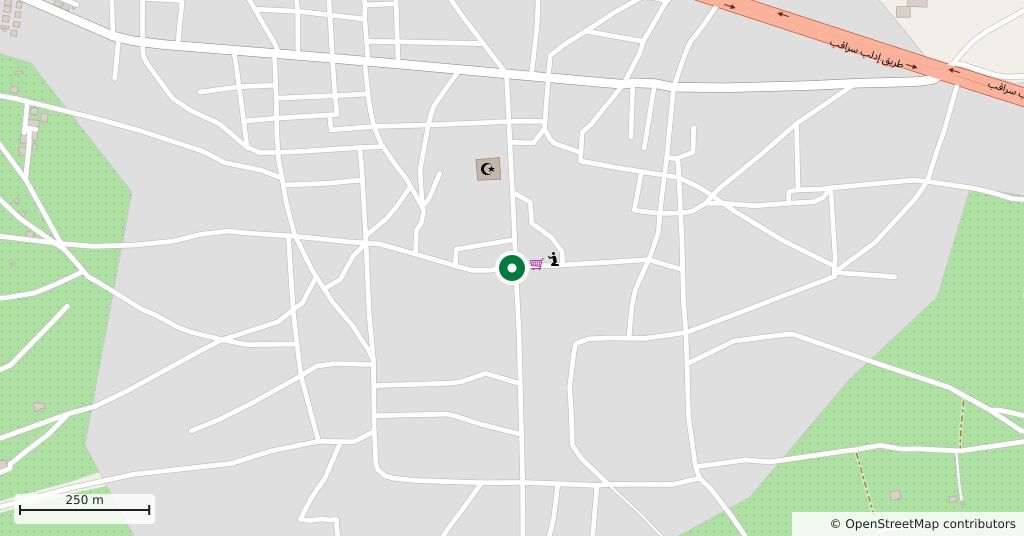
- 7-9 kilometres east of Idlib, at the foot of Jabal al-Ala
A town 7-9 kilometres east of Idlib, at the foot of Jabal al-Ala. The relationship used to run the other way: Idlib was once a village belonging to Sarmin. What makes the town worth a visit is its layers: Roman cisterns, caves cut into the rock, old stone-paved lanes, two old bathhouses, and the story of a soap that travelled as far as Cairo in the Middle Ages.
Sarmin in the Middle Ages
In the 13th century the Aleppan historian Ibn al-Adim described Sarmin as a city with wide lands: it had a Friday mosque and markets, and its stone wall was in ruins. It was said to have once had 360 mosques, but in his day prayers were held only in the Friday mosque. Most of its people were Ismailis, and the town had a mission house, a centre for Ismaili preaching.
Yaqut al-Hamawi also records that the people were Ismailis. Abu al-Fida notes that the land was very fertile and the town had no walls.
The Crusaders and al-Zahir Ghazi
The Franks took Sarmin in 1106, and it was retaken in 1120. In Saladin’s time his son al-Zahir Ghazi besieged the Frankish castle at Sarmin, took its surrender and had it demolished.
Ibn Battuta’s soap
In the 14th century Ibn Battuta described the town’s olive groves and its soap. Soap cut into bricks went to Damascus and Cairo, and a perfumed soap coloured red and yellow was also made. The town also produced cotton cloth.
Under the Mamluks the large village of Binnish, which belonged to Sarmin, was endowed to the Arghun Bimaristan, the hospital in Aleppo.
What is in town
Arabic sources mention two old bathhouses: Hammam al-Maliha and Hammam al-Daraj. A single map entry dates Hammam al-Daraj to AH 1139, that is 1726-1727; we could not confirm this from another source. The town also has traces of soap and weaving workshops, caves cut into the rock, Roman cisterns and old stone-paved lanes. We do not know whether the bathhouses still stand or are open.
The town’s 13th-century mosque, the Great Mosque of Sarmin, has its own page.
How long it takes
An hour and a half for the old lanes, the outside of the bathhouses and the Great Mosque.
Before you go
Sarmin was close to the front line in 2019-2020 and was shelled many times. Unexploded ordnance remains a risk across Idlib governorate: do not enter ruined buildings, caves or cisterns without someone local. Roads and checkpoints change; check the current situation before you set out.
Don’t miss
The rock-cut caves. They show the town’s Roman and medieval layers most clearly; ask in town which quarter they are in.
Tips
- Ask in town where the bathhouses and caves are; they are not signposted
- The Great Mosque is part of the same walk; start from the town centre
- Do not enter ruins or cisterns without someone local; unexploded ordnance is a risk
- Roads and checkpoints change; ask before you set out
Transparency
- How this was chosen
- Written by hand; opening hours, entry fee and coordinates are kept as data. A field that is not known for certain is marked as variable rather than guessed.
- Facts checked
- September 2026
- Last updated
- September 15, 2026