Banqusa, a Dead City of Early Churches
Two churches at the southern end of Jebel Barisha, one of which Butler counted among the region’s oldest and saw as the model for the carving at Qalb Lozeh.
- Opening hours
- Open site, daylight hours
- Entry
- Variable — confirm on arrival
- Duration
- 45 minutes
- Best time
- Spring and autumn, before the summer heat
- Period
- Byzantine
- Address
- West of Deir Seta, southern end of Jebel Barisha, Idlib
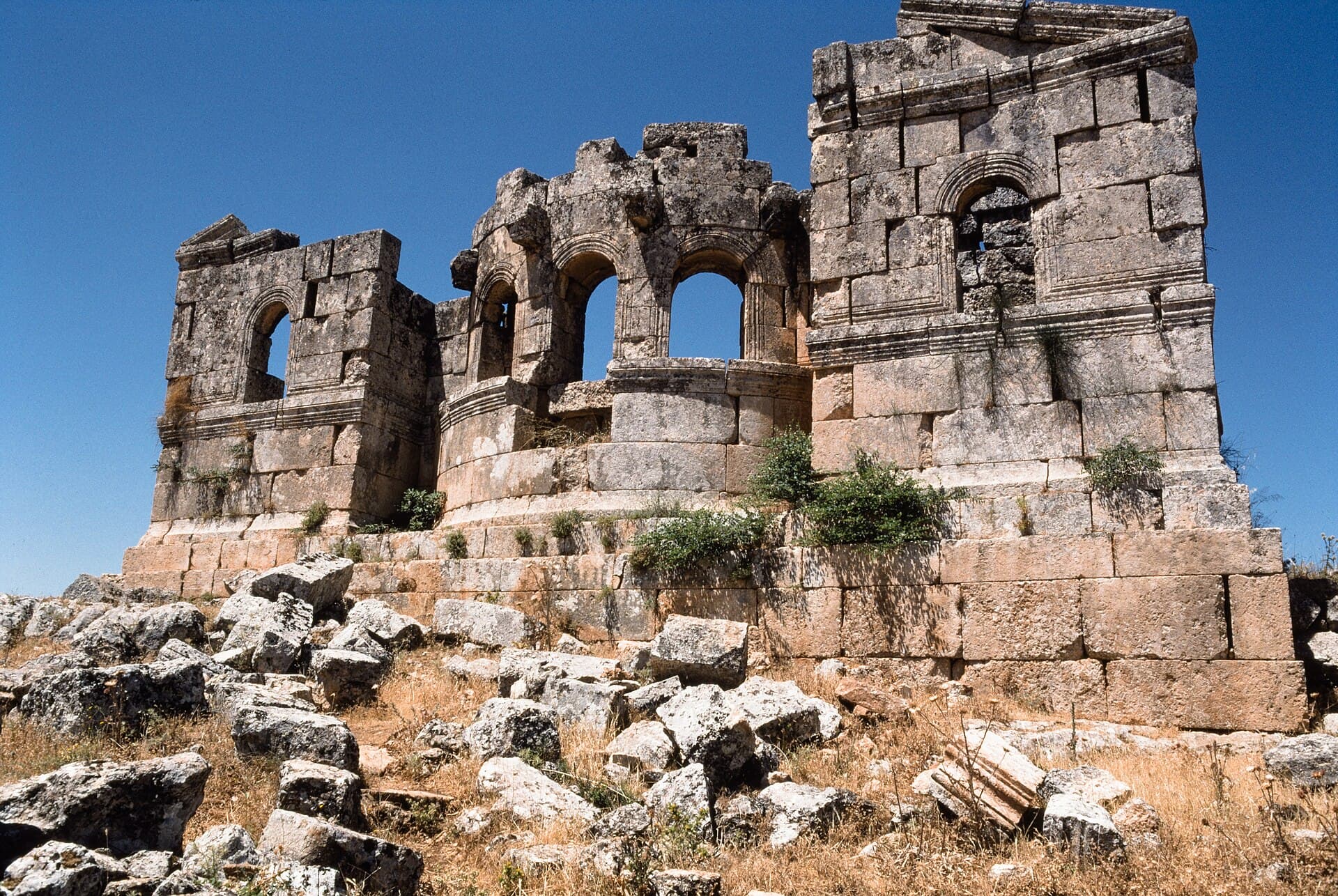
A small Dead City at the southern end of Jebel Barisha, where two churches survive. What makes Banqusa matter is its North Church. Howard Crosby Butler counted it among the oldest Christian buildings in the whole region, and wrote that the decorative scheme of the Church of Qalb Lozeh follows Banqusa. The church is badly preserved, but you can still read on the slope what fell where. Do not be misled by the name: it has nothing to do with the Bankusa quarter of Aleppo or its mosque.
Getting there
North of Idlib, about one and a half kilometres west of the village of Deir Seta. There is no public transport; you hire a car and driver in Idlib. Nothing is signposted and the ruins lie on a slope. The easiest way is to ask in Deir Seta.
How long it takes
Forty-five minutes. That is enough for the two churches and the rubble on the slope. It fits into the same morning as Deir Seta.
What you see
The North Church leans into the slope. Its west end and a third of its north wall are cut straight into the bedrock, and the rest of the walls are large dressed blocks. The east end has collapsed completely, and most of it has rolled down the hillside. The inner arcades have fallen too.
Butler never saw the east end standing, but he reconstructed it. Among the rubble on the slope he found stones from a semi-dome. From these he concluded that a semicircular apse stood between two rectangular side rooms.
The nave and east front of the South Church can be made out in photographs in the Dumbarton Oaks archive. So can its Corinthian capitals, the doorway of the diaconicon and the north capital of the triumphal arch. The diaconicon is the side room where a church kept its clergy’s vestments and vessels. Mosaic tesserae lie on the ground.
Why Banqusa matters
Butler put the North Church among the earliest churches in the region. Its influence also travelled. Butler described another church, whose apse alone still stands, as a better-preserved copy of the Banqusa apse. The decorative scheme of the church at Qalb Lozeh follows Banqusa too. That church was built around 460 and carries the best-known front in the Dead Cities; its model is this building, now scattered across a hillside.
How it stands today
The descriptions here rest on Butler’s publication and photographs in the Dumbarton Oaks archive. We found no verified record of the site’s condition after the war years. The stones on the slope shift underfoot; walk around the rubble, not over it.
Don’t miss
The west end of the North Church. That is where you can see the wall change from bedrock to dressed stone. Most visitors look at the ruined east end and never notice the half of the building cut into the rock.
Tips
- The west end of the North Church is cut into the rock; look for where the wall turns from rock to stone
- The rubble on the slope shifts; shoes with a firm sole help
- Deir Seta is about one and a half kilometres east; put the two in one morning
- It is easily confused with the Bankusa Mosque in Aleppo; describe the ruins near Deir Seta to your driver
Transparency
- How this was chosen
- Written by hand; opening hours, entry fee and coordinates are kept as data. A field that is not known for certain is marked as variable rather than guessed.
- Facts checked
- September 2026
- Last updated
- September 15, 2026