Barish al-Shamali, a Dead Village near Qalb Lozeh
Two kilometres north of Qalb Lozeh: a two-storey public building dated 231 by its inscription, and a three-aisled church of around 600 with its bema still in place.
- Opening hours
- Open site, daylight hours
- Entry
- Variable — confirm on arrival
- Duration
- 45 minutes
- Best time
- Spring and autumn, before the summer heat
- Period
- Roman — Byzantine
- Address
- Qalb Lozeh-Harim road, north of Qalb Lozeh, Jebel al-A'la, Harim, Idlib
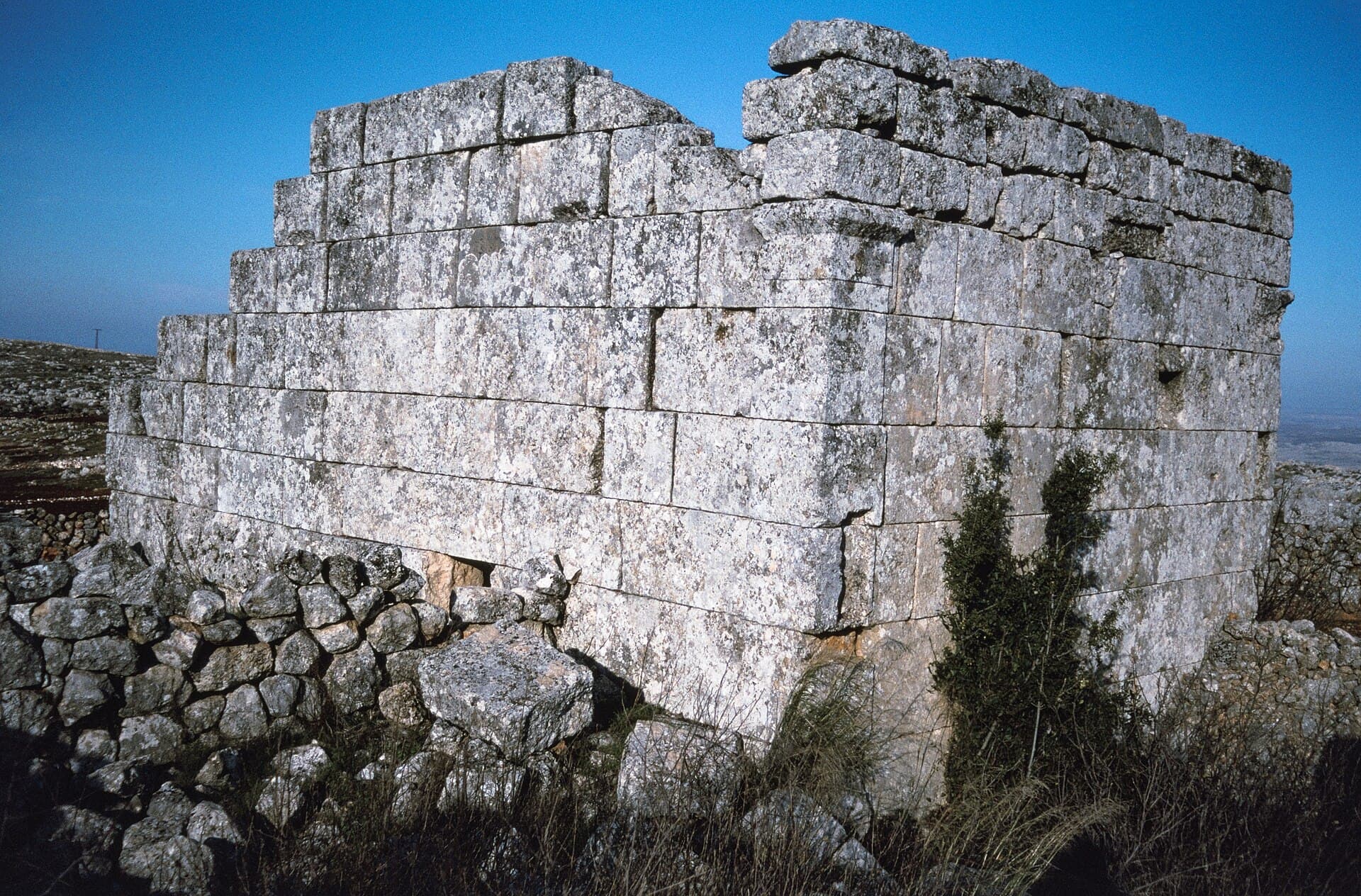
A small Dead City on Jebel al-A’la, about 2 kilometres north of Qalb Lozeh, beside the road from Qalb Lozeh to Harim. It has two buildings, nearly four centuries apart. One is a two-storey building dated 231 by its inscription, among the earliest securely dated civic buildings in the Dead Cities. The other is a three-aisled church of around 600, with its sanctuary still in place. Do not be misled by the name: the village of Barisha on Jebel Barisha is a different place.
Getting there
North-west of Idlib, in the Harim district. On the road from Qalb Lozeh to Harim, about 2 kilometres past the village, at the roadside. There is no public transport; you hire a car and driver in Harim or Idlib. Nothing is signposted. Qirqbize and Kfeir are within a few kilometres.
How long it takes
Forty-five minutes. Both buildings stand on the same site. With Qalb Lozeh and Qirqbize it makes a half day.
The building of 231
The inscription on the pilasters of the north entrance gives the year of building as 231. The building has two storeys. On the ground floor, lengthwise arches rest on two piers, and this floor was most likely used for storage. Upstairs is a paved room entered through three doors. A stair leads up to a raised platform outside.
The door opens straight to the outside rather than onto a courtyard. That is why the building is read as public rather than domestic, and possibly as an andron: the hall where the village’s men gathered. What sets it apart from the androns at places such as Serjilla is its plan. Those run crosswise; this one runs lengthwise. Whether it was a banqueting hall, a storehouse or a meeting place is still debated.
The church
The three-aisled church was built around 600. Its apse is square. The bema survives, the raised stone platform where the clergy sat. Holes in the bema show that a wooden structure once stood on top of it. Reliquary niches set into the steps resemble those at Qirqbize. South of the altar is a martyrion, the room that held a saint’s relics. Ionic and Corinthian capitals can also be made out in photographs in the Dumbarton Oaks archive.
How it stands today
The descriptions here rest on published sources and on photographs in the Dumbarton Oaks archive. We found no verified record of the site’s condition after the war years. Qalb Lozeh is a lived-in village; as you pass through, do not look into courtyards, and ask before taking photographs.
Don’t miss
The inscription on the pilasters of the north entrance. The date 231 is written there. Most visitors head for the church and walk past without realising that the building beside it is one of the earliest dated structures in the Dead Cities.
Tips
- The inscription dated 231 is on the pilasters of the north entrance
- The holes in the bema are traces of a wooden structure; look closely
- It is easily confused with Barisha village on Jebel Barisha; tell the driver it is on the Qalb Lozeh-Harim road
- It fits into the same half day as Qalb Lozeh and Qirqbize
Transparency
- How this was chosen
- Written by hand; opening hours, entry fee and coordinates are kept as data. A field that is not known for certain is marked as variable rather than guessed.
- Facts checked
- September 2026
- Last updated
- September 15, 2026