Ba’uda, a Pyramid Tomb Village on Jebel Zawiya
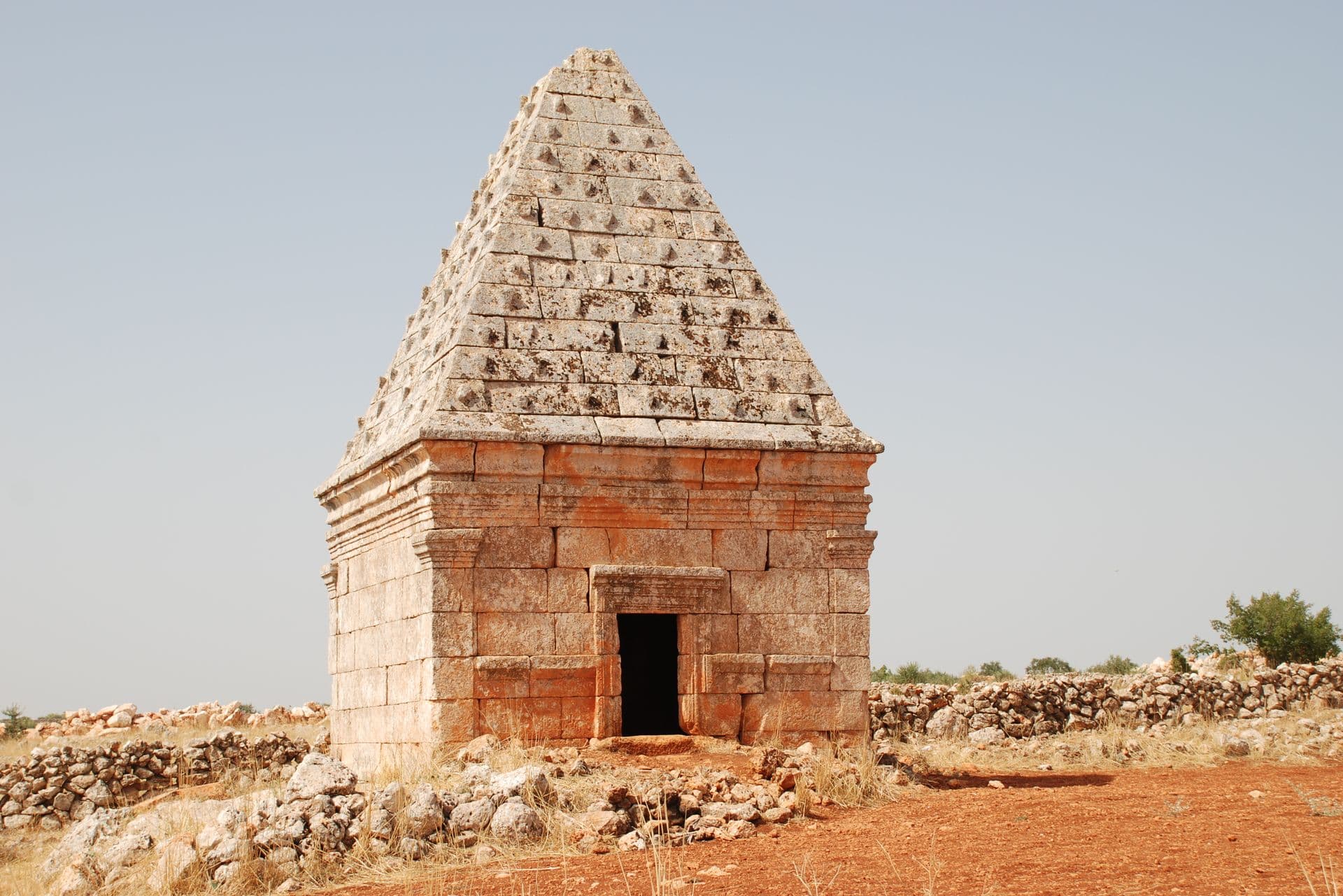
Two kilometres west of Serjilla, in open fields: a 6th-century pyramid-roofed tomb, walls standing two storeys high and sarcophagi. Not the Ba’uda on Jebel Barisha.
- Opening hours
- Open site, daylight hours
- Entry
- Variable — confirm on arrival
- Duration
- 45 minutes
- Best time
- Spring and autumn; there is no shade on the plateau and summer noon is hard going
- Period
- Byzantine
- Address
- Jebel Zawiya, west of Serjilla, Idlib
A small Dead City in the middle of open fields on a thinly settled karst plateau of Jebel Zawiya, at about 700 metres. There are no modern buildings nearby. It is known for its very well preserved pyramid-roofed tomb, built for a wealthy family in the 6th century. Around it, some house walls and the remains of a church stand two storeys high, and heavy-lidded sarcophagi lie between the houses.
The name causes confusion. A second Ba’uda, known for its rows of shops, lies on Jebel Barisha just south of Bab al-Hawa. This page is about the one on Jebel Zawiya, next to Serjilla.
Getting there
From Maarat al-Numan it is 10 kilometres to Kafr Nabl. From there you continue about 5500 metres, turn north, and reach the ruins after 2500 metres. Serjilla is 2 kilometres east and Al-Bara 4 kilometres north-west. There is no public transport, so you need a car and driver. Nothing is signposted.
How long it takes
Forty-five minutes. The tomb, the church and the sarcophagi make a short walk. Serjilla and Al-Bara fit into the same day.
What you see
The pyramid tomb. A square chamber of dressed stone under a steep pyramid roof. Small knobs stand out on the faces of the roof blocks: lifting bosses, left on the stone to grip it while it was hoisted into place. Tombs of the same type stand at Al-Bara and South Dana on Jebel Zawiya.
The church. A small single-nave building with double-faced walls that follows a 4th-century tradition: the west front is closed and the entrances are on the long south side. Parts of its walls stand two storeys high.
Houses and burials. Some house walls still rise two storeys. Between the houses are sarcophagi set at ground level with heavy stone lids, and at least one underground burial chamber. Around the site, vines grow in small red-earth plots divided by stone walls. The French Ifpo archive holds a vertical aerial photograph of the site taken in 1938.
Don’t miss
The sarcophagi between the houses. Because they sit at ground level, they are easy to miss among the tumbled stones. Walk slowly from the tomb towards the houses and the heavy lids appear one by one.
Tips
- It is easily confused with its namesake on Jebel Barisha; ask the driver for the Ba'uda near Serjilla
- Look closely at the blocks of the pyramid roof; the lifting bosses are still on the surface
- The sarcophagi are at ground level; watch your step among the stones
- Serjilla is 2 kilometres east; put the two in one morning
Transparency
- How this was chosen
- Written by hand; opening hours, entry fee and coordinates are kept as data. A field that is not known for certain is marked as variable rather than guessed.
- Facts checked
- September 2026
- Last updated
- September 15, 2026